
一种基于磁共振成像(MRI)和蛋白质组学的半机制方法,用于预测轻度认知障碍向阿尔茨海默病的转化。
A semi-mechanism approach based on MRI and proteomics for prediction of conversion from mild cognitive impairment to Alzheimer's disease.
作者信息
Liu Haochen, Zhou Xiaoting, Jiang Hao, He Hua, Liu Xiaoquan
机构信息
Center of Drug Metabolism and Pharmacokinetics, China Pharmaceutical University, Nanjing, 210009, China.
出版信息
Sci Rep. 2016 Jun 7;6:26712. doi: 10.1038/srep26712.
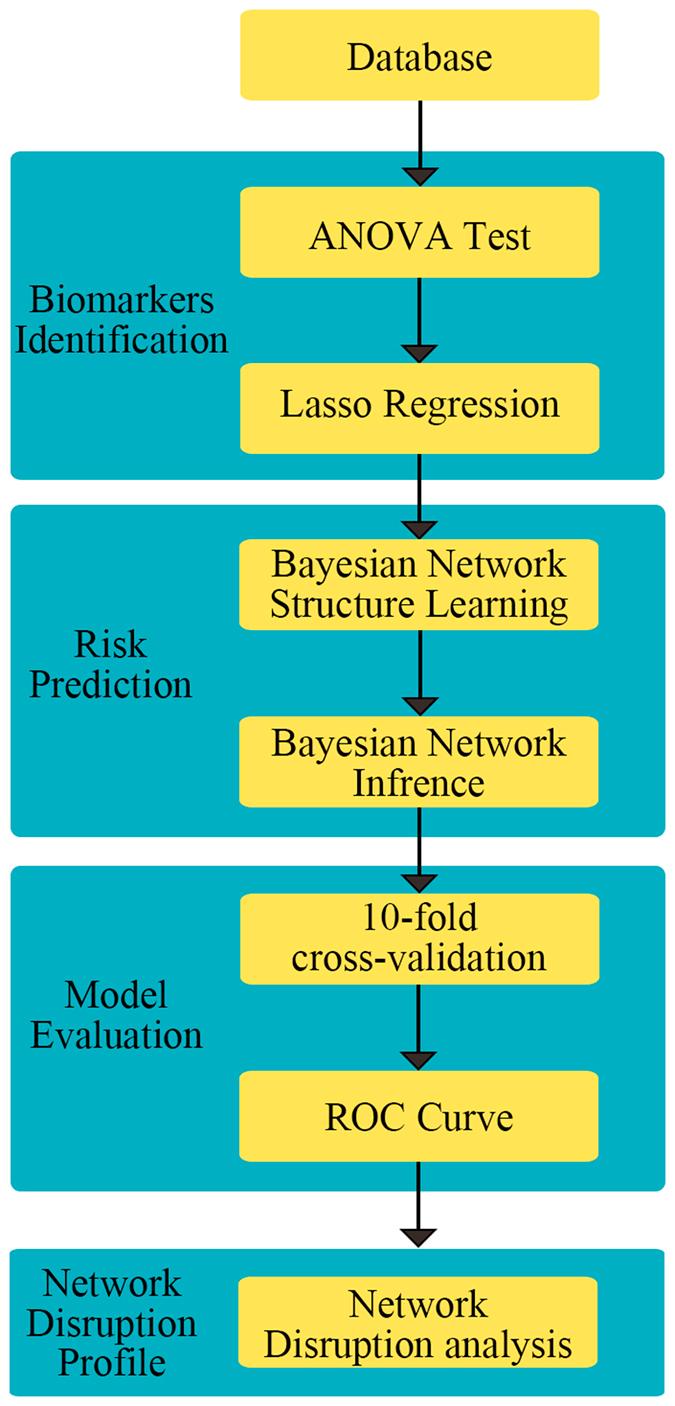
Mild cognitive impairment (MCI) is a precursor phase of Alzheimer's disease (AD). As current treatments may be effective only at the early stages of AD, it is important to track MCI patients who will convert to AD. The aim of this study is to develop a high performance semi-mechanism based approach to predict the conversion from MCI to AD and improve our understanding of MCI-to-AD conversion mechanism. First, analysis of variance (ANOVA) test and lasso regression are employed to identify the markers related to the conversion. Then the Bayesian network based on selected markers is established to predict MCI-to-AD conversion. The structure of Bayesian network suggests that the conversion may start with fibrin clot formation, verbal memory impairment, eating pattern changing and hyperinsulinemia. The Bayesian network achieves a high 10-fold cross-validated prediction performance with 96% accuracy, 95% sensitivity, 65% specificity, area under the receiver operating characteristic curve of 0.82 on data from the Alzheimer's Disease Neuroimaging Initiative (ADNI) database. The semi-mechanism based approach provides not only high prediction performance but also clues of mechanism for MCI-to-AD conversion.
轻度认知障碍(MCI)是阿尔茨海默病(AD)的前驱阶段。由于目前的治疗方法可能仅在AD的早期阶段有效,因此追踪将转化为AD的MCI患者非常重要。本研究的目的是开发一种基于高性能半机制的方法来预测从MCI到AD的转化,并增进我们对MCI向AD转化机制的理解。首先,采用方差分析(ANOVA)测试和套索回归来识别与转化相关的标志物。然后基于选定的标志物建立贝叶斯网络,以预测MCI向AD的转化。贝叶斯网络的结构表明,转化可能始于纤维蛋白凝块形成、言语记忆障碍、饮食模式改变和高胰岛素血症。在来自阿尔茨海默病神经影像倡议(ADNI)数据库的数据上,贝叶斯网络实现了高10倍交叉验证预测性能,准确率为96%,灵敏度为95%,特异性为65%,受试者操作特征曲线下面积为0.82。基于半机制的方法不仅提供了高预测性能,还为MCI向AD的转化提供了机制线索。


 Zotero 插件