Chen Jiu, Chen Gang, Shu Hao, Chen Guangyu, Ward B Douglas, Wang Zan, Liu Duan, Antuono Piero G, Li Shi-Jiang, Zhang Zhijun
Department of Neurology, Affiliated ZhongDa Hospital, School of Medicine, Southeast University, Nanjing, China.
Institute of Neuropsychiatry, the Affiliated Brain Hospital of Nanjing Medical University, Fourth Clinical College of Nanjing Medical University, Nanjing, China.
Aging (Albany NY). 2019 Apr 30;11(8):2185-2201. doi: 10.18632/aging.101883.
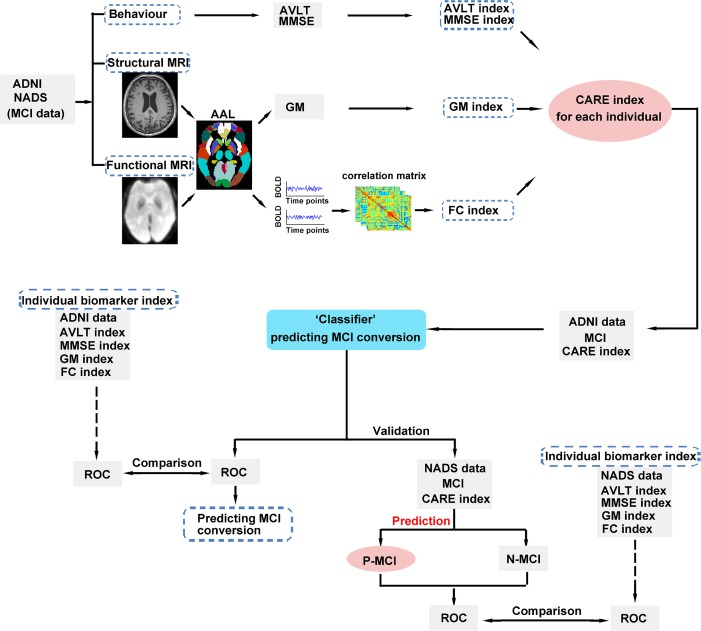
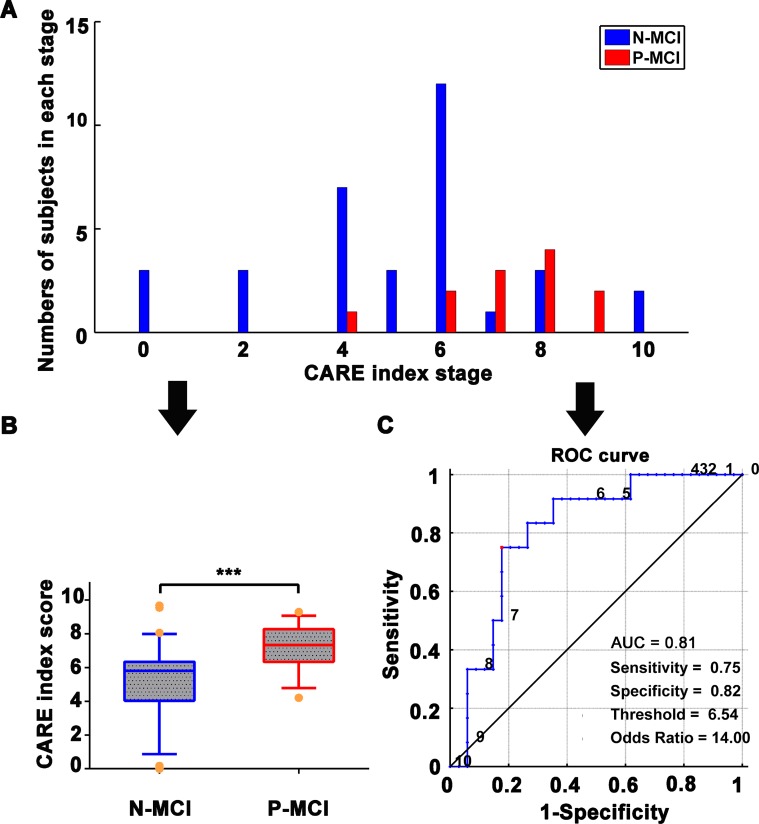
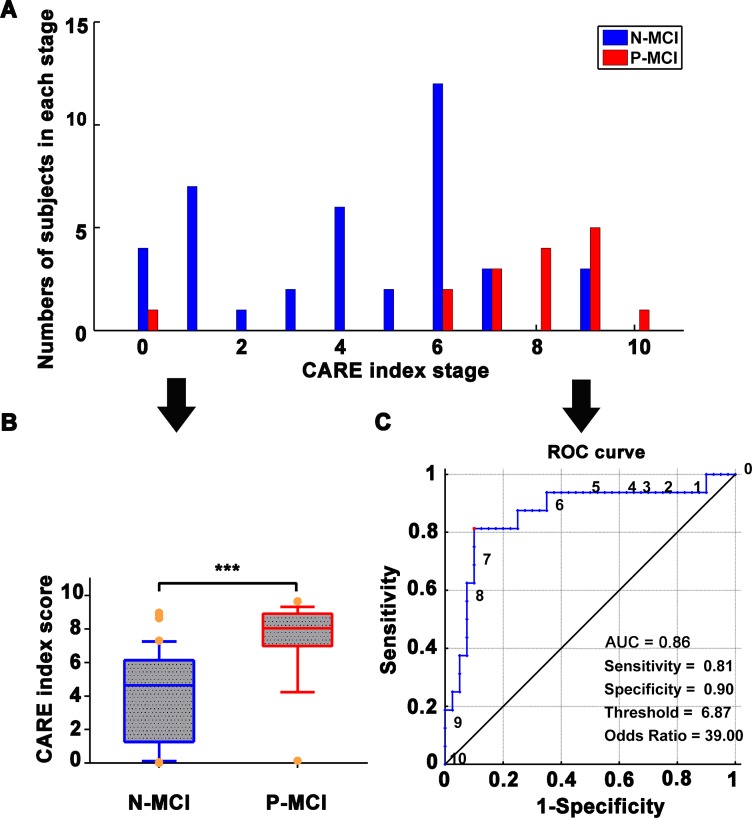
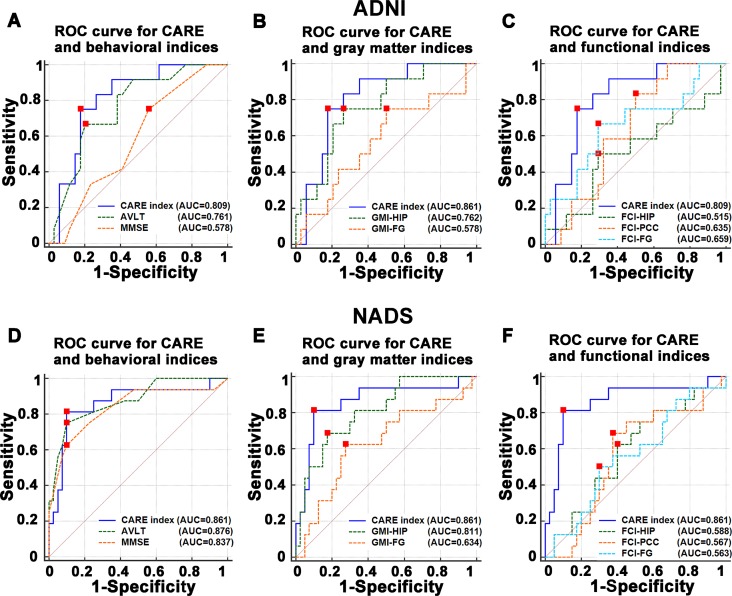
The purposes of this study are to investigate whether the Characterizing Alzheimer's disease Risk Events (CARE) index can accurately predict progression from mild cognitive impairment (MCI) to Alzheimer's disease (AD) on an individual subject basis, and to investigate whether this model can be generalized to an independent cohort. Using an event-based probabilistic model approach to integrate widely available biomarkers from behavioral data and brain structural and functional imaging, we calculated the CARE index. We then applied the CARE index to identify which MCI individuals from the ADNI dataset progressed to AD during a three-year follow-up period. Subsequently, the CARE index was generalized to the prediction of MCI individuals from an independent Nanjing Aging and Dementia Study (NADS) dataset during the same time period. The CARE index achieved high prediction performance with 80.4% accuracy, 75% sensitivity, 82% specificity, and 0.809 area under the receiver operating characteristic (ROC) curve (AUC) on MCI subjects from the ADNI dataset over three years, and a highly validated prediction performance with 87.5% accuracy, 81% sensitivity, 90% specificity, and 0.861 AUC on MCI subjects from the NADS dataset. In conclusion, the CARE index is highly accurate, sufficiently robust, and generalized for predicting which MCI individuals will develop AD over a three-year period. This suggests that the CARE index can be usefully applied to select individuals with MCI for clinical trials and to identify which individuals will convert from MCI to AD for administration of early disease-modifying treatment.
本研究的目的是调查阿尔茨海默病风险事件特征化(CARE)指数能否在个体水平上准确预测从轻度认知障碍(MCI)进展为阿尔茨海默病(AD),并研究该模型是否可推广至独立队列。我们采用基于事件的概率模型方法,整合来自行为数据以及脑结构和功能成像的广泛可用生物标志物,计算出CARE指数。然后,我们应用CARE指数来确定阿尔茨海默病神经影像学倡议(ADNI)数据集中哪些MCI个体在三年随访期内进展为AD。随后,将CARE指数推广至对同一时期独立的南京老龄化与痴呆研究(NADS)数据集中MCI个体的预测。CARE指数在对ADNI数据集中的MCI受试者进行三年预测时,取得了较高的预测性能,准确率为80.4%,灵敏度为75%,特异度为82%,受试者工作特征(ROC)曲线下面积(AUC)为0.809;在对NADS数据集中的MCI受试者进行预测时,得到了高度验证的预测性能,准确率为87.5%,灵敏度为81%,特异度为90%,AUC为0.861。总之,CARE指数在预测哪些MCI个体将在三年内发展为AD方面具有高度准确性、足够的稳健性且具有可推广性。这表明CARE指数可有效地应用于选择MCI个体进行临床试验,并确定哪些个体将从MCI转变为AD以便进行早期疾病修饰治疗。