Xie Chao, Liu Danqing, Chen Qijun, Yang Chong, Wang Bo, Wu Heshui
Pancreatic Disease Institute, Union Hospital, Tongji Medical College, Huazhong University of Science and Technology, Wuhan 430022, Hubei province, People's Republic of China.
Key Laboratory of Ministry of Education for Gastrointestinal Cancer, School of Basic Medical Sciences, Fujian Medical University, Fuzhou 350000, Fujian province, People's Republic of China.
Sci Rep. 2016 Jun 8;6:27528. doi: 10.1038/srep27528.
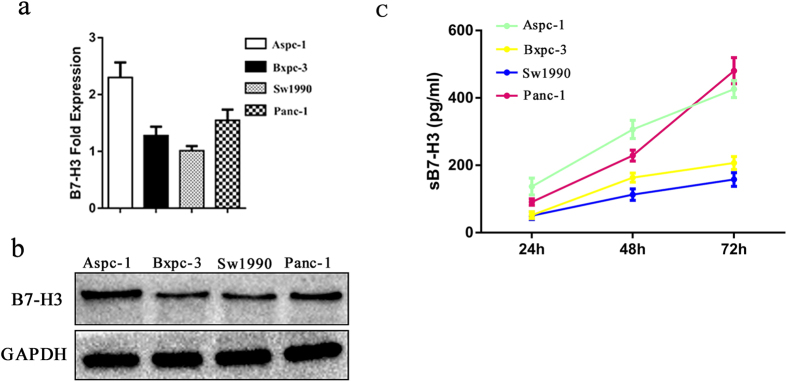
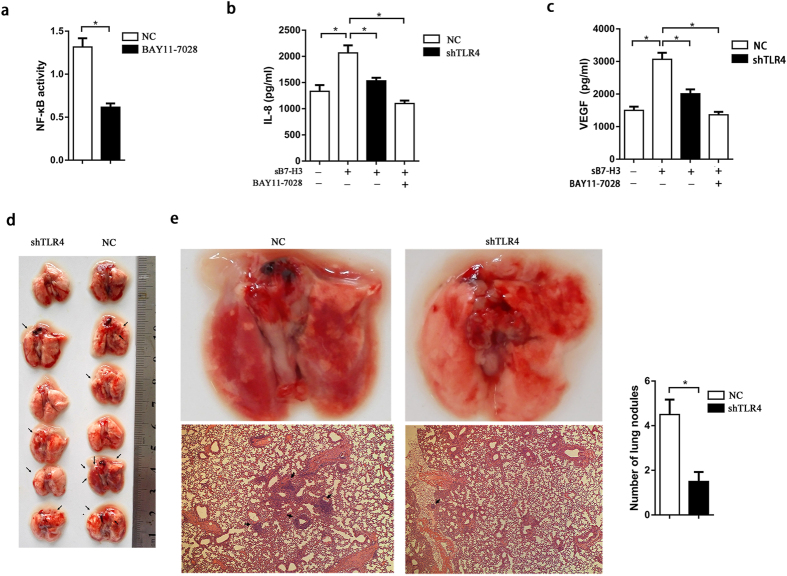
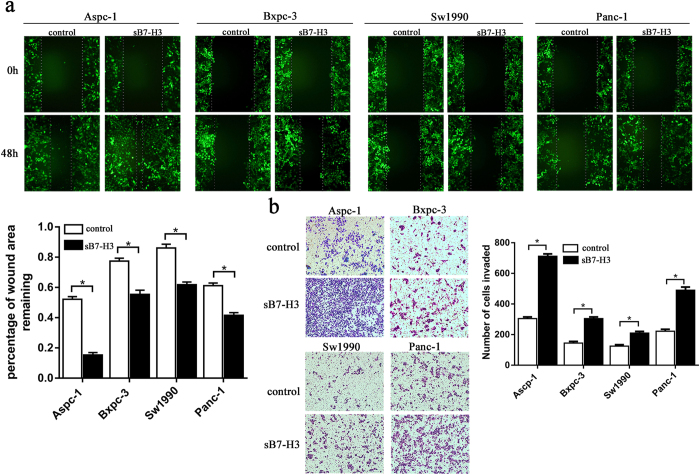
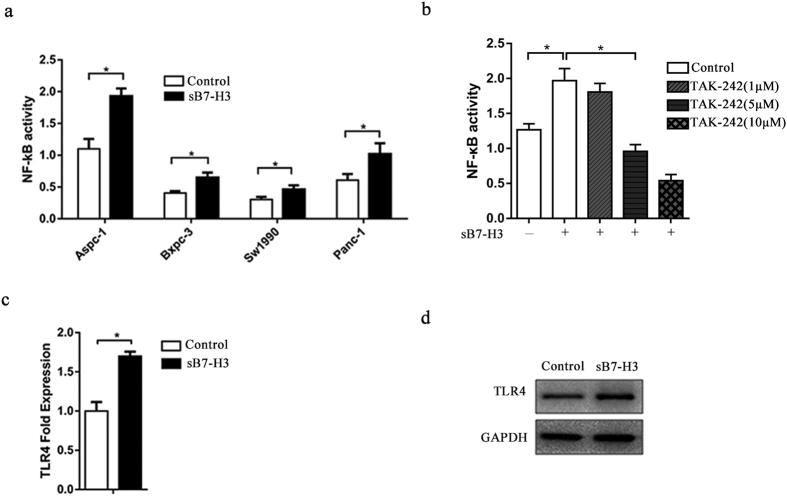
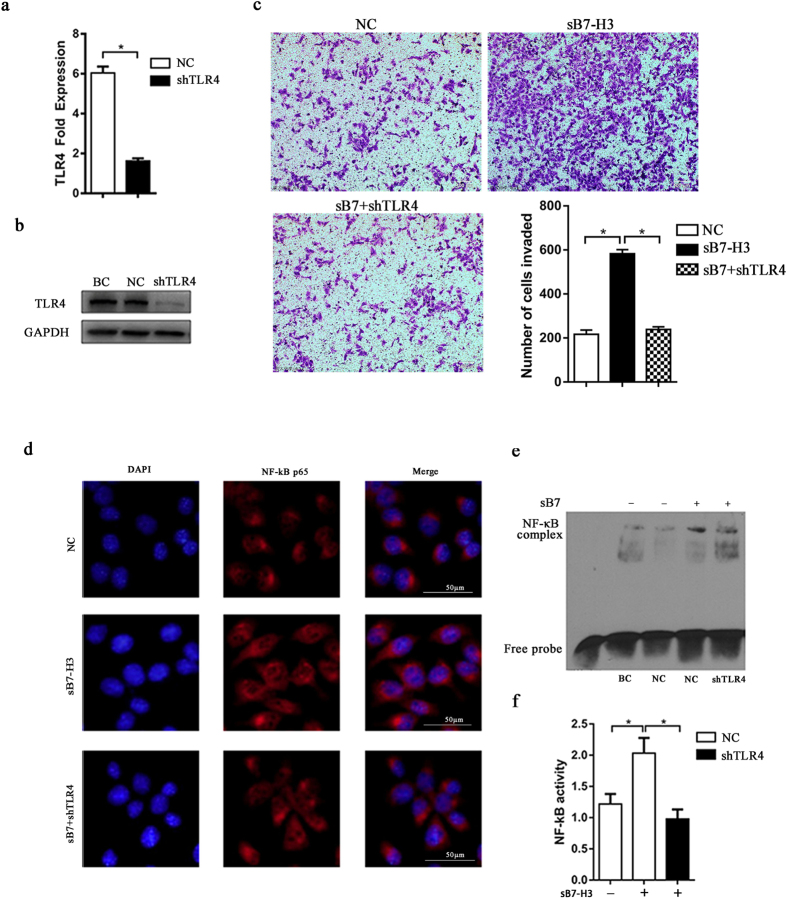
Many studies have demonstrated a relationship between soluble B7-H3 (sB7-H3) and the poor prognosis of patients with malignant tumors, and increasing evidence has shown a connection between sB7-H3 and NF-κB in tumor progression. In the present study, we demonstrate for the first time that sB7-H3 promotes the invasion and metastasis of pancreatic carcinoma cells through the TLR4/NF-κB pathway. In this study, we observed that sB7-H3 was highly expressed in mB7-H3-positive pancreatic carcinoma (PCa) cells. Exogenous sB7-H3 significantly increased NF-κB activity and promoted the migration and invasion of PCa cells. Further studies proved that sB7-H3 first up-regulated TLR4 expression, then activated NF-κB signaling and finally promoted IL-8 and VEGF expression. In contrast, the silencing of TLR4 using a stable short hairpin RNA significantly decreased the sB7-H3-induced activity of NF-κB and the expression of IL-8 and VEGF in PCa cells. In vivo animal experiments further demonstrated that TLR4-knock-down tumor cells displayed a decreased ability to metastasize compared with the control tumor cells after being induced by sB7-H3. Collectively, these results demonstrate that sB7-H3 promotes invasion and metastasis through the TLR4/NF-κB pathway in pancreatic carcinoma cells.
许多研究已证实可溶性B7-H3(sB7-H3)与恶性肿瘤患者的不良预后之间存在关联,且越来越多的证据表明sB7-H3与肿瘤进展中的核因子κB(NF-κB)存在联系。在本研究中,我们首次证明sB7-H3通过Toll样受体4(TLR4)/NF-κB途径促进胰腺癌细胞的侵袭和转移。在本研究中,我们观察到sB7-H3在mB7-H3阳性胰腺癌细胞中高表达。外源性sB7-H3显著增加NF-κB活性并促进胰腺癌细胞的迁移和侵袭。进一步研究证明,sB7-H3首先上调TLR4表达,然后激活NF-κB信号,最终促进白细胞介素-8(IL-8)和血管内皮生长因子(VEGF)表达。相反,使用稳定短发夹RNA沉默TLR4可显著降低sB7-H3诱导的胰腺癌细胞中NF-κB活性以及IL-8和VEGF的表达。体内动物实验进一步表明,与对照肿瘤细胞相比,TLR4敲低的肿瘤细胞在被sB7-H3诱导后转移能力降低。总的来说,这些结果表明sB7-H3通过TLR4/NF-κB途径促进胰腺癌细胞的侵袭和转移。