Cristante Alexandre Fogaça, Rocha Ivan Diasda, MartusMarcon Raphael, Filho Tarcísio Eloy Pessoade Barros
Instituto de Ortopedia e Traumatologia do Hospital das Clínicas da Faculdade de Medicina da Universidade de São Paulo (IOT-HCFMUSP), Departamento Ortopedia e Traumatologia, Divisão de Cirurgia de Coluna Vertebral, São Paulo/SP</state>Brazil.
Clinics (Sao Paulo). 2016 May;71(5):276-80. doi: 10.6061/clinics/2016(05)06.
Hydrodiscectomy is a new technique used for percutaneous spinal discectomy that employs a high-intensity stream of water for herniated disc ablation and tissue aspiration. No previous clinical study has examined the effects of percutaneous hydrodiscectomy. The aim of this study is to evaluate the outcomes of hydrodiscectomy compared to open microdiscectomy regarding pain, function, satisfaction, complications and recurrence rates.
In this randomized clinical trial, patients referred to our tertiary hospital for lumbar back pain were recruited and included in the study if they had disc protrusion or small herniation in only one level, without neurological deficits and with no resolution after six weeks of conservative treatment. One group underwent open microdiscectomy, and the other group underwent percutaneous microdiscectomy via hydrosurgery. Function was evaluated using the Oswestry Disability Index and pain was assessed using a visual analog scale. Evaluations were performed preoperatively, and then during the first week and at one, three, six and twelve months postoperatively. Personal satisfaction was verified. Clinicaltrials.gov: NCT01367860.
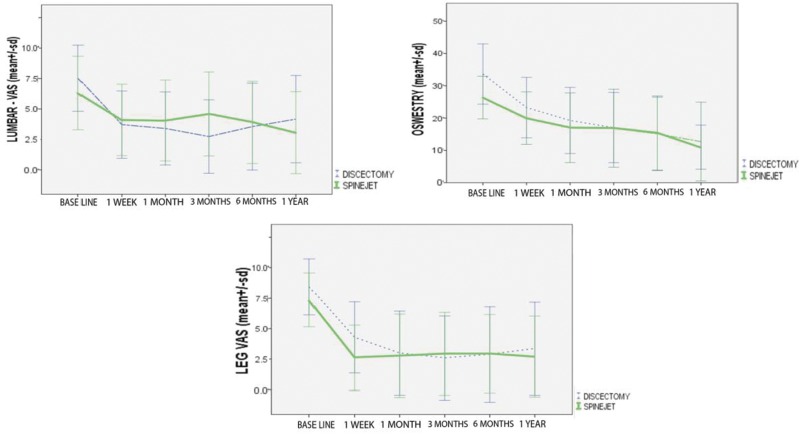
During the study period, 20 patients were included in each arm and 39 completed one-year of follow-up (one patient died of unrelated causes). Both groups exhibited equal improvement on the visual analog scale and Oswestry evaluations after treatment, without any significant differences. The improvement in the lumbar visual analog scale score was not significant in the hydrodiscectomy group (p=0.138). The rates of infection, pain, recurrence and satisfaction were similar between the two groups.
Percutaneous hydrodiscectomy was demonstrated to be as effective as open microdiscectomy for reducing pain. The rates of complications and recurrence of herniation were similar between groups. Patient satisfaction with the treatment was also similar between groups.
水刀椎间盘切除术是一种用于经皮脊柱椎间盘切除术的新技术,它利用高强度水流进行椎间盘突出消融和组织抽吸。此前尚无临床研究考察经皮水刀椎间盘切除术的效果。本研究的目的是比较水刀椎间盘切除术与开放式显微椎间盘切除术在疼痛、功能、满意度、并发症及复发率方面的疗效。
在这项随机临床试验中,招募到我院因腰背痛前来就诊的患者,若他们仅在一个节段有椎间盘突出或小的椎间盘疝出,无神经功能缺损且经过六周保守治疗无效,则纳入研究。一组接受开放式显微椎间盘切除术,另一组通过水刀手术接受经皮显微椎间盘切除术。使用Oswestry功能障碍指数评估功能,使用视觉模拟量表评估疼痛。在术前、术后第一周、术后1、3、6和12个月进行评估。核实个人满意度。Clinicaltrials.gov:NCT01367860。
在研究期间,每组纳入20例患者,39例完成了一年的随访(1例患者死于无关原因)。两组在治疗后视觉模拟量表和Oswestry评估中均有同等程度的改善,无显著差异。水刀椎间盘切除术组腰椎视觉模拟量表评分的改善不显著(p = 0.138)。两组之间的感染、疼痛、复发和满意度发生率相似。
经皮水刀椎间盘切除术在减轻疼痛方面与开放式显微椎间盘切除术同样有效。两组之间的并发症和椎间盘疝复发率相似。两组患者对治疗的满意度也相似。