Cabinian Allison, Sinsimer Daniel, Tang May, Zumba Osvaldo, Mehta Hetali, Toma Annmarie, Sant'Angelo Derek, Laouar Yasmina, Laouar Amale
The Child Health Institute of New Jersey, Robert Wood Johnson Medical School, Rutgers University, New Brunswick, New Jersey, United States of America.
Department of Microbiology and Immunology, University of Michigan School of Medicine, Ann Arbor, Michigan, United States of America.
PLoS One. 2016 Jun 10;11(6):e0156762. doi: 10.1371/journal.pone.0156762. eCollection 2016.
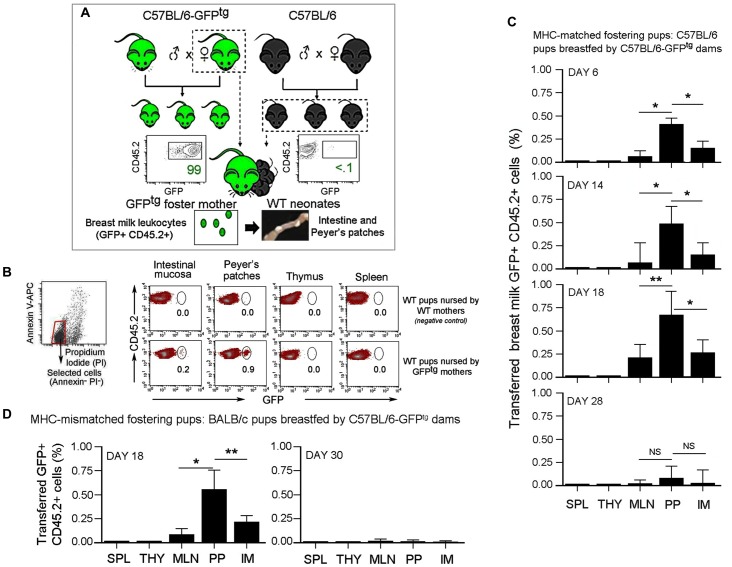
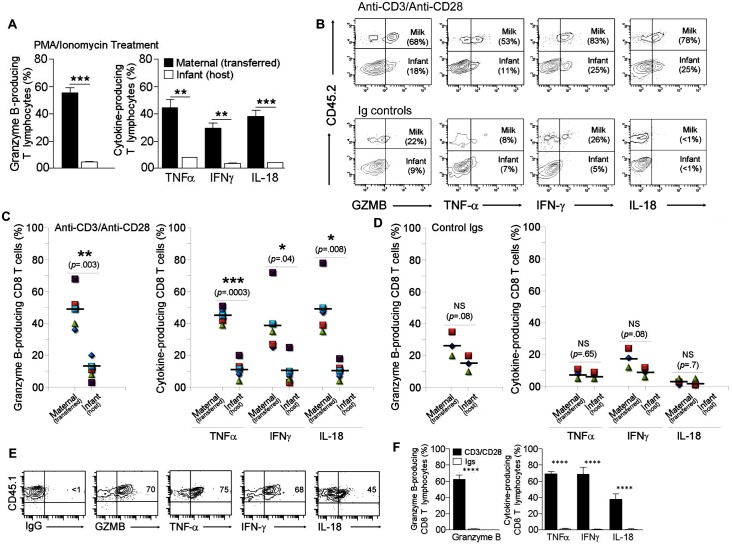
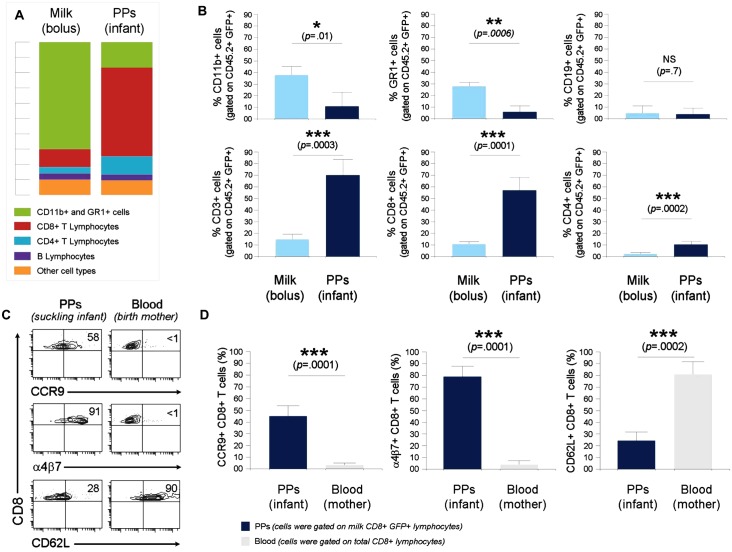
Despite our knowledge of the protective role of antibodies passed to infants through breast milk, our understanding of immunity transfer via maternal leukocytes is still limited. To emulate the immunological interface between the mother and her infant while breast-feeding, we used murine pups fostered after birth onto MHC-matched and MHC-mismatched dams. Overall, data revealed that: 1) Survival of breast milk leukocytes in suckling infants is possible, but not significant after the foster-nursing ceases; 2) Most breast milk lymphocytes establish themselves in specific areas of the intestine termed Peyer's patches (PPs); 3) While most leukocytes in the milk bolus were myeloid cells, the majority of breast milk leukocytes localized to PPs were T lymphocytes, and cytotoxic T cells (CTLs) in particular; 4) These CTLs exhibit high levels of the gut-homing molecules α4β7 and CCR9, but a reduced expression of the systemic homing marker CD62L; 5) Under the same activation conditions, transferred CD8 T cells through breast milk have a superior capacity to produce potent cytolytic and inflammatory mediators when compared to those generated by the breastfed infant. It is therefore possible that maternal CTLs found in breast milk are directed to the PPs to compensate for the immature adaptive immune system of the infant in order to protect it against constant oral infectious risks during the postnatal phase.
尽管我们了解母乳中传递给婴儿的抗体的保护作用,但我们对通过母体白细胞进行免疫转移的理解仍然有限。为了模拟母乳喂养时母亲与婴儿之间的免疫界面,我们使用了出生后寄养在主要组织相容性复合体(MHC)匹配和不匹配母鼠身上的幼鼠。总体而言,数据显示:1)母乳白细胞在哺乳婴儿体内存活是可能的,但在寄养停止后不显著;2)大多数母乳淋巴细胞在肠道特定区域即派尔集合淋巴结(PPs)中定居;3)虽然乳块中的大多数白细胞是髓样细胞,但定位于PPs的母乳白细胞大多数是T淋巴细胞,尤其是细胞毒性T细胞(CTLs);4)这些CTLs表现出高水平的肠道归巢分子α4β7和CCR9,但全身归巢标志物CD62L的表达降低;5)在相同的激活条件下,与母乳喂养婴儿产生的CD8 T细胞相比,通过母乳转移的CD8 T细胞产生强效细胞溶解和炎症介质的能力更强。因此,母乳中发现的母体CTLs可能被导向PPs,以补偿婴儿未成熟的适应性免疫系统,从而在出生后阶段保护其免受持续的经口感染风险。