• 文献检索
  • 文档翻译
  • 深度研究
  • 学术资讯
  • Suppr Zotero 插件Zotero 插件
  • 邀请有礼
  • 套餐&价格
  • 历史记录
应用&插件
Suppr Zotero 插件Zotero 插件浏览器插件Mac 客户端Windows 客户端微信小程序
定价
高级版会员购买积分包购买API积分包
服务
文献检索文档翻译深度研究API 文档MCP 服务
关于我们
关于 Suppr公司介绍联系我们用户协议隐私条款
关注我们

Suppr 超能文献

核心技术专利:CN118964589B侵权必究
粤ICP备2023148730 号-1Suppr @ 2026

文献检索

告别复杂PubMed语法,用中文像聊天一样搜索,搜遍4000万医学文献。AI智能推荐,让科研检索更轻松。

立即免费搜索

文件翻译

保留排版,准确专业,支持PDF/Word/PPT等文件格式,支持 12+语言互译。

免费翻译文档

深度研究

AI帮你快速写综述,25分钟生成高质量综述,智能提取关键信息,辅助科研写作。

立即免费体验

应用稀疏机器学习方法于 Twitter:巴氏涂片检查指南变化的分析(2012 年)。一项序贯混合方法研究。

Applying Sparse Machine Learning Methods to Twitter: Analysis of the 2012 Change in Pap Smear Guidelines. A Sequential Mixed-Methods Study.

机构信息

Center for Vulnerable Populations & Division of General Internal Medicine at the Zuckerberg San Francisco General Hospital, Department of Medicine, University of California San Francisco, San Francisco, CA, United States.

出版信息

JMIR Public Health Surveill. 2016 Jun 10;2(1):e21. doi: 10.2196/publichealth.5308.

DOI:10.2196/publichealth.5308
PMID:27288093
原文链接:https://pmc.ncbi.nlm.nih.gov/articles/PMC4920957/
Abstract

BACKGROUND

It is difficult to synthesize the vast amount of textual data available from social media websites. Capturing real-world discussions via social media could provide insights into individuals' opinions and the decision-making process.

OBJECTIVE

We conducted a sequential mixed methods study to determine the utility of sparse machine learning techniques in summarizing Twitter dialogues. We chose a narrowly defined topic for this approach: cervical cancer discussions over a 6-month time period surrounding a change in Pap smear screening guidelines.

METHODS

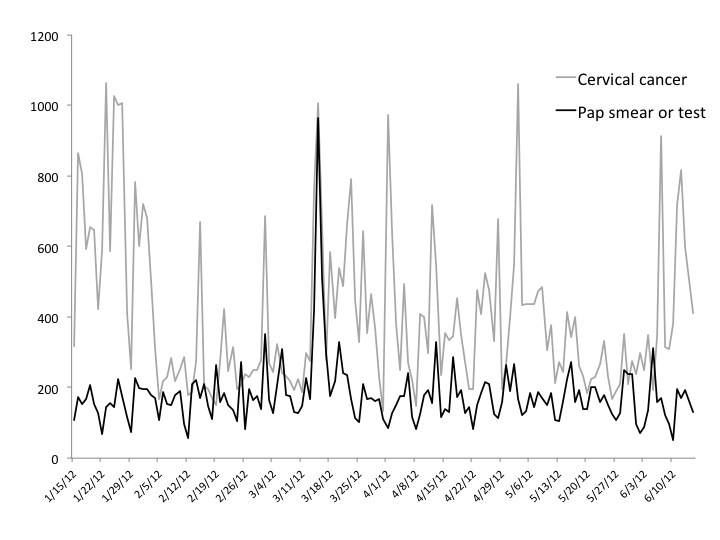
We applied statistical methodologies, known as sparse machine learning algorithms, to summarize Twitter messages about cervical cancer before and after the 2012 change in Pap smear screening guidelines by the US Preventive Services Task Force (USPSTF). All messages containing the search terms "cervical cancer," "Pap smear," and "Pap test" were analyzed during: (1) January 1-March 13, 2012, and (2) March 14-June 30, 2012. Topic modeling was used to discern the most common topics from each time period, and determine the singular value criterion for each topic. The results were then qualitatively coded from top 10 relevant topics to determine the efficiency of clustering method in grouping distinct ideas, and how the discussion differed before vs. after the change in guidelines .

RESULTS

This machine learning method was effective in grouping the relevant discussion topics about cervical cancer during the respective time periods (~20% overall irrelevant content in both time periods). Qualitative analysis determined that a significant portion of the top discussion topics in the second time period directly reflected the USPSTF guideline change (eg, "New Screening Guidelines for Cervical Cancer"), and many topics in both time periods were addressing basic screening promotion and education (eg, "It is Cervical Cancer Awareness Month! Click the link to see where you can receive a free or low cost Pap test.")

CONCLUSIONS

It was demonstrated that machine learning tools can be useful in cervical cancer prevention and screening discussions on Twitter. This method allowed us to prove that there is publicly available significant information about cervical cancer screening on social media sites. Moreover, we observed a direct impact of the guideline change within the Twitter messages.

摘要

背景

从社交媒体网站上获取大量文本数据是很困难的。通过社交媒体捕捉真实世界的讨论,可以深入了解个人的观点和决策过程。

目的

我们进行了一项序贯混合方法研究,以确定稀疏机器学习技术在总结 Twitter 对话中的效用。我们选择了一个狭义的主题来进行这种方法:在 2012 年美国预防服务工作组(USPSTF)改变巴氏涂片筛查指南的 6 个月期间,围绕宫颈癌讨论。

方法

我们应用了统计方法,称为稀疏机器学习算法,来总结 2012 年 USPSTF 改变巴氏涂片筛查指南前后 Twitter 上关于宫颈癌的信息。分析了包含搜索词“宫颈癌”、“巴氏涂片”和“巴氏试验”的所有消息:(1)2012 年 1 月 1 日至 3 月 13 日,(2)2012 年 3 月 14 日至 6 月 30 日。主题建模用于从每个时间段中辨别出最常见的主题,并确定每个主题的奇异值标准。然后,从前 10 个相关主题中对结果进行定性编码,以确定聚类方法在分组不同想法方面的效率,以及讨论在指南更改前后的差异。

结果

这种机器学习方法有效地将宫颈癌相关讨论主题分组到相应的时间段内(两个时间段的总无关内容约为 20%)。定性分析确定,第二个时间段中前 10 个热门讨论主题中有很大一部分直接反映了 USPSTF 指南的变化(例如,“宫颈癌新筛查指南”),并且两个时间段中的许多主题都在讨论基本的筛查推广和教育(例如,“这是宫颈癌宣传月!点击链接查看您可以在哪里接受免费或低价巴氏涂片检查。”)

结论

研究表明,机器学习工具在 Twitter 上的宫颈癌预防和筛查讨论中非常有用。这种方法使我们能够证明社交媒体网站上存在有关宫颈癌筛查的大量公开信息。此外,我们观察到指南变化在 Twitter 消息中直接产生了影响。
https://cdn.ncbi.nlm.nih.gov/pmc/blobs/029b/4920957/fe17bf0393e8/publichealth_v2i1e21_fig3.jpg
https://cdn.ncbi.nlm.nih.gov/pmc/blobs/029b/4920957/fffb8bd29154/publichealth_v2i1e21_fig1.jpg
https://cdn.ncbi.nlm.nih.gov/pmc/blobs/029b/4920957/a927e19ac758/publichealth_v2i1e21_fig2.jpg
https://cdn.ncbi.nlm.nih.gov/pmc/blobs/029b/4920957/fe17bf0393e8/publichealth_v2i1e21_fig3.jpg
https://cdn.ncbi.nlm.nih.gov/pmc/blobs/029b/4920957/fffb8bd29154/publichealth_v2i1e21_fig1.jpg
https://cdn.ncbi.nlm.nih.gov/pmc/blobs/029b/4920957/a927e19ac758/publichealth_v2i1e21_fig2.jpg
https://cdn.ncbi.nlm.nih.gov/pmc/blobs/029b/4920957/fe17bf0393e8/publichealth_v2i1e21_fig3.jpg

相似文献

1
Applying Sparse Machine Learning Methods to Twitter: Analysis of the 2012 Change in Pap Smear Guidelines. A Sequential Mixed-Methods Study.应用稀疏机器学习方法于 Twitter:巴氏涂片检查指南变化的分析(2012 年)。一项序贯混合方法研究。
JMIR Public Health Surveill. 2016 Jun 10;2(1):e21. doi: 10.2196/publichealth.5308.
2
Twitter Discussions and Emotions About the COVID-19 Pandemic: Machine Learning Approach.关于新冠疫情的推特讨论与情绪:机器学习方法
J Med Internet Res. 2020 Nov 25;22(11):e20550. doi: 10.2196/20550.
3
"5 mins of uncomfyness is better than dealing with cancer 4 a lifetime": an exploratory qualitative analysis of cervical and breast cancer screening dialogue on Twitter.“五分钟的不适好过一辈子与癌症打交道”:对推特上宫颈癌和乳腺癌筛查对话的探索性定性分析
J Cancer Educ. 2013 Mar;28(1):127-33. doi: 10.1007/s13187-012-0432-2.
4
A review of image analysis and machine learning techniques for automated cervical cancer screening from pap-smear images.基于巴氏涂片图像的宫颈癌自动筛查的图像分析和机器学习技术综述。
Comput Methods Programs Biomed. 2018 Oct;164:15-22. doi: 10.1016/j.cmpb.2018.05.034. Epub 2018 Jun 26.
5
Exploring Eating Disorder Topics on Twitter: Machine Learning Approach.在推特上探索饮食失调话题:机器学习方法。
JMIR Med Inform. 2020 Oct 30;8(10):e18273. doi: 10.2196/18273.
6
Cervical cancer screening among women without a cervix.无子宫女性的宫颈癌筛查
JAMA. 2004 Jun 23;291(24):2990-3. doi: 10.1001/jama.291.24.2990.
7
Raising Awareness About Cervical Cancer Using Twitter: Content Analysis of the 2015 #SmearForSmear Campaign.利用推特提高对宫颈癌的认识:2015年#涂片换涂片运动的内容分析
J Med Internet Res. 2017 Oct 16;19(10):e344. doi: 10.2196/jmir.8421.
8
Characterizing the Discussion of Antibiotics in the Twittersphere: What is the Bigger Picture?剖析推特上关于抗生素的讨论:整体情况如何?
J Med Internet Res. 2015 Jun 19;17(6):e154. doi: 10.2196/jmir.4220.
9
Using Social Media Data to Understand the Impact of Promotional Information on Laypeople's Discussions: A Case Study of Lynch Syndrome.利用社交媒体数据了解宣传信息对普通民众讨论的影响:以林奇综合征为例
J Med Internet Res. 2017 Dec 13;19(12):e414. doi: 10.2196/jmir.9266.
10
A Cross-Sectional Review of Cervical Cancer Messages on Twitter During Cervical Cancer Awareness Month.《宫颈癌宣传月期间推特上宫颈癌相关信息的横断面回顾》
J Low Genit Tract Dis. 2018 Jan;22(1):8-12. doi: 10.1097/LGT.0000000000000363.

引用本文的文献

1
Celebrity Cancer on Twitter: Mapping a Novel Opportunity for Cancer Prevention.推特上的名人患癌事件:探寻癌症预防的新契机
Cancer Control. 2019 Jan-Dec;26(1):1073274819825826. doi: 10.1177/1073274819825826.
2
Using Social Media to Target Cancer Prevention in Young Adults: Viewpoint.利用社交媒体针对年轻人开展癌症预防工作:观点
J Med Internet Res. 2018 Jun 5;20(6):e203. doi: 10.2196/jmir.8882.
3
Representations of Codeine Misuse on Instagram: Content Analysis.Instagram上可待因滥用的呈现:内容分析

本文引用的文献

1
Patient concerns about human papillomavirus testing and 5-year intervals in routine cervical cancer screening.患者对人乳头瘤病毒检测及常规宫颈癌筛查中5年间隔时间的担忧。
Obstet Gynecol. 2015 Feb;125(2):317-329. doi: 10.1097/AOG.0000000000000638.
2
"5 mins of uncomfyness is better than dealing with cancer 4 a lifetime": an exploratory qualitative analysis of cervical and breast cancer screening dialogue on Twitter.“五分钟的不适好过一辈子与癌症打交道”:对推特上宫颈癌和乳腺癌筛查对话的探索性定性分析
J Cancer Educ. 2013 Mar;28(1):127-33. doi: 10.1007/s13187-012-0432-2.
3
Screening for cervical cancer: U.S. Preventive Services Task Force recommendation statement.
JMIR Public Health Surveill. 2018 Mar 20;4(1):e22. doi: 10.2196/publichealth.8144.
宫颈癌筛查:美国预防服务工作组推荐声明。
Ann Intern Med. 2012 Jun 19;156(12):880-91, W312. doi: 10.7326/0003-4819-156-12-201206190-00424.
4
Social networks--are they good for your health? The era of Facebook and Twitter.
QJM. 2011 Sep;104(9):819-20. doi: 10.1093/qjmed/hcr078. Epub 2011 Jun 3.
5
Social media use in the United States: implications for health communication.美国社交媒体的使用:对健康传播的影响。
J Med Internet Res. 2009 Nov 27;11(4):e48. doi: 10.2196/jmir.1249.
6
Take two aspirin and tweet me in the morning: how Twitter, Facebook, and other social media are reshaping health care.吃两片阿司匹林,早上在推特上给我留言:推特、脸书和其他社交媒体如何重塑医疗保健。
Health Aff (Millwood). 2009 Mar-Apr;28(2):361-8. doi: 10.1377/hlthaff.28.2.361.
7
Whatever happened to qualitative description?定性描述怎么了?
Res Nurs Health. 2000 Aug;23(4):334-40. doi: 10.1002/1098-240x(200008)23:4<334::aid-nur9>3.0.co;2-g.
8
Reaching the parts other methods cannot reach: an introduction to qualitative methods in health and health services research.触及其他方法无法触及之处:健康与健康服务研究中的定性方法导论。
BMJ. 1995 Jul 1;311(6996):42-5. doi: 10.1136/bmj.311.6996.42.