Biomedical Engineering, Johns Hopkins University, Baltimore, MD, United States of America.
Phys Med Biol. 2018 Oct 24;63(21):215006. doi: 10.1088/1361-6560/aae66c.
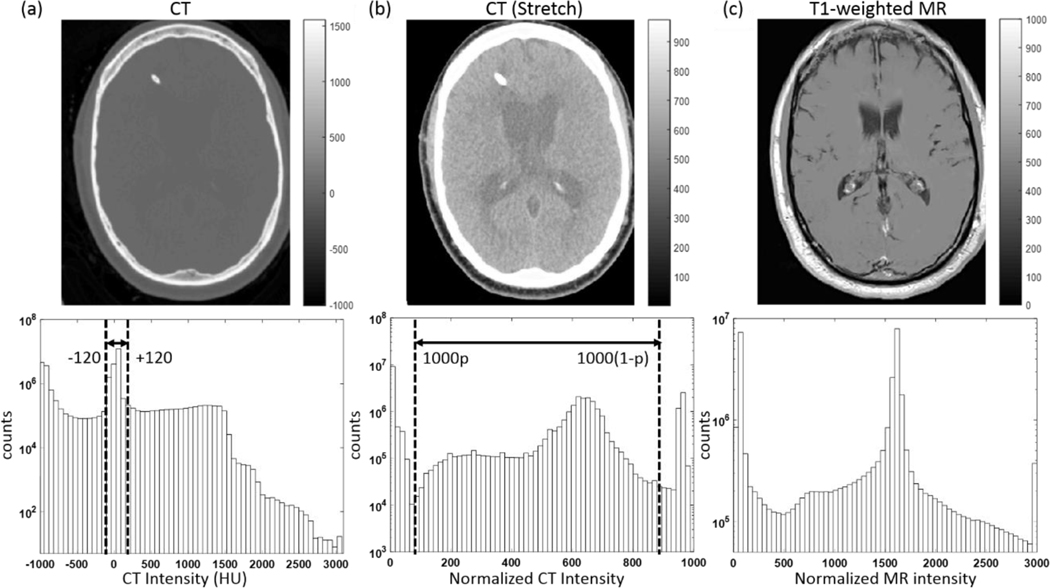
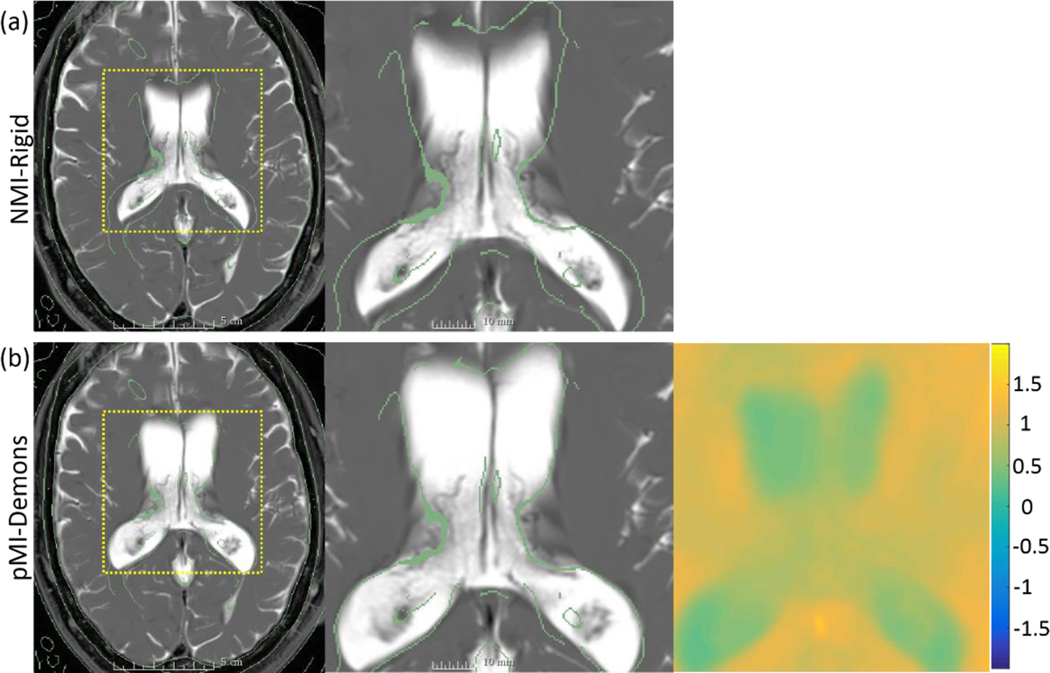
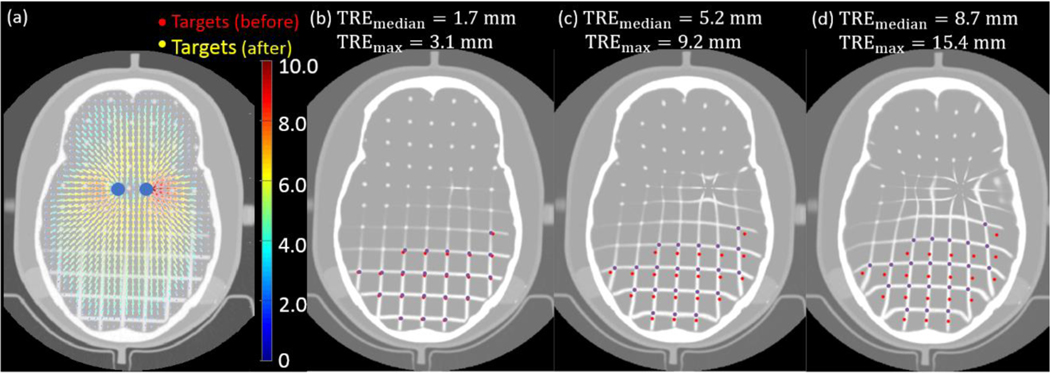
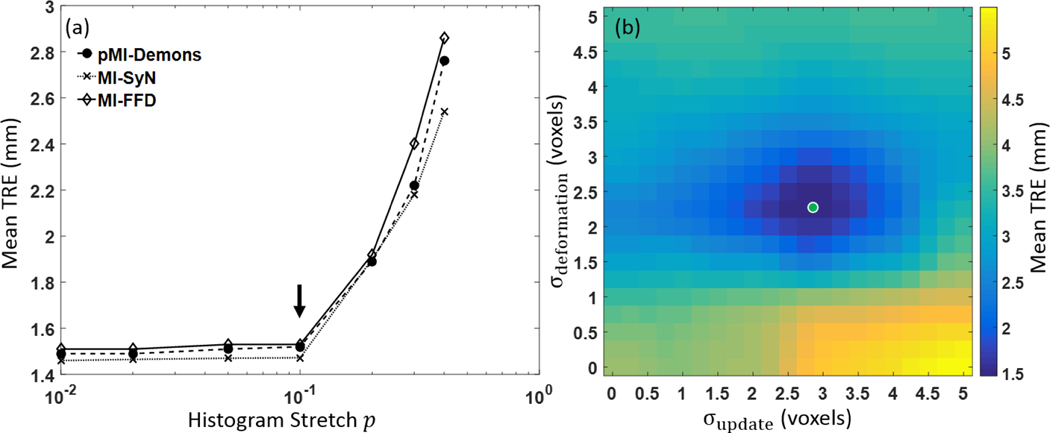
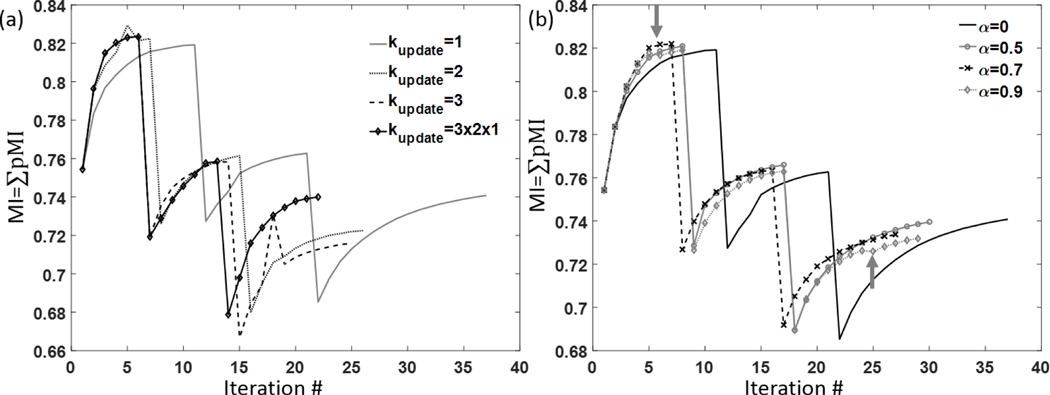
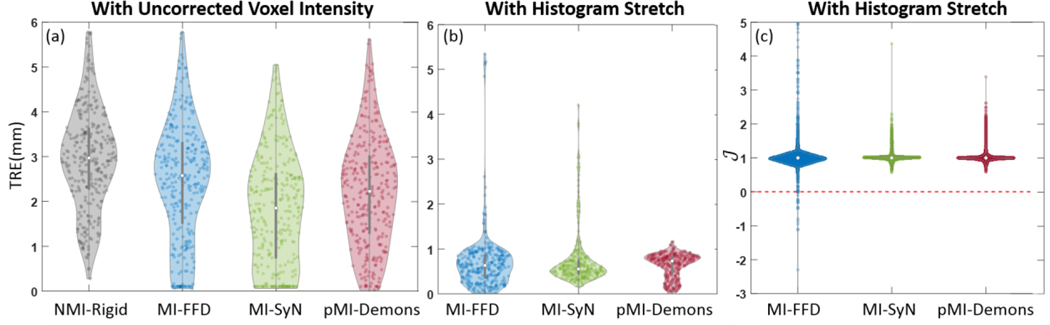
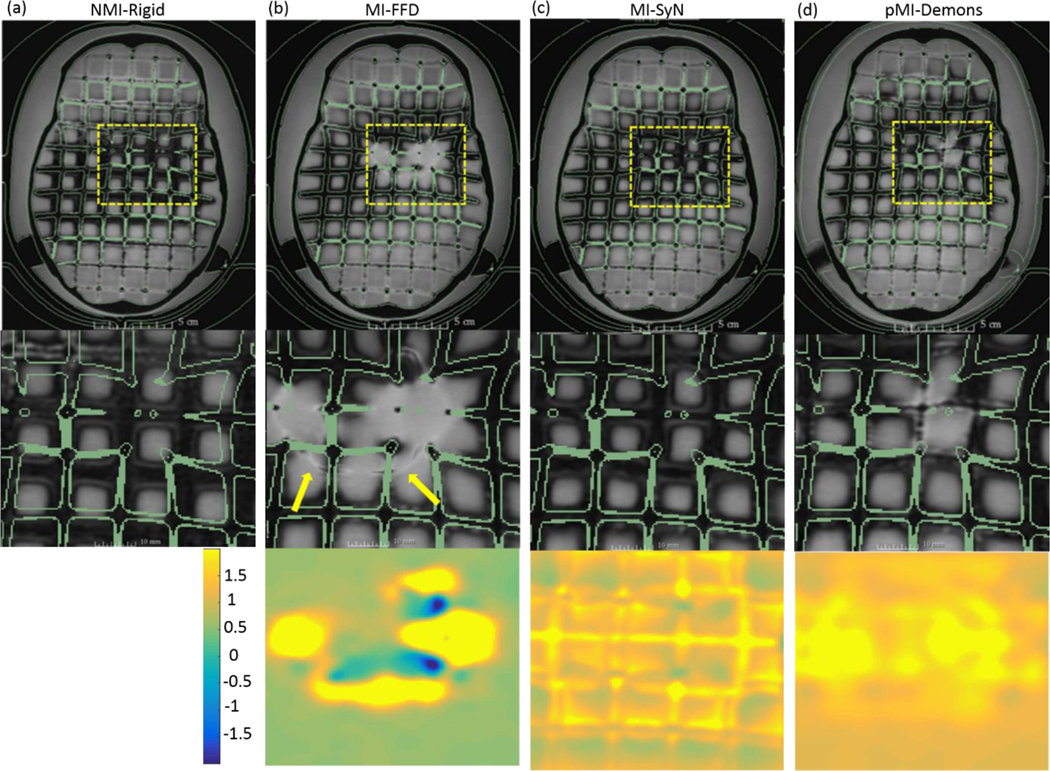
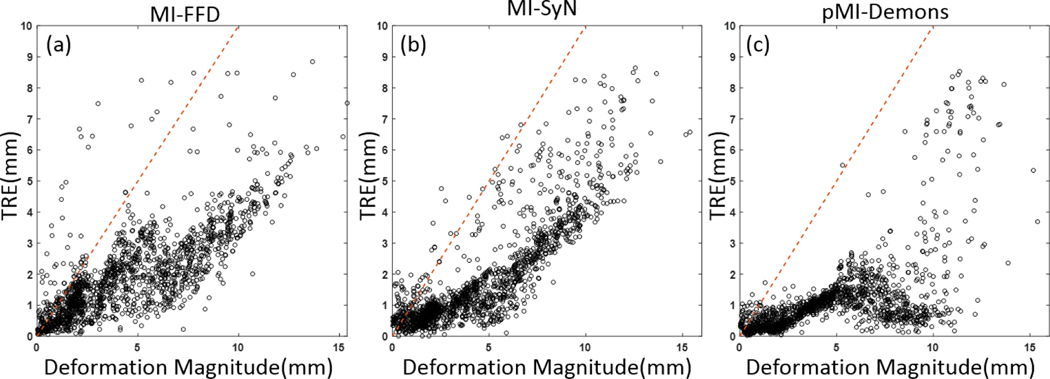
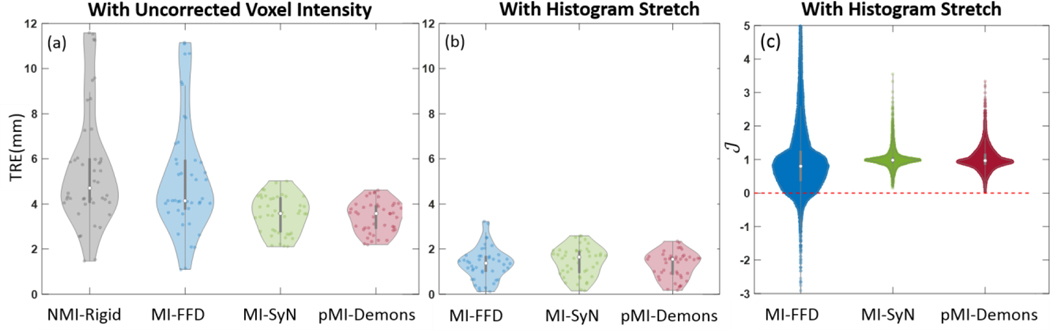
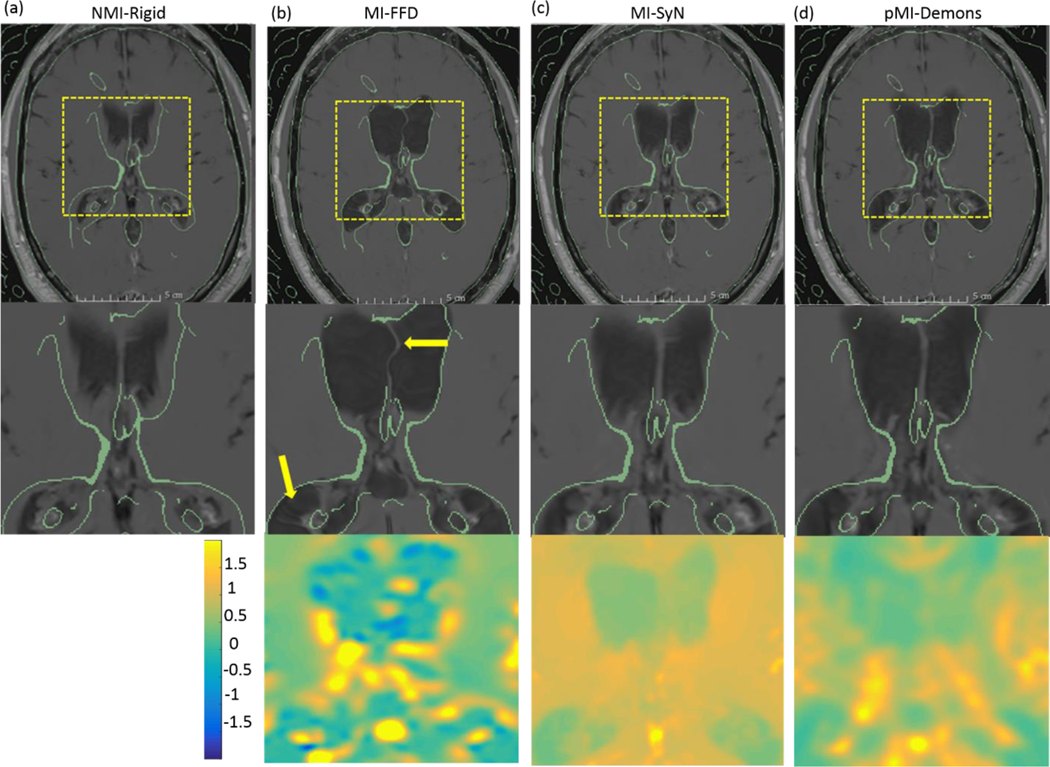
Neuro-navigated procedures require a high degree of geometric accuracy but are subject to geometric error from complex deformation in the deep brain-e.g. regions about the ventricles due to egress of cerebrospinal fluid (CSF) upon neuroendoscopic approach or placement of a ventricular shunt. We report a multi-modality, diffeomorphic, deformable registration method using momentum-based acceleration of the Demons algorithm to solve the transformation relating preoperative MRI and intraoperative CT as a basis for high-precision guidance. The registration method (pMI-Demons) extends the mono-modality, diffeomorphic form of the Demons algorithm to multi-modality registration using pointwise mutual information (pMI) as a similarity metric. The method incorporates a preprocessing step to nonlinearly stretch CT image values and incorporates a momentum-based approach to accelerate convergence. Registration performance was evaluated in phantom and patient images: first, the sensitivity of performance to algorithm parameter selection (including update and displacement field smoothing, histogram stretch, and the momentum term) was analyzed in a phantom study over a range of simulated deformations; and second, the algorithm was applied to registration of MR and CT images for four patients undergoing minimally invasive neurosurgery. Performance was compared to two previously reported methods (free-form deformation using mutual information (MI-FFD) and symmetric normalization using mutual information (MI-SyN)) in terms of target registration error (TRE), Jacobian determinant (J), and runtime. The phantom study identified optimal or nominal settings of algorithm parameters for translation to clinical studies. In the phantom study, the pMI-Demons method achieved comparable registration accuracy to the reference methods and strongly reduced outliers in TRE (p [Formula: see text] 0.001 in Kolmogorov-Smirnov test). Similarly, in the clinical study: median TRE = 1.54 mm (0.83-1.66 mm interquartile range, IQR) for pMI-Demons compared to 1.40 mm (1.02-1.67 mm IQR) for MI-FFD and 1.64 mm (0.90-1.92 mm IQR) for MI-SyN. The pMI-Demons and MI-SyN methods yielded diffeomorphic transformations (J > 0) that preserved topology, whereas MI-FFD yielded unrealistic (J < 0) deformations subject to tissue folding and tearing. Momentum-based acceleration gave a ~35% speedup of the pMI-Demons method, providing registration runtime of 10.5 min (reduced to 2.2 min on GPU), compared to 15.5 min for MI-FFD and 34.7 min for MI-SyN. The pMI-Demons method achieved registration accuracy comparable to MI-FFD and MI-SyN, maintained diffeomorphic transformation similar to MI-SyN, and accelerated runtime in a manner that facilitates translation to image-guided neurosurgery.
神经导航手术需要高度的几何精度,但由于神经内窥镜方法或脑室分流器的放置导致脑脊液(CSF)流出,深部脑的复杂变形会导致几何误差。我们报告了一种多模态、变形、可变形的配准方法,使用基于动量的 Demons 算法加速,以解决术前 MRI 和术中 CT 之间的转换关系,作为高精度引导的基础。该配准方法(pMI-Demons)将 Demons 算法的单模态、变形形式扩展到使用点互信息(pMI)作为相似性度量的多模态配准。该方法包含一个预处理步骤,用于非线性拉伸 CT 图像值,并包含基于动量的方法来加速收敛。在体模和患者图像中评估了配准性能:首先,在模拟变形范围内的体模研究中分析了性能对算法参数选择(包括更新和位移场平滑、直方图拉伸和动量项)的敏感性;其次,将该算法应用于 4 名接受微创神经外科手术的患者的 MR 和 CT 图像配准。根据目标配准误差(TRE)、雅可比行列式(J)和运行时间,将性能与两种先前报道的方法(基于互信息的自由形态变形(MI-FFD)和基于互信息的对称归一化(MI-SyN))进行了比较。体模研究确定了将算法参数转换为临床研究的最佳或标称设置。在体模研究中,pMI-Demons 方法与参考方法相比达到了相当的配准精度,并大大减少了 TRE 中的异常值(Kolmogorov-Smirnov 检验 p [Formula: see text] 0.001)。同样,在临床研究中:对于 pMI-Demons,中位数 TRE = 1.54 mm(0.83-1.66 mm 四分位距,IQR),对于 MI-FFD,中位数 TRE = 1.40 mm(1.02-1.67 mm IQR),对于 MI-SyN,中位数 TRE = 1.64 mm(0.90-1.92 mm IQR)。pMI-Demons 和 MI-SyN 方法产生了保形变换(J > 0),保持了拓扑结构,而 MI-FFD 方法产生了不真实的(J < 0)变形,容易导致组织折叠和撕裂。基于动量的加速为 pMI-Demons 方法提供了约 35%的速度提升,注册运行时间为 10.5 分钟(在 GPU 上减少到 2.2 分钟),而 MI-FFD 为 15.5 分钟,MI-SyN 为 34.7 分钟。pMI-Demons 方法达到了与 MI-FFD 和 MI-SyN 相当的配准精度,保持了与 MI-SyN 相似的保形变换,并以有利于图像引导神经外科的方式加速了运行时间。