Department of Medical Nanotechnology, Faculty of Advanced Technologies in Medicine, Iran University of Medical Sciences, Tehran, Iran.
Advanced Nanobiotechnology and Nanomedicine Research Group (ANNRG), Iran University of Medical Sciences, Tehran, Iran.
Lab Chip. 2016 Jul 5;16(14):2551-71. doi: 10.1039/c6lc00489j.
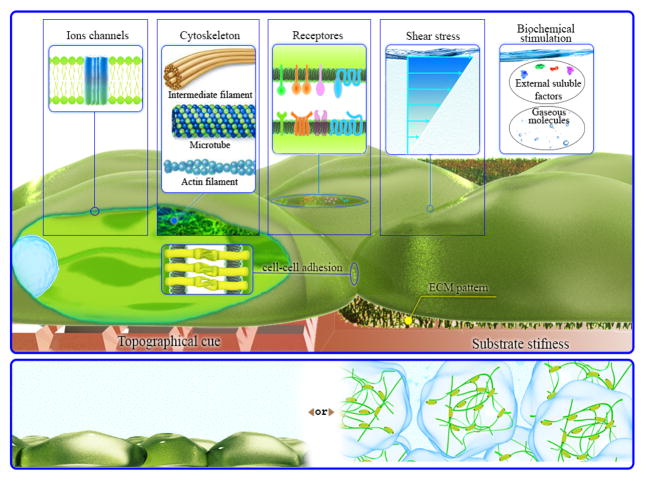
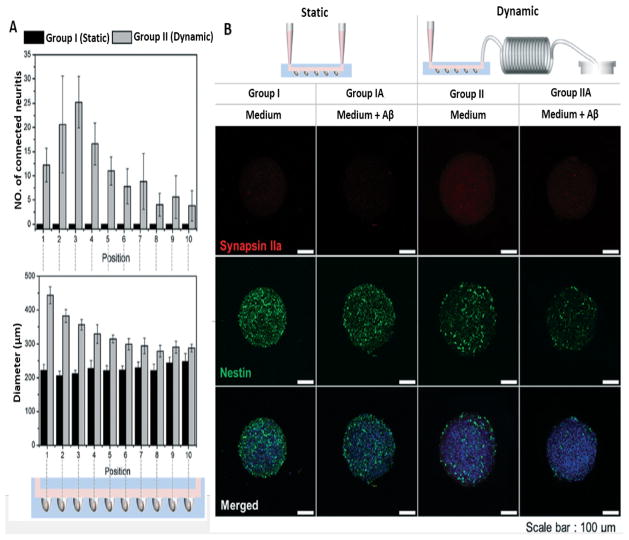
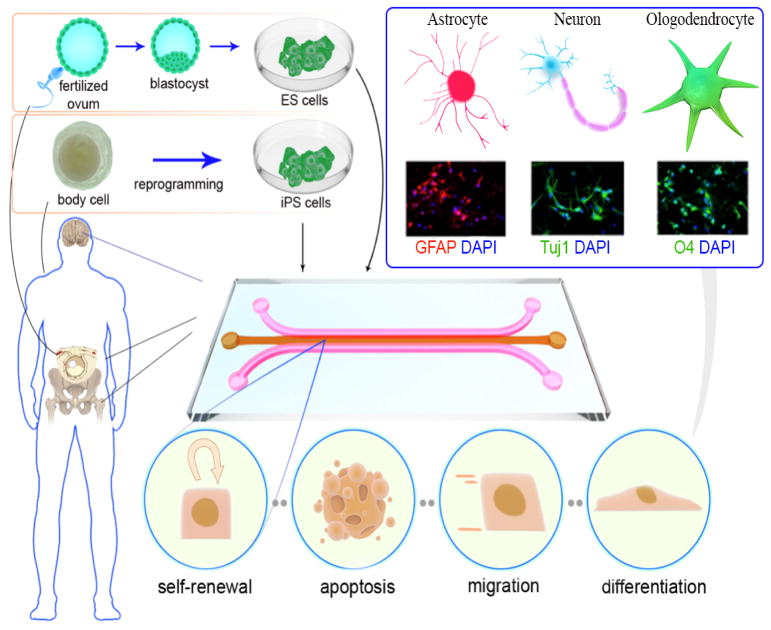
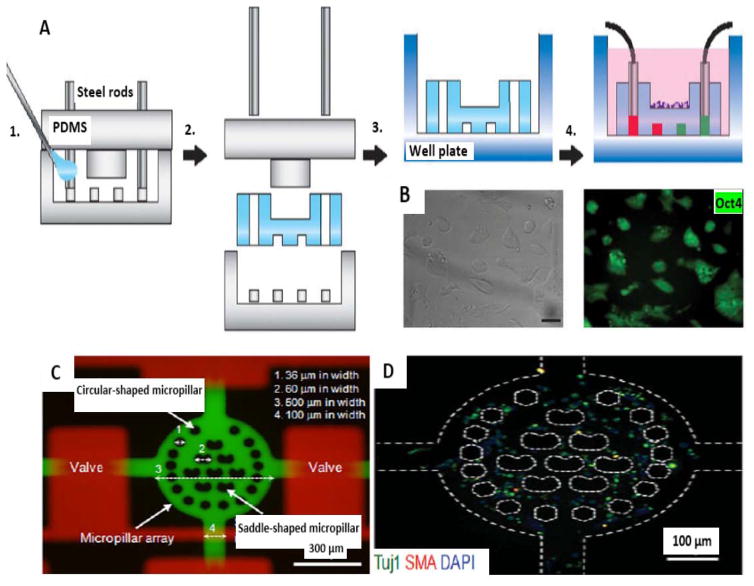
Neural tissue engineering aims at developing novel approaches for the treatment of diseases of the nervous system, by providing a permissive environment for the growth and differentiation of neural cells. Three-dimensional (3D) cell culture systems provide a closer biomimetic environment, and promote better cell differentiation and improved cell function, than could be achieved by conventional two-dimensional (2D) culture systems. With the recent advances in the discovery and introduction of different types of stem cells for tissue engineering, microfluidic platforms have provided an improved microenvironment for the 3D-culture of stem cells. Microfluidic systems can provide more precise control over the spatiotemporal distribution of chemical and physical cues at the cellular level compared to traditional systems. Various microsystems have been designed and fabricated for the purpose of neural tissue engineering. Enhanced neural migration and differentiation, and monitoring of these processes, as well as understanding the behavior of stem cells and their microenvironment have been obtained through application of different microfluidic-based stem cell culture and tissue engineering techniques. As the technology advances it may be possible to construct a "brain-on-a-chip". In this review, we describe the basics of stem cells and tissue engineering as well as microfluidics-based tissue engineering approaches. We review recent testing of various microfluidic approaches for stem cell-based neural tissue engineering.
神经组织工程旨在通过为神经细胞的生长和分化提供一个许可的环境,开发治疗神经系统疾病的新方法。三维(3D)细胞培养系统提供了更接近仿生的环境,并促进了更好的细胞分化和改善的细胞功能,这是传统的二维(2D)培养系统无法实现的。随着最近在组织工程中发现和引入不同类型的干细胞的进展,微流控平台为干细胞的 3D 培养提供了一个改进的微环境。与传统系统相比,微流控系统可以在细胞水平上更精确地控制化学和物理线索的时空分布。已经设计和制造了各种微系统,用于神经组织工程。通过应用不同的基于微流控的干细胞培养和组织工程技术,可以增强神经迁移和分化,并监测这些过程,以及了解干细胞及其微环境的行为。随着技术的进步,构建“芯片上的大脑”可能成为可能。在这篇综述中,我们描述了干细胞和组织工程以及基于微流控的组织工程方法的基础知识。我们回顾了最近对各种基于微流控的干细胞神经组织工程方法的测试。