Inaba Yasushi, Abe Reika, Geshi Masaya, Matoba Satoko, Nagai Takashi, Somfai Tamás
Animal Breeding and Reproduction Research Division, NARO Institute of Livestock and Grassland Science, Ibaraki 305-0901, Japan.
J Reprod Dev. 2016 Oct 18;62(5):451-456. doi: 10.1262/jrd.2016-032. Epub 2016 Jun 10.
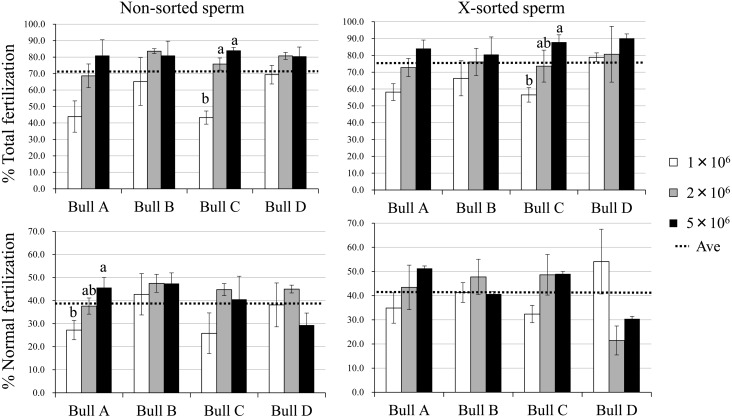
The aim of the present study was to clarify if flow-cytometric sex-sorting of bovine sperm affected in vitro blastocyst production in different bulls, either in terms of its ability to fertilize the oocyte or by interfering with post-fertilization embryo development. We performed in vitro fertilization (IVF) using both commercially available frozen-thawed X-sorted and non-sorted sperm of 4 Holstein bulls at 3 concentrations (1 × 10, 2 × 10, and 5 × 10 sperm/ml). When fertilization rates were compared, a variation in fertilization rates among different sperm concentrations was detected in 2 bulls, with similar results for X-sorted and non-sorted sperm. However, we found no evidence that the fertilization rates were affected by the sorting process. To investigate effects on embryo development, we determined the optimum sperm concentration for IVF in each bull, which resulted in similar fertilization rates among bulls. We next performed IVF using both X-sorted and non-sorted sperm of the 4 bulls at their optimum sperm concentration and compared in vitro embryo development. Cleavage rates with X-sorted sperm were similar to their non-sorted counterparts. However, significantly reduced blastocyst development was associated with the use of X-sorted sperm in one bull, whereas in the other three bulls, blastocyst development after IVF with X-sorted and non-sorted sperm was similar. In conclusion, in our system, X-sorting affects in vitro blastocyst production by reducing the developmental competence of fertilized oocytes rather than affecting the fertilization ability of the sperm. However, the occurrence of this phenomenon varies among bulls.
本研究的目的是阐明牛精子的流式细胞仪性别分选是否会影响不同公牛的体外囊胚生产,无论是在使卵母细胞受精的能力方面,还是通过干扰受精后的胚胎发育。我们使用4头荷斯坦公牛市售的冷冻解冻X分选精子和未分选精子,以3种浓度(1×10、2×10和5×10精子/毫升)进行体外受精(IVF)。比较受精率时,在2头公牛中检测到不同精子浓度之间受精率存在差异,X分选精子和未分选精子的结果相似。然而,我们没有发现受精率受分选过程影响的证据。为了研究对胚胎发育的影响,我们确定了每头公牛IVF的最佳精子浓度,这导致公牛之间的受精率相似。接下来,我们使用4头公牛的X分选精子和未分选精子在其最佳精子浓度下进行IVF,并比较体外胚胎发育。X分选精子的卵裂率与其未分选的对应物相似。然而,在一头公牛中,使用X分选精子与显著降低的囊胚发育相关,而在其他三头公牛中,X分选精子和未分选精子IVF后的囊胚发育相似。总之,在我们的系统中,X分选通过降低受精卵母细胞的发育能力而不是影响精子的受精能力来影响体外囊胚生产。然而,这种现象的发生在公牛之间有所不同。