Aponte Maria, Blaiotta Giuseppe
Sezione di "Microbiologia", Dipartimento di Agraria, Università degli Studi di Napoli Federico II Napoli, Italy.
Sezione di "Scienze della Vigna e del Vino", Dipartimento di Agraria, Università degli Studi di Napoli Federico II Avellino, Italy.
Front Microbiol. 2016 May 27;7:809. doi: 10.3389/fmicb.2016.00809. eCollection 2016.
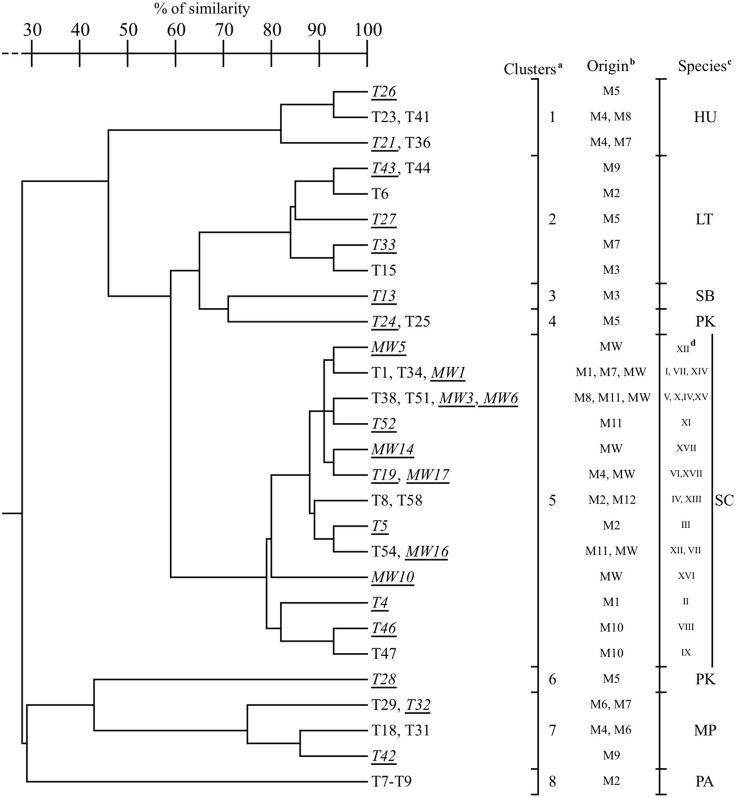
Twelve samples of Aglianico grapes, collected in different locations of the Taurasi DOCG (Appellation of Controlled and Guaranteed Origin) production area were naturally fermented in sterile containers at room temperature. A total of 70 yeast cultures were isolated from countable WL agar plates: 52 in the middle of the fermentation and 18 at the end. On the basis of ITS-RFLP analysis and ITS sequencing, all cultures collected at the end of fermentations were identified as Saccharomyces (S.) cerevisiae; while, the 52 isolates, collected after 1 week, could be referred to the following species: Metschnikowia (M.) pulcherrima; Starmerella (Star.) bacillaris; Pichia (P.) kudriavzevii; Lachancea (L.) thermotolerans; Hanseniaspora (H.) uvarum; Pseudozyma (Pseud.) aphidis; S. cerevisiae. By means of Interdelta analysis, 18 different biotypes of S. cerevisiae were retrieved. All strains were characterized for ethanol production, SO2 resistance, H2S development, β-glucosidasic, esterasic and antagonistic activities. Fermentation abilities of selected strains were evaluated in micro-fermentations on Aglianico must. Within non-Saccharomyces species, some cultures showed features of technological interest. Antagonistic activity was expressed by some strains of M. pulcherrima, L. thermotolerans, P. kudriavzevii, and S. cerevisiae. Strains of M. pulcherrima showed the highest β-glucosidase activity and proved to be able to produce high concentrations of succinic acid. L. thermotolerans produced both succinic and lactic acids. The lowest amount of acetic acid was produced by M. pulcherrima and L. thermotolerans; while the highest content was recorded for H. uvarum. The strain of Star. bacillaris produced the highest amount of glycerol and was able to metabolize all fructose and malic acid. Strains of M. pulcherrima and H. uvarum showed a low fermentation power (about 4%), while, L. thermotolerans, Star. Bacillaris, and P. kudriavzevii of about 10%. Significant differences were even detected for S. cerevisiae biotypes with respect to H2S production, antagonistic activity and β-glucosidase activity as well as for the production of acetic acid, glycerol and ethanol in micro-vinification experiments.
在陶拉斯法定产区(受控和保证原产地名称)不同地点采集的12个阿格利亚尼科葡萄样品,在无菌容器中于室温下自然发酵。从可计数的WL琼脂平板上共分离出70株酵母培养物:发酵中期52株,末期18株。基于ITS-RFLP分析和ITS测序,发酵末期收集的所有培养物均被鉴定为酿酒酵母;而在1周后收集的52株分离株可归为以下物种:美丽梅奇酵母;巴氏星芒酵母;库德里阿兹威毕赤酵母;嗜热拉赫酵母;葡萄汁有孢汉逊酵母;蚜虫假丝酵母;酿酒酵母。通过Interdelta分析,获得了18种不同的酿酒酵母生物型。对所有菌株的乙醇产量、二氧化硫抗性、硫化氢产生、β-葡萄糖苷酶、酯酶和拮抗活性进行了表征。在阿格利亚尼科葡萄汁的微型发酵中评估了所选菌株的发酵能力。在非酿酒酵母物种中,一些培养物表现出具有技术意义的特征。一些美丽梅奇酵母、嗜热拉赫酵母、库德里阿兹威毕赤酵母和酿酒酵母菌株表现出拮抗活性。美丽梅奇酵母菌株表现出最高的β-葡萄糖苷酶活性,并被证明能够产生高浓度的琥珀酸。嗜热拉赫酵母产生琥珀酸和乳酸。美丽梅奇酵母和嗜热拉赫酵母产生的乙酸量最低;而葡萄汁有孢汉逊酵母的乙酸含量最高。巴氏星芒酵母菌株产生的甘油量最高,并且能够代谢所有的果糖和苹果酸。美丽梅奇酵母和葡萄汁有孢汉逊酵母菌株的发酵能力较低(约4%),而嗜热拉赫酵母、巴氏星芒酵母和库德里阿兹威毕赤酵母约为10%。在微型酿酒实验中,甚至检测到酿酒酵母生物型在硫化氢产生、拮抗活性和β-葡萄糖苷酶活性以及乙酸、甘油和乙醇产量方面存在显著差异。