Kilany Walid H, Safwat Marwa, Mohammed Samy M, Salim Abdullah, Fasina Folorunso Oludayo, Fasanmi Olubunmi G, Shalaby Azhar G, Dauphin Gwenaelle, Hassan Mohammed K, Lubroth Juan, Jobre Yilma M
Reference Laboratory for Veterinary Quality Control on Poultry Production (NLQP), Animal Health Research Institute, P.O. Box, 264, Giza, Egypt.
Food and Agriculture Organization of the United Nations (FAO)-Emergency Center of Transboundary Animal Diseases (ECTAD), P.O. Box, 2223, Giza, Egypt.
PLoS One. 2016 Jun 15;11(6):e0156747. doi: 10.1371/journal.pone.0156747. eCollection 2016.
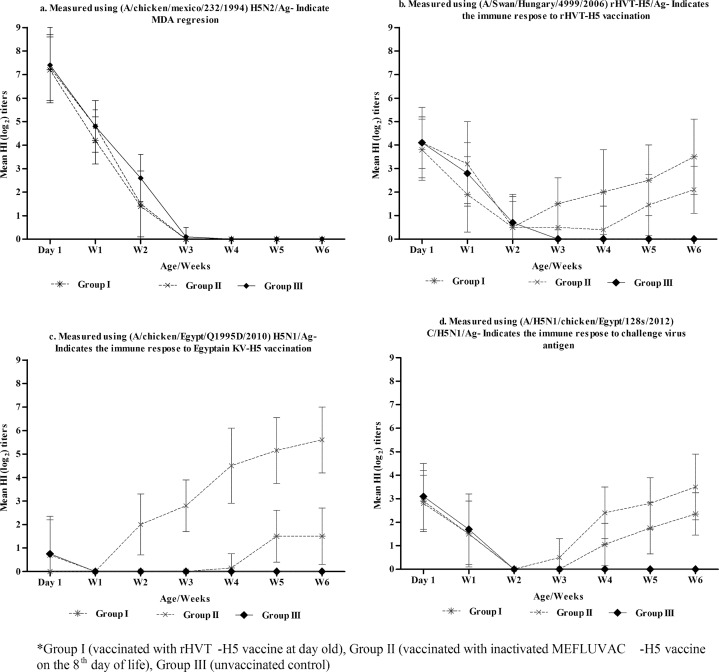
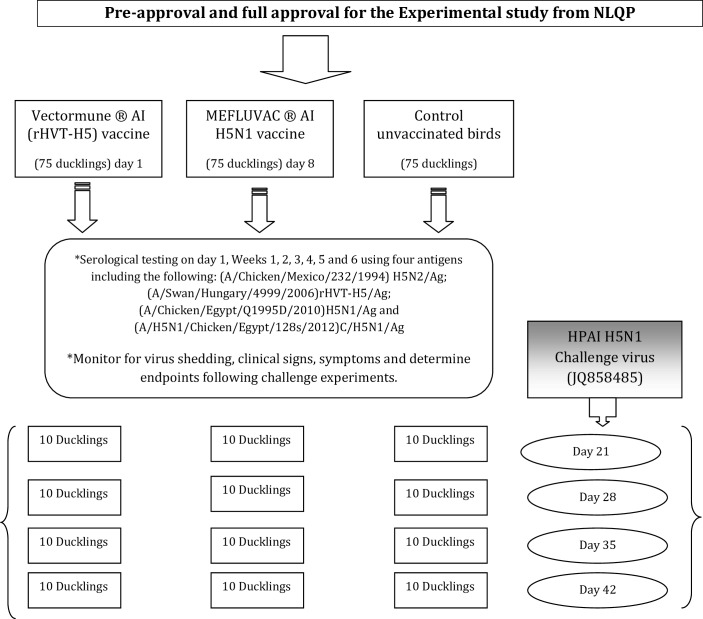
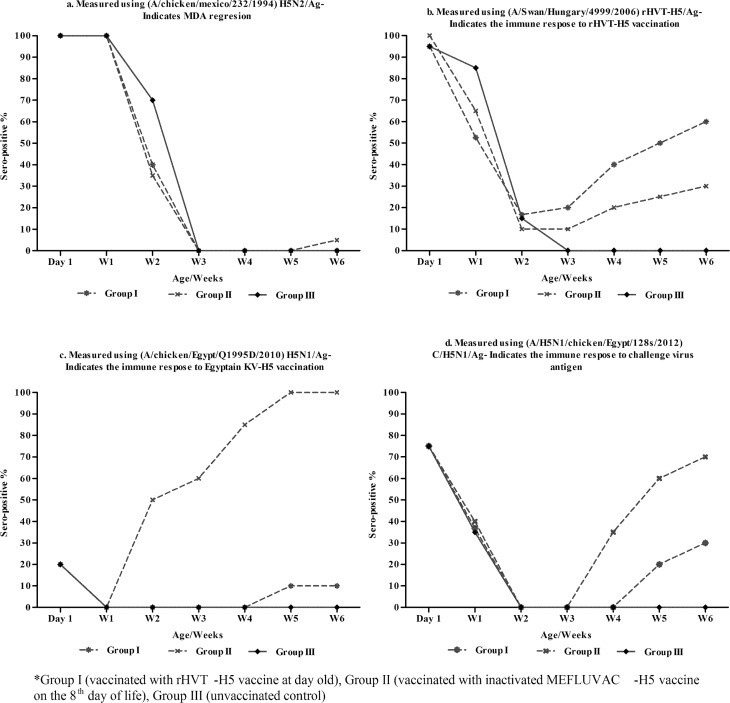
In Egypt, ducks kept for commercial purposes constitute the second highest poultry population, at 150 million ducks/year. Hence, ducks play an important role in the introduction and transmission of avian influenza (AI) in the Egyptian poultry population. Attempts to control outbreaks include the use of vaccines, which have varying levels of efficacy and failure. To date, the effects of vaccine efficacy has rarely been determined in ducks. In this study, we evaluated the protective efficacy of a live recombinant vector vaccine based on a turkey Herpes Virus (HVT) expressing the H5 gene from a clade 2.2 H5N1 HPAIV strain (A/Swan/Hungary/499/2006) (rHVT-H5) and a bivalent inactivated H5N1 vaccine prepared from clade 2.2.1 and 2.2.1.1 H5N1 seeds in Mulard ducks. A 0.3ml/dose subcutaneous injection of rHVT-H5 vaccine was administered to one-day-old ducklings (D1) and another 0.5ml/dose subcutaneous injection of the inactivated MEFLUVAC was administered at 7 days (D7). Four separate challenge experiments were conducted at Days 21, 28, 35 and 42, in which all the vaccinated ducks were challenged with 106EID50/duck of H5N1 HPAI virus (A/chicken/Egypt/128s/2012(H5N1) (clade 2.2.1) via intranasal inoculation. Maternal-derived antibody regression and post-vaccination antibody immune responses were monitored weekly. Ducks vaccinated at 21, 28, 35 and 42 days with the rHVT-H5 and MEFLUVAC vaccines were protected against mortality (80%, 80%, 90% and 90%) and (50%, 70%, 80% and 90%) respectively, against challenges with the H5N1 HPAI virus. The amount of viral shedding and shedding rates were lower in the rHVT-H5 vaccine groups than in the MEFLUVAC groups only in the first two challenge experiments. However, the non-vaccinated groups shed significantly more of the virus than the vaccinated groups. Both rHVT-H5 and MEFLUVAC provide early protection, and rHVT-H5 vaccine in particular provides protection against HPAI challenge.
在埃及,用于商业目的饲养的鸭子数量在禽类中位居第二,每年达1.5亿只。因此,鸭子在埃及家禽群体中禽流感(AI)的传入和传播方面发挥着重要作用。控制疫情爆发的措施包括使用疫苗,但疫苗的效果参差不齐,且存在失败情况。迄今为止,疫苗效力在鸭子身上的效果很少得到确定。在本研究中,我们评估了一种基于火鸡疱疹病毒(HVT)的活重组载体疫苗和一种双价灭活H5N1疫苗在骡鸭中的保护效力。该重组载体疫苗表达来自2.2分支H5N1高致病性禽流感病毒株(A/天鹅/匈牙利/499/2006)的H5基因(rHVT-H5),双价灭活H5N1疫苗由2.2.1和2.2.1.1分支H5N1毒株制备而成。给一日龄雏鸭(D1)皮下注射0.3ml/剂量的rHVT-H5疫苗,在7日龄(D7)时给另一组皮下注射0.5ml/剂量的灭活疫苗MEFLUVAC。在第21、28、35和42天进行了四项独立的攻毒实验,所有接种疫苗的鸭子通过鼻内接种106EID50/只的H5N1高致病性禽流感病毒(A/鸡/埃及/128s/2012(H5N1)(2.2.1分支)进行攻毒。每周监测母源抗体消退情况和接种疫苗后的抗体免疫反应。在第21、28、35和42天接种rHVT-H5和MEFLUVAC疫苗的鸭子分别有80%、80%、90%和90%以及50%、70%、80%和90%免受死亡威胁,并抵抗H5N1高致病性禽流感病毒的攻毒。仅在前两项攻毒实验中,rHVT-H5疫苗组的病毒排泄量和排泄率低于MEFLUVAC组。然而,未接种疫苗的组比接种疫苗的组排出的病毒明显更多。rHVT-H5和MEFLUVAC都能提供早期保护,特别是rHVT-H5疫苗能抵抗高致病性禽流感病毒的攻毒。