Ott Michael, Stegmayr Bernd, Salander Renberg Ellinor, Werneke Ursula
Department of Public Health and Clinical Medicine - Medicine, University Hospital, Umeå, Sweden
Department of Public Health and Clinical Medicine - Medicine, University Hospital, Umeå, Sweden.
J Psychopharmacol. 2016 Oct;30(10):1008-19. doi: 10.1177/0269881116652577. Epub 2016 Jun 14.
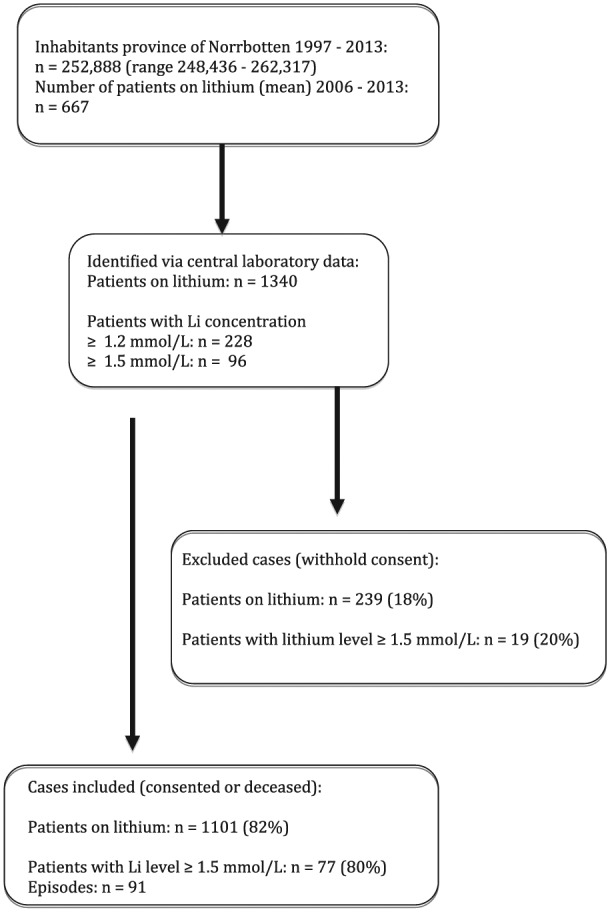
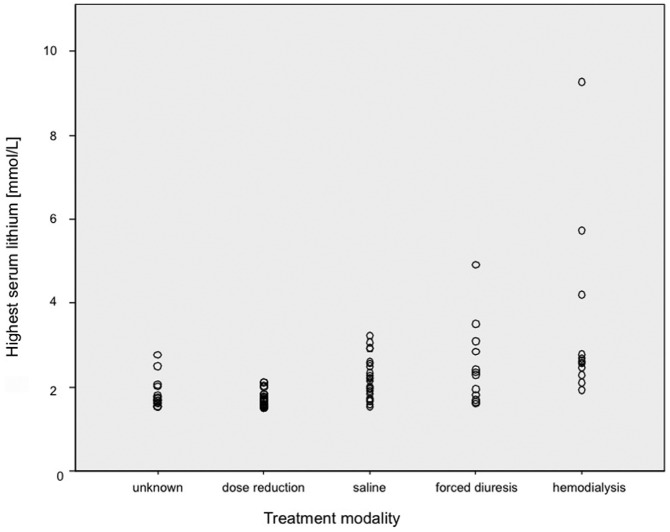
When prescribing lithium, the risk of toxicity remains a concern. In this study, we examined a cohort of patients exposed to lithium between 1997 and 2013. The aims of this study were to determine the frequency of lithium intoxication and to evaluate the clinical course and changes in renal function. Of 1340 patients, 96 had experienced at least one episode of lithium levels ⩾1.5 mmol/L, yielding an incidence of 0.01 per patient-year. Seventy-seven patients available for review had experienced 91 episodes, of whom 34% required intensive care and 13% were treated with haemodialysis. There were no fatalities. Acute kidney injury occurred, but renal function at baseline was not different to renal function after the episode. Renal impairment was often associated with co-morbidities and other factors. Both intermittent and continuous-venovenous haemodialysis were used, but the clearance of continuous-venovenous haemodialysis can be too low in cases where large amounts of lithium have been ingested. Saline and forced diuresis have been used and are safe. Lithium intoxication seems rare and can be safely managed in most cases. Physicians should not withhold lithium for fear of intoxication in patients who benefit from it. Yet, physicians should have a low threshold to screen for toxicity.
在开具锂盐处方时,毒性风险仍然是一个令人担忧的问题。在本研究中,我们调查了1997年至2013年间接触锂盐的一组患者。本研究的目的是确定锂中毒的发生率,并评估临床病程及肾功能变化。在1340例患者中,96例至少经历过一次锂水平≥1.5 mmol/L的情况,患者年发生率为0.01。77例可供复查的患者经历了91次发作,其中34%需要重症监护,13%接受了血液透析治疗。无死亡病例。发生了急性肾损伤,但发作前的肾功能与发作后的肾功能无差异。肾功能损害常与合并症及其他因素有关。间歇性和连续性静脉-静脉血液透析均有使用,但在大量摄入锂的情况下,连续性静脉-静脉血液透析的清除率可能过低。生理盐水和强制利尿已被使用且安全。锂中毒似乎罕见,在大多数情况下可安全处理。对于受益于锂盐的患者,医生不应因担心中毒而停用锂盐。然而,医生应保持较低的阈值以筛查毒性。