Kim Su-A, Kim Jang Young, Park Jeong Bae
Division of Cardiology, Department of Medicine, Cheil General Hospital, Dankook University College of Medicine, Seoul, Republic of Korea Division of Cardiology, Department of Internal Medicine, Yonsei University Wonju College of Medicine, Republic of Korea.
Medicine (Baltimore). 2016 Jun;95(24):e3888. doi: 10.1097/MD.0000000000003888.
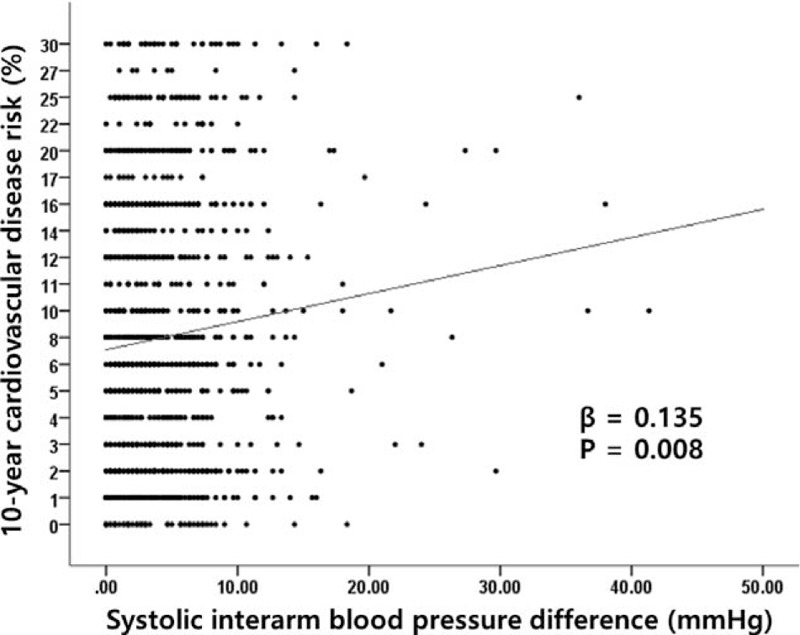
There has been a rising interest in interarm blood pressure difference (IAD), due to its relationship with peripheral arterial disease and its possible relationship with cardiovascular disease. This study aimed to characterize hypertensive patients with a significant IAD in relation to cardiovascular risk. A total of 3699 patients (mean age, 61 ± 11 years) were prospectively enrolled in the study. Blood pressure (BP) was measured simultaneously in both arms 3 times using an automated cuff-oscillometric device. IAD was defined as the absolute difference in averaged BPs between the left and right arm, and an IAD ≥ 10 mm Hg was considered to be significant. The Framingham risk score was used to calculate the 10-year cardiovascular risk. The mean systolic IAD (sIAD) was 4.3 ± 4.1 mm Hg, and 285 (7.7%) patients showed significant sIAD. Patients with significant sIAD showed larger body mass index (P < 0.001), greater systolic BP (P = 0.050), more coronary artery disease (relative risk = 1.356, P = 0.034), and more cerebrovascular disease (relative risk = 1.521, P = 0.072). The mean 10-year cardiovascular risk was 9.3 ± 7.7%. By multiple regression, sIAD was significantly but weakly correlated with the 10-year cardiovascular risk (β = 0.135, P = 0.008). Patients with significant sIAD showed a higher prevalence of coronary artery disease, as well as an increase in 10-year cardiovascular risk. Therefore, accurate measurements of sIAD may serve as a simple and cost-effective tool for predicting cardiovascular risk in clinical settings.
由于臂间血压差异(IAD)与外周动脉疾病相关,且可能与心血管疾病有关,人们对其兴趣日益增加。本研究旨在描述有显著IAD的高血压患者的心血管风险特征。共有3699名患者(平均年龄61±11岁)前瞻性纳入本研究。使用自动袖带示波装置同时测量双臂血压3次。IAD定义为左右臂平均血压的绝对差值,IAD≥10 mmHg被认为有显著差异。采用弗雷明汉风险评分计算10年心血管风险。平均收缩期IAD(sIAD)为4.3±4.1 mmHg,285名(7.7%)患者显示有显著sIAD。有显著sIAD的患者体重指数更大(P<0.001),收缩压更高(P = 0.050),冠心病更多(相对风险 = 1.356,P = 0.034),脑血管疾病更多(相对风险 = 1.521,P = 0.072)。平均10年心血管风险为9.3±7.7%。通过多元回归分析,sIAD与10年心血管风险显著但弱相关(β = 0.135,P = 0.008)。有显著sIAD的患者冠心病患病率更高,10年心血管风险也增加。因此,准确测量sIAD可能是临床环境中预测心血管风险的一种简单且经济有效的工具。