Giam Chou-Zen, Semmes Oliver John
Department of Microbiology and Immunology, Uniformed Services University of the Health Sciences, 4301 Jones Bridge Rd., Bethesda, MD 20814, USA.
Department of Microbiology and Molecular Cell Biology, The Leroy T. Canoles Jr Cancer Research Center, Eastern Virginia Medical School, Norfolk, VA 23501, USA.
Viruses. 2016 Jun 16;8(6):161. doi: 10.3390/v8060161.
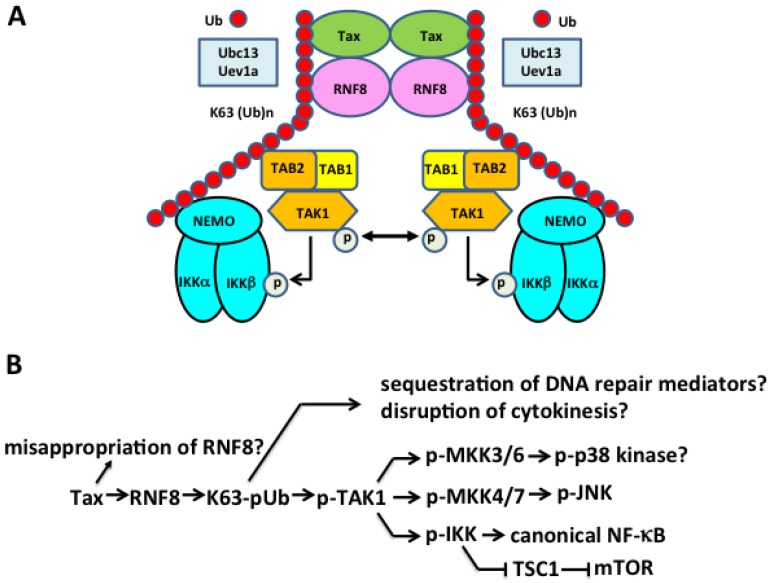
HTLV-1 (Human T-cell lymphotropic virus type 1) is a complex human delta retrovirus that currently infects 10-20 million people worldwide. While HTLV-1 infection is generally asymptomatic, 3%-5% of infected individuals develop a highly malignant and intractable T-cell neoplasm known as adult T-cell leukemia/lymphoma (ATL) decades after infection. How HTLV-1 infection progresses to ATL is not well understood. Two viral regulatory proteins, Tax and HTLV-1 basic zipper protein (HBZ), encoded by the sense and antisense viral transcripts, respectively, are thought to play indispensable roles in the oncogenic process of ATL. This review focuses on the roles of Tax and HBZ in viral replication, persistence, and oncogenesis. Special emphasis is directed towards recent literature on the mechanisms of action of these two proteins and the roles of Tax and HBZ in influencing the outcomes of HTLV-1 infection including senescence induction, viral latency and persistence, genome instability, cell proliferation, and ATL development. Attempts are made to integrate results from cell-based studies of HTLV-1 infection and studies of HTLV-1 proviral integration site preference, clonality, and clonal expansion based on high throughput DNA sequencing. Recent data showing that Tax hijacks key mediators of DNA double-strand break repair signaling-the ubiquitin E3 ligase, ring finger protein 8 (RNF8) and the ubiquitin E2 conjugating enzyme (UBC13)-to activate the canonical nuclear factor kappa-light-chain-enhancer of activated B-cells (NF-κB) and other signaling pathways will be discussed. A perspective on how the Tax-RNF8 signaling axis might impact genomic instability and how Tax may collaborate with HBZ to drive oncogenesis is provided.
人类嗜T淋巴细胞病毒1型(HTLV-1)是一种复杂的人类δ逆转录病毒,目前全球有1000万至2000万人感染该病毒。虽然HTLV-1感染通常没有症状,但3%-5%的感染者在感染数十年后会发展成一种高度恶性且难以治疗的T细胞肿瘤,即成人T细胞白血病/淋巴瘤(ATL)。目前尚不清楚HTLV-1感染如何发展为ATL。由病毒正义和反义转录本分别编码的两种病毒调节蛋白,即Tax和HTLV-1碱性拉链蛋白(HBZ),被认为在ATL的致癌过程中发挥不可或缺的作用。本综述重点关注Tax和HBZ在病毒复制、持续存在和致癌作用中的作用。特别强调了关于这两种蛋白作用机制的最新文献,以及Tax和HBZ在影响HTLV-1感染结果方面的作用,包括衰老诱导、病毒潜伏和持续存在、基因组不稳定、细胞增殖以及ATL的发展。我们试图整合基于细胞的HTLV-1感染研究结果,以及基于高通量DNA测序的HTLV-1前病毒整合位点偏好、克隆性和克隆扩增研究结果。最近的数据表明,Tax劫持DNA双链断裂修复信号的关键介质——泛素E3连接酶、环指蛋白8(RNF8)和泛素E2结合酶(UBC13)——以激活活化B细胞的经典核因子κB轻链增强子(NF-κB)和其他信号通路,将对此进行讨论。本文还提供了关于Tax-RNF8信号轴如何影响基因组不稳定以及Tax如何与HBZ协同驱动致癌作用的观点。