• 文献检索
  • 文档翻译
  • 深度研究
  • 学术资讯
  • Suppr Zotero 插件Zotero 插件
  • 邀请有礼
  • 套餐&价格
  • 历史记录
应用&插件
Suppr Zotero 插件Zotero 插件浏览器插件Mac 客户端Windows 客户端微信小程序
定价
高级版会员购买积分包购买API积分包
服务
文献检索文档翻译深度研究API 文档MCP 服务
关于我们
关于 Suppr公司介绍联系我们用户协议隐私条款
关注我们

Suppr 超能文献

核心技术专利:CN118964589B侵权必究
粤ICP备2023148730 号-1Suppr @ 2026

文献检索

告别复杂PubMed语法,用中文像聊天一样搜索,搜遍4000万医学文献。AI智能推荐,让科研检索更轻松。

立即免费搜索

文件翻译

保留排版,准确专业,支持PDF/Word/PPT等文件格式,支持 12+语言互译。

免费翻译文档

深度研究

AI帮你快速写综述,25分钟生成高质量综述,智能提取关键信息,辅助科研写作。

立即免费体验

肺泡巨噬细胞不参与碳纳米颗粒诱导的小鼠急性肺部炎症的起始过程。

No involvement of alveolar macrophages in the initiation of carbon nanoparticle induced acute lung inflammation in mice.

作者信息

Chen Shanze, Yin Renfu, Mutze Kathrin, Yu Youjia, Takenaka Shinji, Königshoff Melanie, Stoeger Tobias

机构信息

Comprehensive Pneumology Center, Institute of Lung Biology and Disease, Helmholtz Zentrum München, Member of the German Center for Lung Research (DZL), Munich, Germany.

Department of Pathophysiology, West China School of Preclinical Sciences and Forensic Medicine, Sichuan University, Chengdu, 610041, Sichuan Province, People's Republic of China.

出版信息

Part Fibre Toxicol. 2016 Jun 21;13(1):33. doi: 10.1186/s12989-016-0144-6.

DOI:10.1186/s12989-016-0144-6
PMID:27328634
原文链接:https://pmc.ncbi.nlm.nih.gov/articles/PMC4915176/
Abstract

BACKGROUND

Carbonaceous nanoparticles (CNP) represent a major constituent of urban particulate air pollution, and inhalation of high CNP levels has been described to trigger a pro-inflammatory response of the lung. While several studies identified specific particle characteristics driving respiratory toxicity of low-solubility and low-toxicity particles such as CNP, the major lung cell type, which initiates and drives that response, remains still uncertain. Since alveolar macrophages (AM) are known to effectively phagocytose inhaled particles and play a crucial role for the initiation of pulmonary inflammation caused by invading microbes, we aimed to determine their role for sterile stimuli such as CNP by profiling the primary alveolar cell compartments of the lung. We exposed C57BL/6 mice to 20 μg CNP by intratracheal instillation and comprehensively investigated the expression of the underlying mediators during a time span of 3 to 72 h in three different lung cell populations: CD45- (negative) structural cells, CD45+ (positive) leukocytes, and by BAL recovered cells.

RESULTS

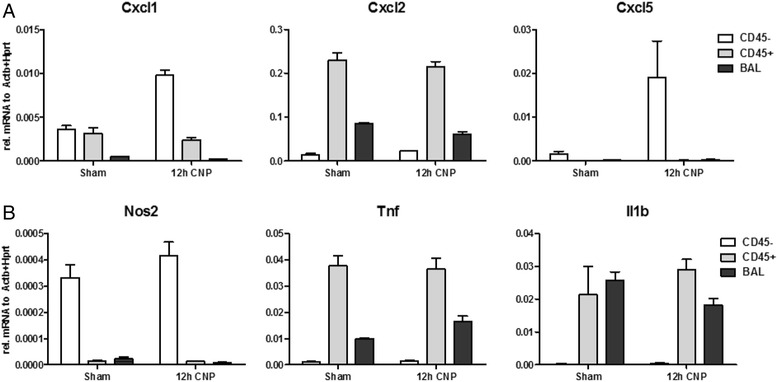
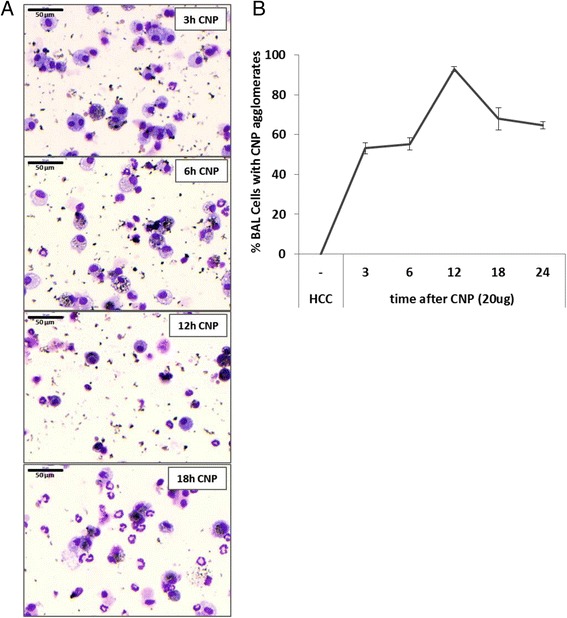
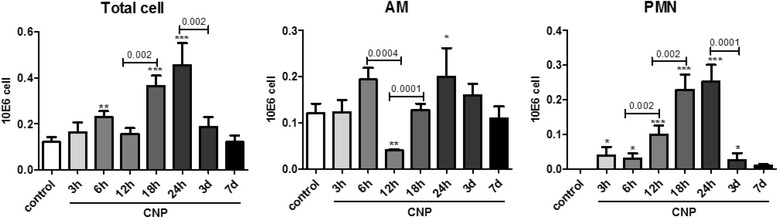
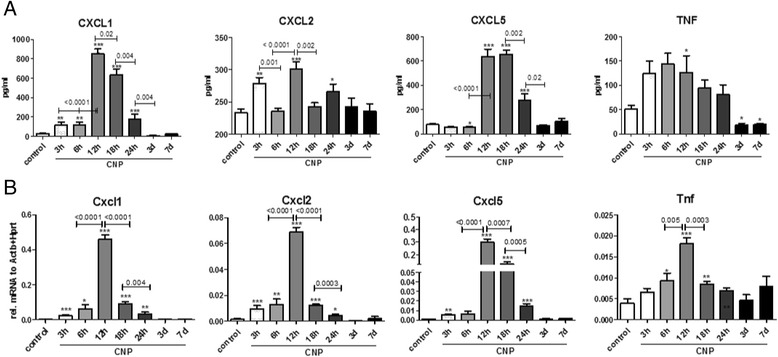
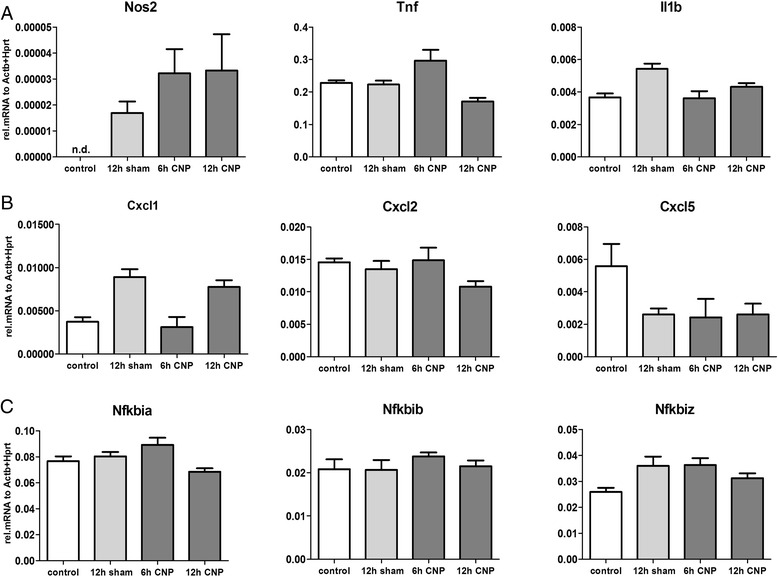
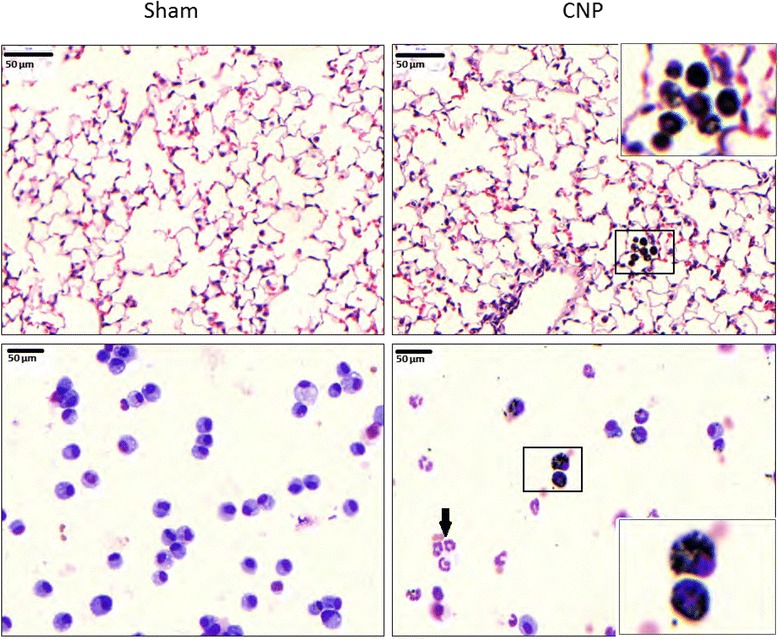
Bronchoalveolar lavage (BAL) analysis revealed an acute inflammatory response characterized by the most prominent culmination of neutrophil granulocytes from 12 to 24 h after instillation, which declined to basal levels by day 7. As early as 3 h after CNP exposure 50 % of the AM revealed particle laden. BAL concentrations and lung gene expression profiles of TNFα, and the neutrophil chemoattractants CXCL1,-2 and-5 preceded the neutrophil recruitment and showed highest levels after 12 h of CNP exposure, pointing to a significant activation of the inflammation-evoking lung cells at this point of time. AM, isolated from lungs 3 to 12 h after CNP instillation, however, did not show a pro-inflammatory signature. On the contrary, gene expression analysis of different lung cell populations isolated 12 h after CNP instillation revealed CD45-, mainly representing alveolar epithelial type II (ATII) cells as major producer of inflammatory CXCL cytokines. Particularly by CD45- cells expressed Cxcl5 proved to be the most abundant chemokine, being 12 h after CNP exposure 24 (±11) fold induced.

CONCLUSION

Our data suggests that AM are noninvolved in the initiation of the inflammatory response. ATII cells, which induced highest CXCL levels early on, might in contrast be the driver of acute neutrophilic inflammation upon pulmonary CNP exposure.

摘要

背景

碳质纳米颗粒(CNP)是城市空气中颗粒物污染的主要成分,吸入高浓度的CNP会引发肺部的促炎反应。虽然多项研究确定了驱动低溶解度和低毒性颗粒(如CNP)产生呼吸毒性的特定颗粒特征,但引发并驱动该反应的主要肺细胞类型仍不明确。由于已知肺泡巨噬细胞(AM)能有效吞噬吸入的颗粒,并在由入侵微生物引起的肺部炎症起始过程中发挥关键作用,我们旨在通过分析肺的主要肺泡细胞区室来确定它们在诸如CNP这种无菌刺激中的作用。我们通过气管内滴注法让C57BL/6小鼠暴露于20μg CNP,并在3至72小时的时间段内,对三种不同肺细胞群体中潜在介质的表达进行了全面研究:CD45-(阴性)结构细胞、CD45+(阳性)白细胞以及通过支气管肺泡灌洗回收的细胞。

结果

支气管肺泡灌洗(BAL)分析显示出一种急性炎症反应,其特征为在滴注后12至24小时中性粒细胞最为显著地聚集,到第7天降至基础水平。早在CNP暴露后3小时,50%的AM就显示有颗粒负载。TNFα以及中性粒细胞趋化因子CXCL1、-2和-5的BAL浓度和肺基因表达谱先于中性粒细胞募集出现,并在CNP暴露12小时后达到最高水平,表明此时引发炎症的肺细胞有显著激活。然而,在CNP滴注后3至12小时从肺中分离出的AM并未显示出促炎特征。相反,在CNP滴注12小时后分离出的不同肺细胞群体的基因表达分析显示,CD45-细胞(主要代表II型肺泡上皮细胞(ATII))是炎症性CXCL细胞因子的主要产生者。特别是由CD45-细胞表达的Cxcl5被证明是最丰富的趋化因子,在CNP暴露12小时后诱导倍数为24(±11)倍。

结论

我们的数据表明,AM不参与炎症反应的起始。相比之下,早期诱导最高CXCL水平的ATII细胞可能是肺部暴露于CNP后急性中性粒细胞炎症的驱动因素。
https://cdn.ncbi.nlm.nih.gov/pmc/blobs/ed6f/4915176/1bf5930054d3/12989_2016_144_Fig6_HTML.jpg
https://cdn.ncbi.nlm.nih.gov/pmc/blobs/ed6f/4915176/29d14b31b6a7/12989_2016_144_Fig1_HTML.jpg
https://cdn.ncbi.nlm.nih.gov/pmc/blobs/ed6f/4915176/0dcce5b114df/12989_2016_144_Fig2_HTML.jpg
https://cdn.ncbi.nlm.nih.gov/pmc/blobs/ed6f/4915176/1110cdda94b3/12989_2016_144_Fig3_HTML.jpg
https://cdn.ncbi.nlm.nih.gov/pmc/blobs/ed6f/4915176/1227c777f108/12989_2016_144_Fig4_HTML.jpg
https://cdn.ncbi.nlm.nih.gov/pmc/blobs/ed6f/4915176/3e9e478d2d78/12989_2016_144_Fig5_HTML.jpg
https://cdn.ncbi.nlm.nih.gov/pmc/blobs/ed6f/4915176/1bf5930054d3/12989_2016_144_Fig6_HTML.jpg
https://cdn.ncbi.nlm.nih.gov/pmc/blobs/ed6f/4915176/29d14b31b6a7/12989_2016_144_Fig1_HTML.jpg
https://cdn.ncbi.nlm.nih.gov/pmc/blobs/ed6f/4915176/0dcce5b114df/12989_2016_144_Fig2_HTML.jpg
https://cdn.ncbi.nlm.nih.gov/pmc/blobs/ed6f/4915176/1110cdda94b3/12989_2016_144_Fig3_HTML.jpg
https://cdn.ncbi.nlm.nih.gov/pmc/blobs/ed6f/4915176/1227c777f108/12989_2016_144_Fig4_HTML.jpg
https://cdn.ncbi.nlm.nih.gov/pmc/blobs/ed6f/4915176/3e9e478d2d78/12989_2016_144_Fig5_HTML.jpg
https://cdn.ncbi.nlm.nih.gov/pmc/blobs/ed6f/4915176/1bf5930054d3/12989_2016_144_Fig6_HTML.jpg

相似文献

1
No involvement of alveolar macrophages in the initiation of carbon nanoparticle induced acute lung inflammation in mice.肺泡巨噬细胞不参与碳纳米颗粒诱导的小鼠急性肺部炎症的起始过程。
Part Fibre Toxicol. 2016 Jun 21;13(1):33. doi: 10.1186/s12989-016-0144-6.
2
Impaired resolution of inflammatory response in the lungs of JF1/Msf mice following carbon nanoparticle instillation.碳纳米颗粒注入后,JF1/Msf 小鼠肺部炎症反应的解决能力受损。
Respir Res. 2011 Jul 15;12(1):94. doi: 10.1186/1465-9921-12-94.
3
Effects of inhaled nanoparticles on acute lung injury induced by lipopolysaccharide in mice.吸入性纳米颗粒对脂多糖诱导的小鼠急性肺损伤的影响。
Toxicology. 2007 Sep 5;238(2-3):99-110. doi: 10.1016/j.tox.2007.05.022. Epub 2007 Jun 2.
4
Carbon-nanoparticle-triggered acute lung inflammation and its resolution are not altered in PPARγ-defective (P465L) mice.PPARγ 缺陷型(P465L)小鼠中,碳纳米颗粒引发的急性肺炎症及其消退未受影响。
Part Fibre Toxicol. 2011 Sep 20;8:28. doi: 10.1186/1743-8977-8-28.
5
Time course of chemotactic factor generation and neutrophil recruitment in the lungs of dust-exposed rats.暴露于粉尘的大鼠肺中趋化因子生成及中性粒细胞募集的时间进程。
Am J Respir Cell Mol Biol. 1996 Aug;15(2):268-74. doi: 10.1165/ajrcmb.15.2.8703484.
6
Effects of particle exposure and particle-elicited inflammatory cells on mutation in rat alveolar epithelial cells.颗粒物暴露及颗粒物引发的炎症细胞对大鼠肺泡上皮细胞突变的影响。
Carcinogenesis. 1997 Feb;18(2):423-30. doi: 10.1093/carcin/18.2.423.
7
Assessing toxicity of fine and nanoparticles: comparing in vitro measurements to in vivo pulmonary toxicity profiles.评估细颗粒和纳米颗粒的毒性:将体外测量结果与体内肺部毒性概况进行比较。
Toxicol Sci. 2007 May;97(1):163-80. doi: 10.1093/toxsci/kfm018. Epub 2007 Feb 14.
8
Comparison of particle-exposure triggered pulmonary and systemic inflammation in mice fed with three different diets.三种不同饮食喂养的小鼠中,颗粒暴露引发的肺部和全身炎症的比较。
Part Fibre Toxicol. 2011 Sep 27;8:30. doi: 10.1186/1743-8977-8-30.
9
Inhalation toxicity assessment of carbon-based nanoparticles.碳基纳米粒子吸入毒性评估。
Acc Chem Res. 2013 Mar 19;46(3):770-81. doi: 10.1021/ar200311b. Epub 2012 May 11.
10
The alarmin IL-1α is a master cytokine in acute lung inflammation induced by silica micro- and nanoparticles.警报素白细胞介素-1α是由二氧化硅微米和纳米颗粒诱导的急性肺部炎症中的主要细胞因子。
Part Fibre Toxicol. 2014 Dec 13;11:69. doi: 10.1186/s12989-014-0069-x.

引用本文的文献

1
LungVis 1.0: an automatic AI-powered 3D imaging ecosystem unveils spatial profiling of nanoparticle delivery and acinar migration of lung macrophages.LungVis 1.0:一个自动的人工智能驱动的 3D 成像生态系统,揭示了纳米颗粒传递的空间分布和肺巨噬细胞的肺泡迁移。
Nat Commun. 2024 Nov 27;15(1):10138. doi: 10.1038/s41467-024-54267-1.
2
Carbon-based Nanomaterials in Photothermal Therapy Guided by Photoacoustic Imaging: State of Knowledge and Recent Advances.光声成像引导下的光热疗法中的碳基纳米材料:知识现状与最新进展
Curr Med Chem. 2025;32(2):238-257. doi: 10.2174/0109298673287448240311112523.
3
Nanoparticle-Exposure-Triggered Virus Reactivation Induces Lung Emphysema in Mice.

本文引用的文献

1
The role of tissue resident cells in neutrophil recruitment.组织驻留细胞在中性粒细胞募集中的作用。
Trends Immunol. 2015 Sep;36(9):547-55. doi: 10.1016/j.it.2015.07.007. Epub 2015 Aug 18.
2
Enolase 1 (ENO1) and protein disulfide-isomerase associated 3 (PDIA3) regulate Wnt/β-catenin-driven trans-differentiation of murine alveolar epithelial cells.烯醇化酶1(ENO1)和蛋白二硫键异构酶相关蛋白3(PDIA3)调节Wnt/β-连环蛋白驱动的小鼠肺泡上皮细胞转分化。
Dis Model Mech. 2015 Aug 1;8(8):877-90. doi: 10.1242/dmm.019117. Epub 2015 May 14.
3
The alarmin IL-1α is a master cytokine in acute lung inflammation induced by silica micro- and nanoparticles.
纳米颗粒暴露触发病毒激活导致小鼠肺气肿。
ACS Nano. 2023 Nov 14;17(21):21056-21072. doi: 10.1021/acsnano.3c04111. Epub 2023 Oct 19.
4
Determinants and mechanisms of inorganic nanoparticle translocation across mammalian biological barriers.无机纳米颗粒穿过哺乳动物生物屏障的决定因素和机制。
Arch Toxicol. 2023 Aug;97(8):2111-2131. doi: 10.1007/s00204-023-03528-x. Epub 2023 Jun 12.
5
Editorial: Exploring impacts of combined exposures to particles and chemicals on immune reactions across living organisms.社论:探索颗粒物与化学物质联合暴露对整个生物界免疫反应的影响。
Front Toxicol. 2023 Mar 6;5:1148374. doi: 10.3389/ftox.2023.1148374. eCollection 2023.
6
Lung Organoids for Hazard Assessment of Nanomaterials.用于纳米材料危害评估的肺类器官。
Int J Mol Sci. 2022 Dec 10;23(24):15666. doi: 10.3390/ijms232415666.
7
Systematic review of preclinical studies on the neutrophil-mediated immune response to air pollutants, 1980-2020.1980 - 2020年关于中性粒细胞介导的对空气污染物免疫反应的临床前研究的系统评价
Heliyon. 2022 Jan 25;8(1):e08778. doi: 10.1016/j.heliyon.2022.e08778. eCollection 2022 Jan.
8
Nanomaterial- and shape-dependency of TLR2 and TLR4 mediated signaling following pulmonary exposure to carbonaceous nanomaterials in mice.纳米材料和形状依赖性 TLR2 和 TLR4 介导的信号转导,在小鼠肺部暴露于碳纳米材料后。
Part Fibre Toxicol. 2021 Oct 30;18(1):40. doi: 10.1186/s12989-021-00432-z.
9
In vitro-in vivo correlations of pulmonary inflammogenicity and genotoxicity of MWCNT.MWCNT 的肺部炎症和遗传毒性的体外-体内相关性
Part Fibre Toxicol. 2021 Jul 23;18(1):25. doi: 10.1186/s12989-021-00413-2.
10
Interactions of nasal epithelium with macrophages and dendritic cells variously alter urban PM-induced inflammation in healthy, asthma and COPD.鼻腔上皮与巨噬细胞和树突状细胞的相互作用可改变健康人群、哮喘和 COPD 患者对城市 PM 诱导的炎症反应。
Sci Rep. 2021 Jun 24;11(1):13259. doi: 10.1038/s41598-021-92626-w.
警报素白细胞介素-1α是由二氧化硅微米和纳米颗粒诱导的急性肺部炎症中的主要细胞因子。
Part Fibre Toxicol. 2014 Dec 13;11:69. doi: 10.1186/s12989-014-0069-x.
4
Ultrafine carbon particle mediated cardiovascular impairment of aged spontaneously hypertensive rats.超细碳颗粒介导的老年自发性高血压大鼠心血管损伤
Part Fibre Toxicol. 2014 Sep 17;11:36. doi: 10.1186/s12989-014-0036-6.
5
Critical determinants of uptake and translocation of nanoparticles by the human pulmonary alveolar epithelium.人肺泡上皮细胞对纳米颗粒摄取和转运的关键决定因素。
ACS Nano. 2014 Nov 25;8(11):11778-89. doi: 10.1021/nn505399e. Epub 2014 Nov 4.
6
Cigarette smoke extract affects mitochondrial function in alveolar epithelial cells.香烟烟雾提取物影响肺泡上皮细胞的线粒体功能。
Am J Physiol Lung Cell Mol Physiol. 2014 Dec 1;307(11):L895-907. doi: 10.1152/ajplung.00180.2014. Epub 2014 Oct 17.
7
Effects of ultrafine particles on the allergic inflammation in the lung of asthmatics: results of a double-blinded randomized cross-over clinical pilot study.超细颗粒对哮喘患者肺部过敏性炎症的影响:一项双盲随机交叉临床试点研究的结果
Part Fibre Toxicol. 2014 Sep 10;11:39. doi: 10.1186/s12989-014-0039-3.
8
Biokinetics of nanoparticles and susceptibility to particulate exposure in a murine model of cystic fibrosis.纳米颗粒的生物动力学及囊性纤维化小鼠模型中对颗粒物暴露的易感性
Part Fibre Toxicol. 2014 Apr 24;11:19. doi: 10.1186/1743-8977-11-19.
9
CXCL5-secreting pulmonary epithelial cells drive destructive neutrophilic inflammation in tuberculosis.分泌 CXCL5 的肺上皮细胞在结核病中驱动破坏性中性粒细胞炎症。
J Clin Invest. 2014 Mar;124(3):1268-82. doi: 10.1172/JCI72030. Epub 2014 Feb 10.
10
Diverse macrophage populations mediate acute lung inflammation and resolution.多种巨噬细胞群体介导急性肺炎症和消退。
Am J Physiol Lung Cell Mol Physiol. 2014 Apr 15;306(8):L709-25. doi: 10.1152/ajplung.00341.2013. Epub 2014 Feb 7.