García-Álvarez Ana, Pereda Daniel, García-Lunar Inés, Sanz-Rosa David, Fernández-Jiménez Rodrigo, García-Prieto Jaime, Nuño-Ayala Mario, Sierra Federico, Santiago Evelyn, Sandoval Elena, Campelos Paula, Agüero Jaume, Pizarro Gonzalo, Peinado Víctor I, Fernández-Friera Leticia, García-Ruiz José M, Barberá Joan A, Castellá Manuel, Sabaté Manel, Fuster Valentín, Ibañez Borja
Centro Nacional de Investigaciones Cardiovasculares Carlos III (CNIC), Madrid, Spain.
Hospital Clínic, IDIBAPS, Barcelona, Spain.
Basic Res Cardiol. 2016 Jul;111(4):49. doi: 10.1007/s00395-016-0567-0. Epub 2016 Jun 21.
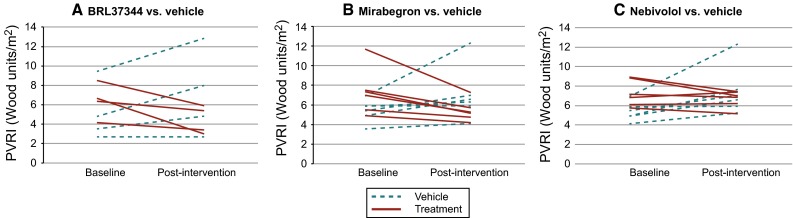
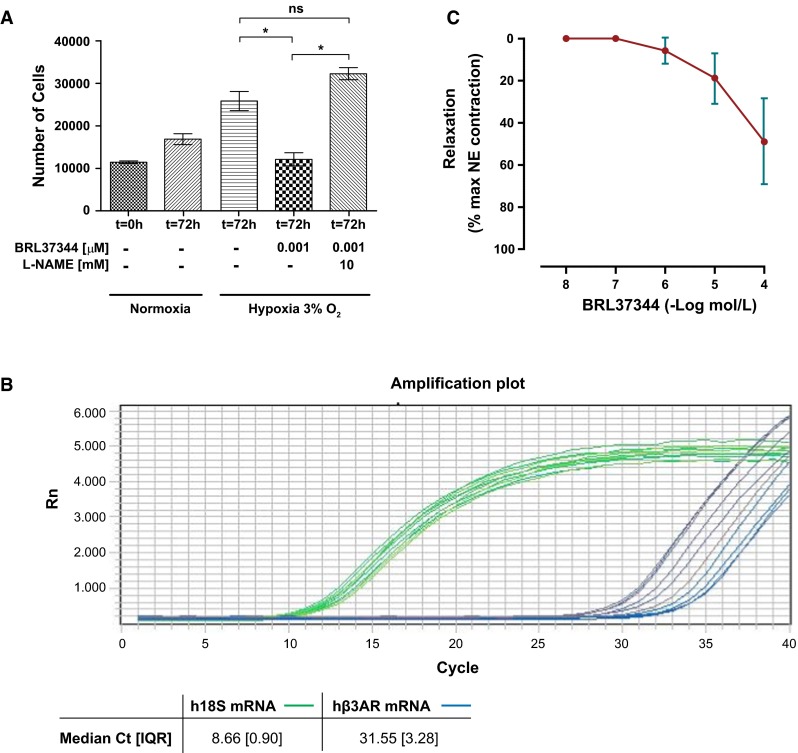
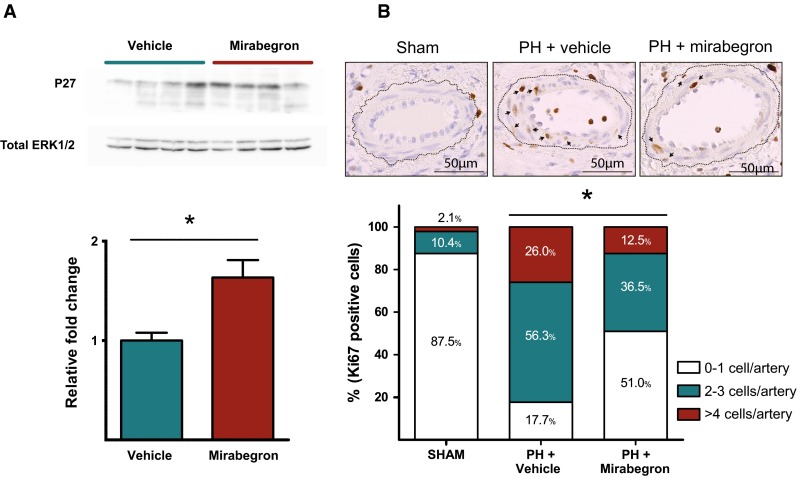
Beta-3 adrenergic receptor (β3AR) agonists have been shown to produce vasodilation and prevention of ventricular remodeling in different conditions. Given that these biological functions are critical in pulmonary hypertension (PH), we aimed to demonstrate a beneficial effect of β3AR agonists in PH. An experimental study in pigs (n = 34) with chronic PH created by pulmonary vein banding was designed to evaluate the acute hemodynamic effect and the long-term effect of β3AR agonists on hemodynamics, vascular remodeling and RV performance in chronic PH. Ex vivo human experiments were performed to explore the expression of β3AR mRNA and the vasodilator response of β3AR agonists in pulmonary arteries. Single intravenous administration of the β3AR agonist BRL37344 produced a significant acute reduction in PVR, and two-weeks treatment with two different β3AR selective agonists, intravenous BRL37344 or oral mirabegron, resulted in a significant reduction in PVR (median of -2.0 Wood units/m(2) for BRL37344 vs. +1.5 for vehicle, p = 0.04; and -1.8 Wood units/m(2) for mirabegron vs. +1.6 for vehicle, p = 0.002) associated with a significant improvement in magnetic resonance-measured RV performance. Histological markers of pulmonary vascular proliferation (p27 and Ki67) were significantly attenuated in β3AR agonists-treated pigs. β3AR was expressed in human pulmonary arteries and β3AR agonists produced vasodilatation. β3AR agonists produced a significant reduction in PVR and improved RV performance in experimental PH, emerging as a potential novel approach for treating patients with chronic PH.
β-3肾上腺素能受体(β3AR)激动剂已被证明在不同情况下可产生血管舒张作用并预防心室重构。鉴于这些生物学功能在肺动脉高压(PH)中至关重要,我们旨在证明β3AR激动剂在PH中的有益作用。设计了一项对通过肺静脉束带造成慢性PH的猪(n = 34)进行的实验研究,以评估β3AR激动剂对慢性PH的急性血流动力学效应以及对血流动力学、血管重构和右心室性能的长期影响。进行了体外人体实验,以探索β3AR mRNA的表达以及β3AR激动剂在肺动脉中的血管舒张反应。单次静脉注射β3AR激动剂BRL37344可使肺血管阻力(PVR)显著急性降低,而用两种不同的β3AR选择性激动剂(静脉注射BRL37344或口服米拉贝隆)进行为期两周的治疗,可使PVR显著降低(BRL37344组中位数为-2.0伍德单位/m²,而对照组为+1.5,p = 0.04;米拉贝隆组为-1.8伍德单位/m²,而对照组为+1.6,p = 0.002),同时磁共振测量的右心室性能有显著改善。在接受β3AR激动剂治疗的猪中,肺血管增殖的组织学标志物(p27和Ki67)显著减弱。β3AR在人肺动脉中表达,且β3AR激动剂可产生血管舒张作用。β3AR激动剂在实验性PH中可使PVR显著降低并改善右心室性能,成为治疗慢性PH患者的一种潜在新方法。