Scaplen Kristin M, Kaun Karla R
a Department of Neuroscience , Brown University , Providence , RI , USA.
J Neurogenet. 2016 Jun;30(2):133-48. doi: 10.1080/01677063.2016.1180385.
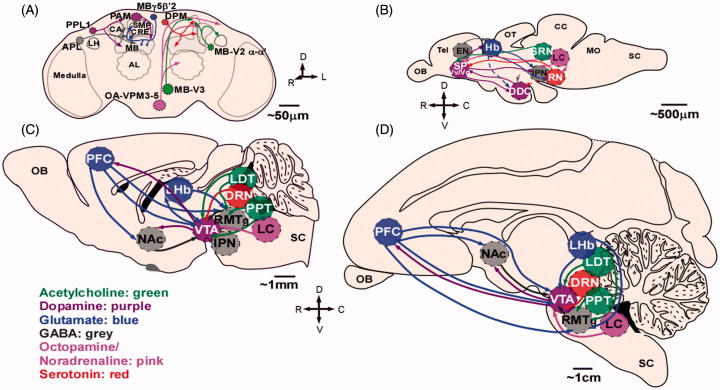
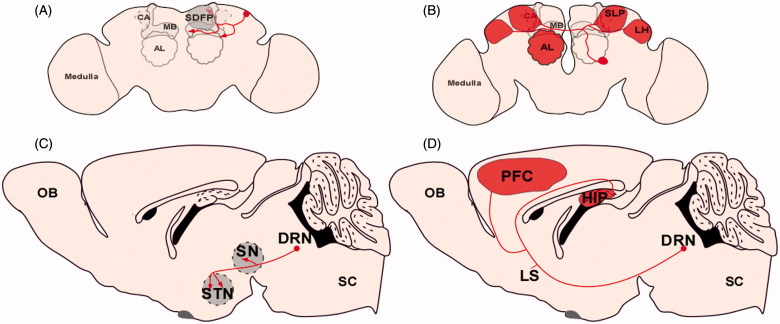
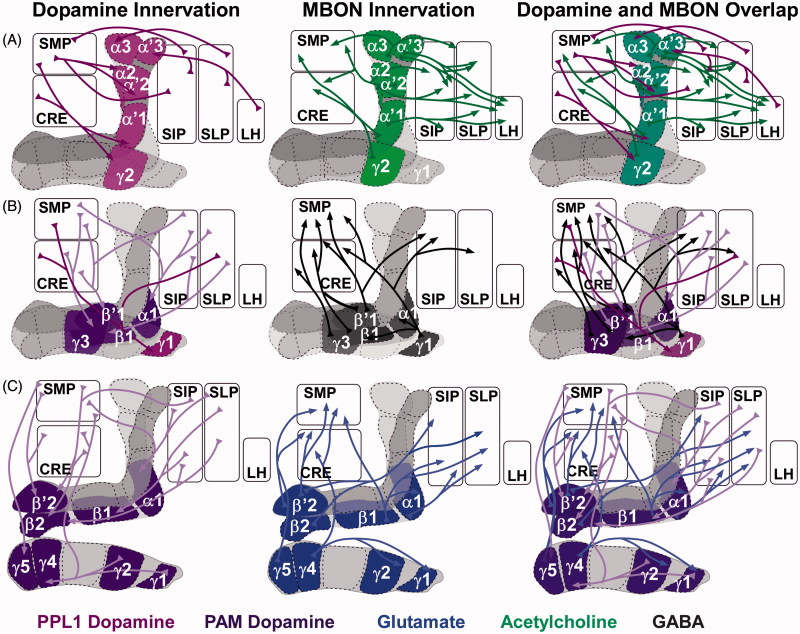
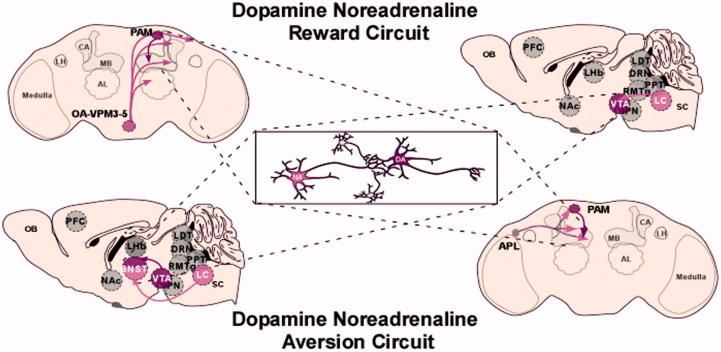
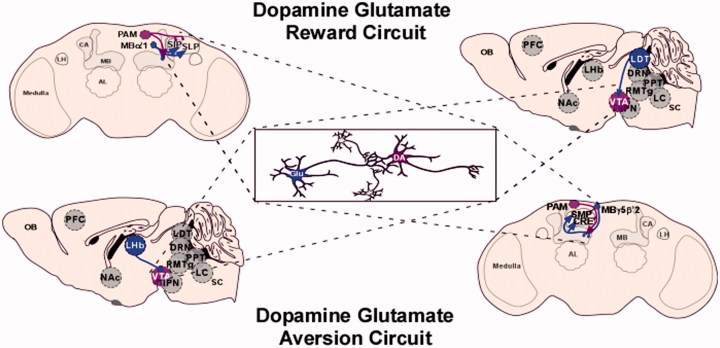
In a complex environment, animals learn from their responses to stimuli and events. Appropriate response to reward and punishment can promote survival, reproduction and increase evolutionary fitness. Interestingly, the neural processes underlying these responses are remarkably similar across phyla. In all species, dopamine is central to encoding reward and directing motivated behaviors, however, a comprehensive understanding of how circuits encode reward and direct motivated behaviors is still lacking. In part, this is a result of the sheer diversity of neurons, the heterogeneity of their responses and the complexity of neural circuits within which they are found. We argue that general features of reward circuitry are common across model organisms, and thus principles learned from invertebrate model organisms can inform research across species. In particular, we discuss circuit motifs that appear to be functionally equivalent from flies to primates. We argue that a comparative approach to studying and understanding reward circuit function provides a more comprehensive understanding of reward circuitry, and informs disorders that affect the brain's reward circuitry.
在复杂环境中,动物从其对刺激和事件的反应中学习。对奖励和惩罚做出适当反应可促进生存、繁殖并提高进化适应性。有趣的是,这些反应背后的神经过程在不同门类中显著相似。在所有物种中,多巴胺对于编码奖励和指导动机行为至关重要,然而,对于神经回路如何编码奖励和指导动机行为仍缺乏全面理解。部分原因在于神经元的极度多样性、其反应的异质性以及它们所处神经回路的复杂性。我们认为奖励回路的一般特征在模式生物中是共有的,因此从无脊椎动物模式生物中学到的原理可为跨物种研究提供参考。特别是,我们讨论了从果蝇到灵长类动物中似乎功能等效的回路基序。我们认为,采用比较方法来研究和理解奖励回路功能能更全面地了解奖励回路,并为影响大脑奖励回路的疾病研究提供参考。