Singapore University of Technology and Design (SUTD), 8 Somapah Road, Singapore 487372, Singapore.
Massachusetts Institute of Technology (MIT), Cambridge, Massachusetts 02139, USA.
Nat Commun. 2016 Jun 22;7:11983. doi: 10.1038/ncomms11983.
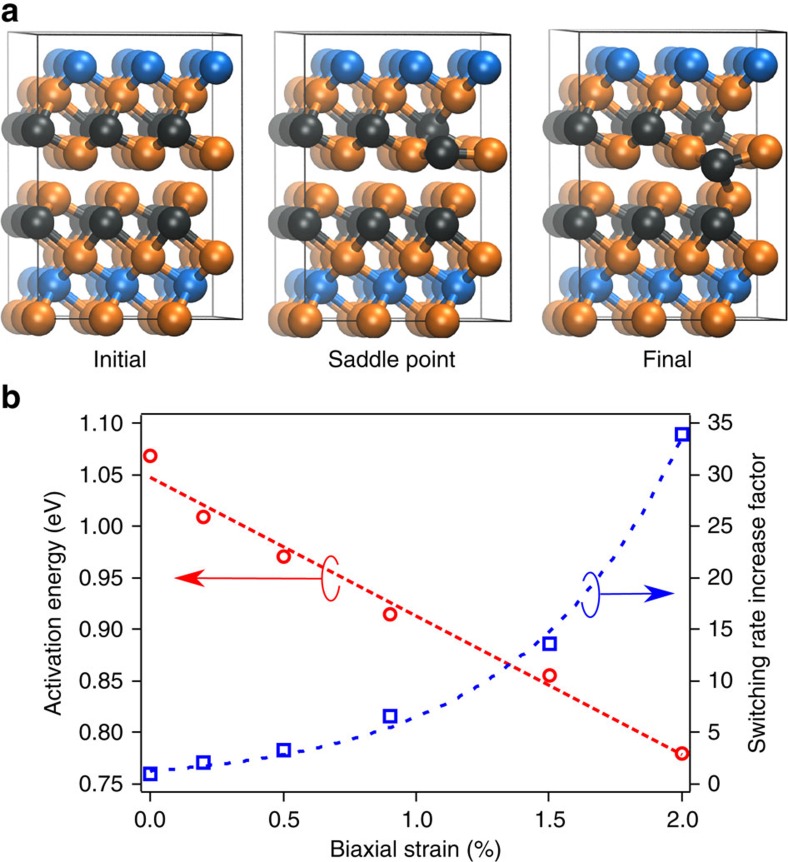
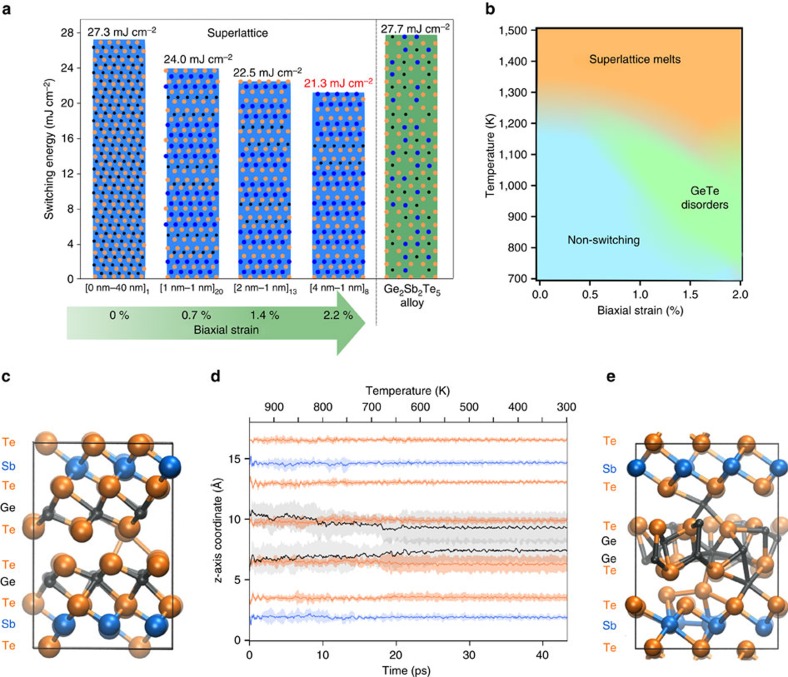
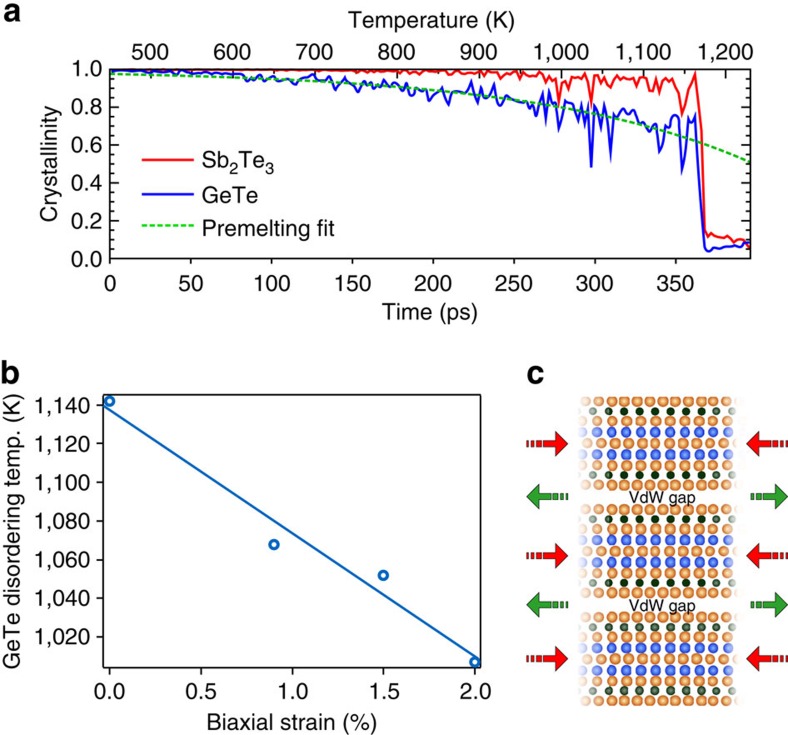
Strain engineering is an emerging route for tuning the bandgap, carrier mobility, chemical reactivity and diffusivity of materials. Here we show how strain can be used to control atomic diffusion in van der Waals heterostructures of two-dimensional (2D) crystals. We use strain to increase the diffusivity of Ge and Te atoms that are confined to 5 Å thick 2D planes within an Sb2Te3-GeTe van der Waals superlattice. The number of quintuple Sb2Te3 2D crystal layers dictates the strain in the GeTe layers and consequently its diffusive atomic disordering. By identifying four critical rules for the superlattice configuration we lay the foundation for a generalizable approach to the design of switchable van der Waals heterostructures. As Sb2Te3-GeTe is a topological insulator, we envision these rules enabling methods to control spin and topological properties of materials in reversible and energy efficient ways.
应变工程是一种新兴的方法,可以调整材料的能带隙、载流子迁移率、化学反应性和扩散率。在这里,我们展示了应变如何用于控制二维(2D)晶体范德华异质结构中的原子扩散。我们利用应变来提高 Ge 和 Te 原子的扩散率,这些原子被限制在 Sb2Te3-GeTe 范德华超晶格中 5Å 厚的 2D 平面内。 quintuple Sb2Te3 2D 晶体层的数量决定了 GeTe 层的应变,从而决定了其扩散原子的无序程度。通过确定超晶格结构的四个关键规则,我们为可切换范德华异质结构的设计奠定了基础。由于 Sb2Te3-GeTe 是拓扑绝缘体,我们设想这些规则能够以可逆和节能的方式控制材料的自旋和拓扑性质的方法。