Meiling Till T, Cywiński Piotr J, Bald Ilko
Physical Chemistry, Institute of Chemistry, University of Potsdam, 14476 Potsdam-Golm, Germany.
Functional Materials and Devices, Fraunhofer Institute for Applied Polymer Research, 14476 Potsdam-Golm, Germany.
Sci Rep. 2016 Jun 23;6:28557. doi: 10.1038/srep28557.
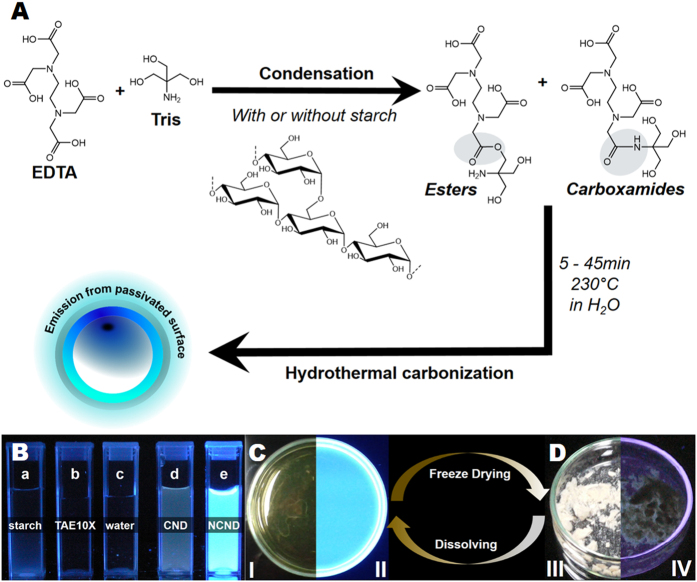
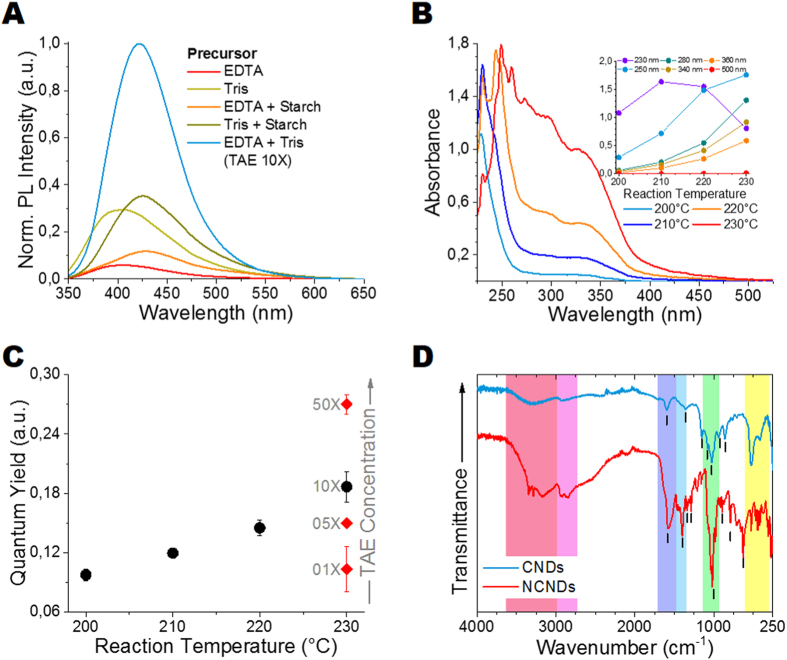
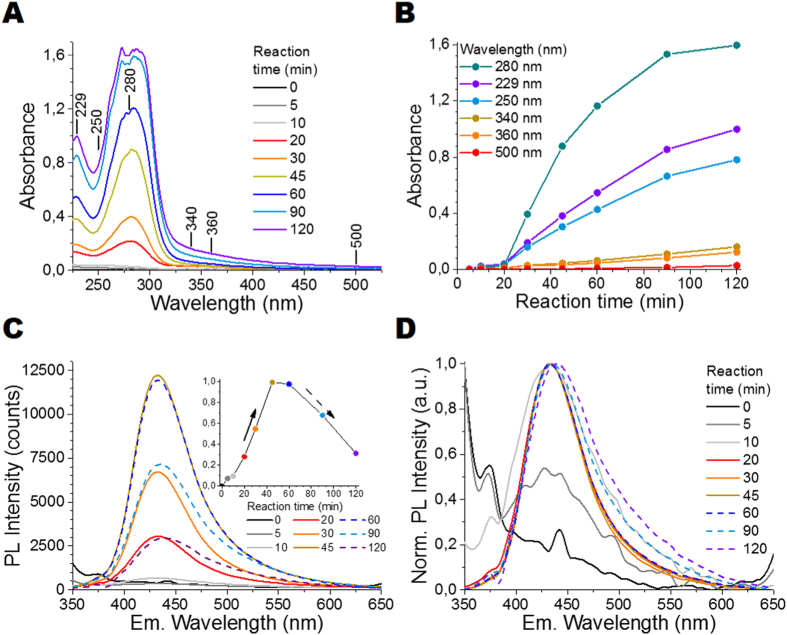
In this study, a new reliable, economic, and environmentally-friendly one-step synthesis is established to obtain carbon nanodots (CNDs) with well-defined and reproducible photoluminescence (PL) properties via the microwave-assisted hydrothermal treatment of starch and Tris-acetate-EDTA (TAE) buffer as carbon sources. Three kinds of CNDs are prepared using different sets of above mentioned starting materials. The as-synthesized CNDs: C-CND (starch only), N-CND 1 (starch in TAE) and N-CND 2 (TAE only) exhibit highly homogenous PL and are ready to use without need for further purification. The CNDs are stable over a long period of time (>1 year) either in solution or as freeze-dried powder. Depending on starting material, CNDs with PL quantum yield (PLQY) ranging from less than 1% up to 28% are obtained. The influence of the precursor concentration, reaction time and type of additives on the optical properties (UV-Vis absorption, PL emission spectrum and PLQY) is carefully investigated, providing insight into the chemical processes that occur during CND formation. Remarkably, upon freeze-drying the initially brown CND-solution turns into a non-fluorescent white/slightly brown powder which recovers PL in aqueous solution and can potentially be applied as fluorescent marker in bio-imaging, as a reduction agent or as a photocatalyst.
在本研究中,建立了一种新的可靠、经济且环保的一步合成法,通过对淀粉和Tris-乙酸-EDTA(TAE)缓冲液作为碳源进行微波辅助水热处理,来获得具有明确且可重现的光致发光(PL)特性的碳纳米点(CND)。使用上述不同起始原料组合制备了三种CND。合成的CND:C-CND(仅淀粉)、N-CND 1(淀粉在TAE中)和N-CND 2(仅TAE)呈现出高度均匀的PL,无需进一步纯化即可使用。这些CND在溶液中或作为冻干粉末在很长一段时间内(>1年)都很稳定。根据起始原料的不同,可获得PL量子产率(PLQY)范围从小于1%到28%的CND。仔细研究了前驱体浓度、反应时间和添加剂类型对光学性质(紫外-可见吸收、PL发射光谱和PLQY)的影响,深入了解了CND形成过程中发生的化学过程。值得注意的是,将最初呈棕色的CND溶液冻干后会变成无荧光的白色/微棕色粉末,该粉末在水溶液中可恢复PL,并且有可能作为生物成像中的荧光标记物、还原剂或光催化剂应用。