Li Wei, Kong Li-Hong, Wang Hui, Shen Feng, Wang Ya-Wen, Zhou Hua, Sun Guo-Jie
Hubei University of Chinese Medicine, Wuhan, Hubei Province, China.
School of Acupuncture Orthopedics, Hubei University of Chinese Medicine, Wuhan, Hubei Province, China.
Neural Regen Res. 2016 May;11(5):801-6. doi: 10.4103/1673-5374.182708.
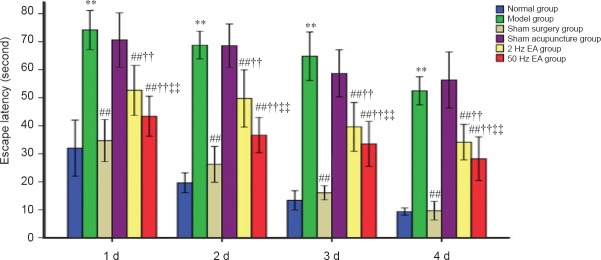
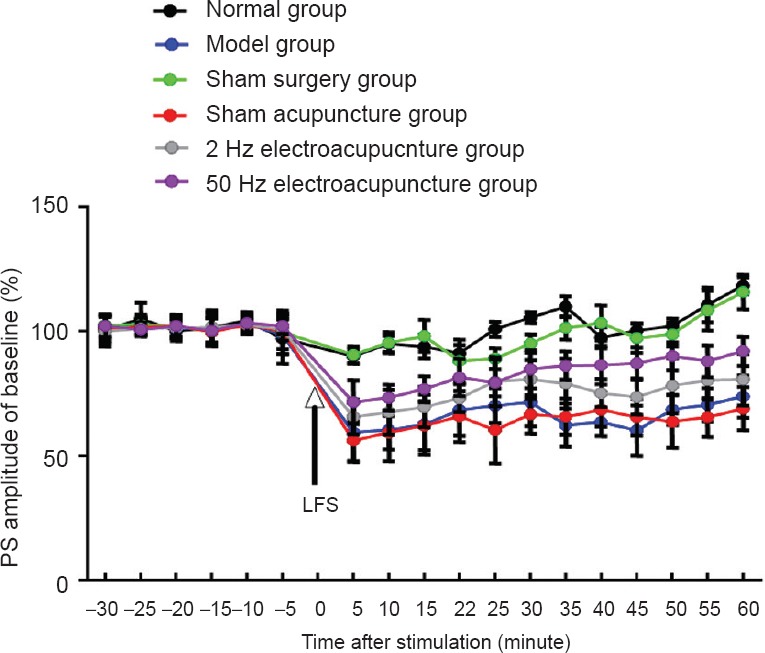
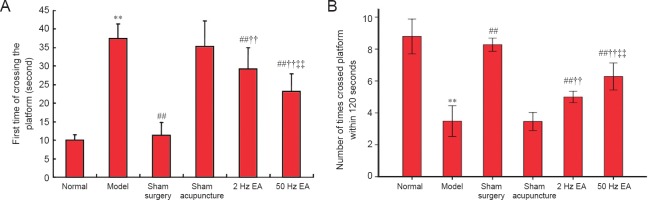
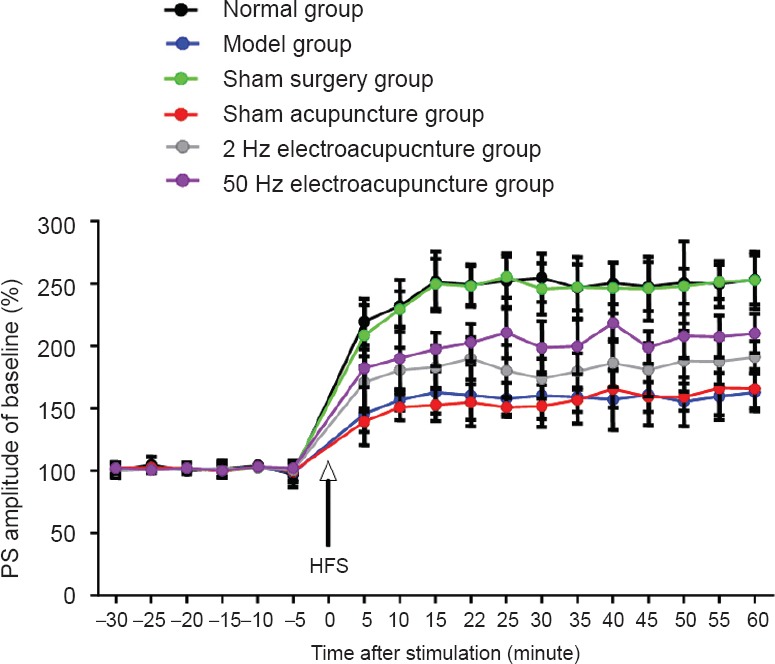
The frequency range of electroacupuncture in treatment of Alzheimer's disease in rats is commonly 2-5 Hz (low frequency) and 50-100 Hz (high frequency). We established a rat model of Alzheimer's disease by injecting β-amyloid 1-42 (Aβ1-42) into the bilateral hippocampal dentate gyrus to verify which frequency may be better suited in treatment. Electroacupuncture at 2 Hz or 50 Hz was used to stimulate Baihui (DU20) and Shenshu (BL23) acupoints. The water maze test and electrophysiological studies demonstrated that spatial memory ability was apparently improved, and the ranges of long-term potentiation and long-term depression were increased in Alzheimer's disease rats after electroacupuncture treatment. Moreover, the effects of electroacupuncture at 50 Hz were better than that at 2 Hz. These findings suggest that high-frequency electroacupuncture may enhance hippocampal synaptic transmission and potentially improve memory disorders in Alzheimer's disease rats.
电针治疗大鼠阿尔茨海默病的频率范围通常为2 - 5赫兹(低频)和50 - 100赫兹(高频)。我们通过向双侧海马齿状回注射β-淀粉样蛋白1 - 42(Aβ1 - 42)建立大鼠阿尔茨海默病模型,以验证哪种频率可能更适合治疗。采用2赫兹或50赫兹的电针刺激百会(DU20)和肾俞(BL23)穴位。水迷宫试验和电生理研究表明,电针治疗后,阿尔茨海默病大鼠的空间记忆能力明显提高,长时程增强和长时程抑制的范围增加。此外,50赫兹电针的效果优于2赫兹电针。这些发现表明,高频电针可能增强海马突触传递,并有可能改善阿尔茨海默病大鼠的记忆障碍。