Unger Kerstin, Ackerman Laura, Chatham Christopher H, Amso Dima, Badre David
Department of Cognitive, Linguistic, & Psychological Sciences, Brown University, United States.
Department of Cognitive, Linguistic, & Psychological Sciences, Brown University, United States.
Cognition. 2016 Oct;155:8-22. doi: 10.1016/j.cognition.2016.05.020. Epub 2016 Jun 20.
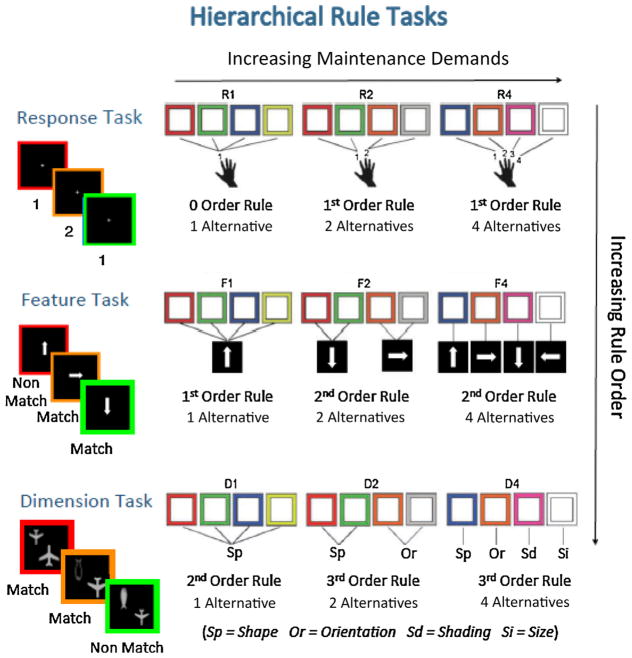
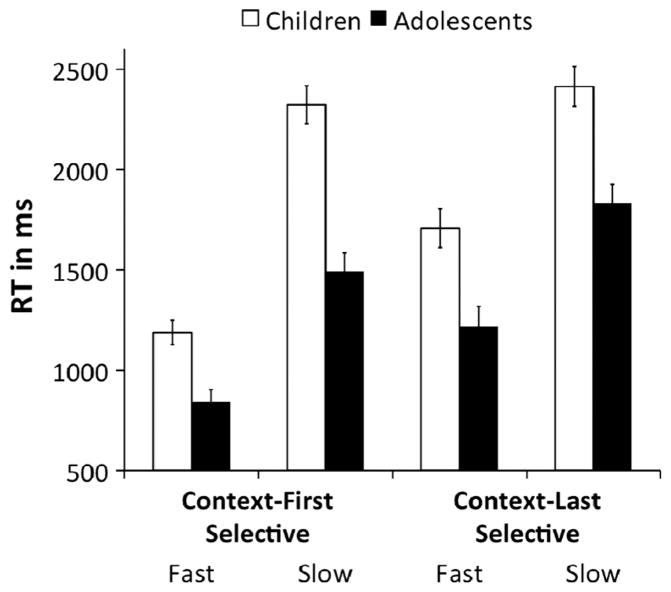
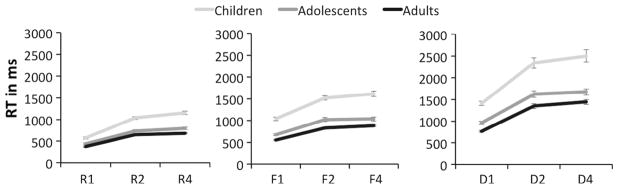
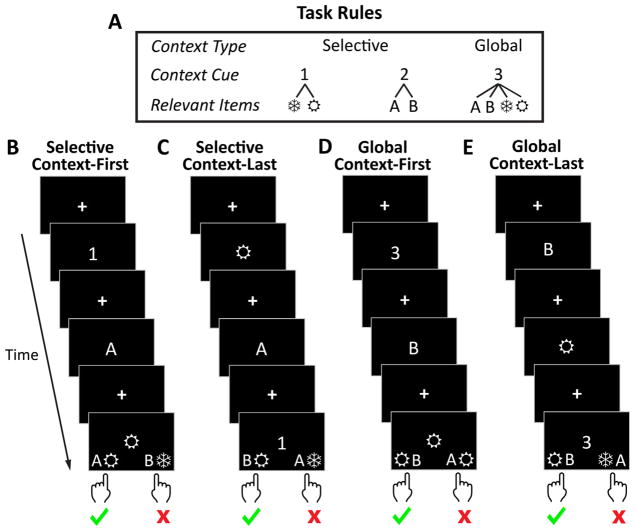
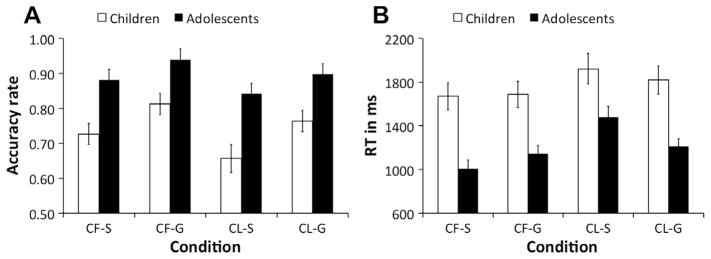
Cognitive control requires choosing contextual information to update into working memory (input gating), maintaining it there (maintenance) stable against distraction, and then choosing which subset of maintained information to use in guiding action (output gating). Recent work has raised the possibility that the development of rule-guided behavior, in the transition from childhood to adolescence, is linked specifically to changes in the gating components of working memory (Amso, Haas, McShane, & Badre, 2014). Given the importance of effective rule-guided behavior for decision making in this developmental transition, we used hierarchical rule tasks to probe the precise developmental dynamics of working memory gating. This mechanistic precision informs ongoing efforts to train cognitive control and working memory operations across typical and atypical development. The results of Experiment 1 verified that the development of rule-guided behavior is uniquely linked to increasing hierarchical complexity but not to increasing maintenance demands across 1st, 2nd, and 3rd order rule tasks. Experiment 2 then investigated whether this developmental trajectory in rule-guided behavior is best explained by change in input gating or output gating. Further, as input versus output gating also tend to correlate with a more proactive versus reactive control strategy in these tasks, we assessed developmental change in the degree to which these two processes were deployed efficiently given the task. Experiment 2 shows that the developmental change observed in Experiment 1 and in Amso et al. (2014) is likely a result of increased efficacy of output gating processes, as well as greater strategic efficiency in that adolescents opt for this costly process less often than children.
认知控制需要选择情境信息以更新到工作记忆中(输入门控),在工作记忆中保持该信息(维持)以稳定对抗干扰,然后选择所维持信息的哪一个子集用于指导行动(输出门控)。最近的研究提出了一种可能性,即在从童年到青少年的过渡阶段,规则引导行为的发展与工作记忆门控成分的变化存在特定联系(阿姆索、哈斯、麦克沙恩和巴德雷,2014年)。鉴于有效规则引导行为对于这一发展过渡阶段决策的重要性,我们使用分层规则任务来探究工作记忆门控精确的发展动态。这种机制上的精确性为正在进行的跨典型和非典型发展阶段训练认知控制和工作记忆操作的努力提供了信息。实验1的结果证实,规则引导行为的发展与一阶至三阶规则任务中层次复杂性的增加有独特联系,但与维持需求的增加无关。实验2随后研究了规则引导行为的这种发展轨迹是否最好由输入门控或输出门控的变化来解释。此外,由于在这些任务中输入门控与输出门控也往往分别与更主动和更被动的控制策略相关,我们评估了在给定任务的情况下这两个过程有效部署程度的发展变化。实验2表明,在实验1以及阿姆索等人(2014年)研究中观察到的发展变化可能是输出门控过程效率提高的结果,同时也是策略效率提高的结果,因为青少年比儿童更少选择这种代价高昂的过程。