Woerner Jacqueline, Kopetz Catalina, Lechner William V, Lejuez Carl
Wayne State University, United States.
Center for Alcohol and Addiction Studies, Brown University School of Public Health, United States.
Addict Behav. 2016 Nov;62:73-8. doi: 10.1016/j.addbeh.2016.06.006. Epub 2016 Jun 7.
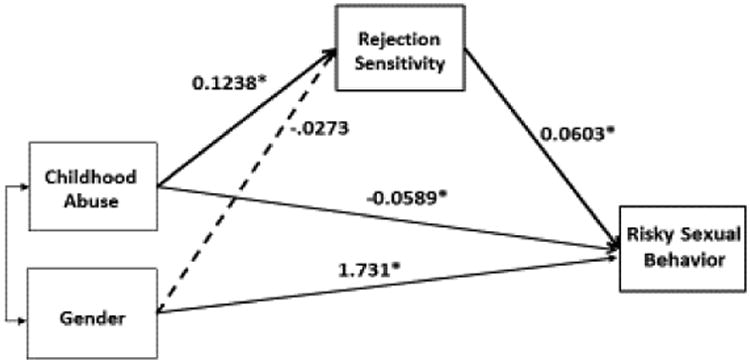
This study investigates abuse and rejection sensitivity as important correlates of risky sexual behavior in the context of substance use. Victims of abuse may experience heightened sensitivity to acute social rejection and consequently engage in risky sexual behavior in an attempt to restore belonging. Data were collected from 258 patients at a substance use treatment facility in Washington, D.C. Participants' history of abuse and risky sexual behavior were assessed via self-report. To test the mediating role of rejection sensitivity, participants completed a social rejection task (Cyberball) and responded to a questionnaire assessing their reaction to the rejection experience. General risk-taking propensity was assessed using a computerized lab measure. Abuse was associated with increased rejection sensitivity (B=0.124, SE=0.040, p=0.002), which was in turn associated with increased risky sex (B=0.06, SE=0.028, p=0.03) (indirect effect=0.0075, SE=0.0043; 95% CI [0.0006, 0.0178]), but not with other indices of risk-taking. These findings suggest that rejection sensitivity may be an important mechanism underlying the relationship between abuse and risky sexual behavior among substance users. These effects do not extend to other risk behaviors, supporting the notion that risky sex associated with abuse represents a means to interpersonal connection rather than a general tendency toward self-defeating behavior.
本研究调查了在物质使用背景下,虐待和拒绝敏感性作为危险性行为重要相关因素的情况。虐待受害者可能对急性社会拒绝表现出更高的敏感性,因此会试图通过从事危险性行为来恢复归属感。数据收集自华盛顿特区一家物质使用治疗机构的258名患者。通过自我报告评估参与者的虐待史和危险性行为。为了测试拒绝敏感性的中介作用,参与者完成了一项社会拒绝任务(Cyberball),并回答了一份评估他们对拒绝经历反应的问卷。使用计算机化实验室测量评估一般冒险倾向。虐待与更高的拒绝敏感性相关(B = 0.124,标准误 = 0.040,p = 0.002),而这反过来又与更高的危险性行为相关(B = 0.06,标准误 = 0.028,p = 0.03)(间接效应 = 0.0075,标准误 = 0.0043;95%置信区间[0.0006, 0.0178]),但与其他冒险指标无关。这些发现表明,拒绝敏感性可能是物质使用者中虐待与危险性行为之间关系的一个重要潜在机制。这些影响并不延伸至其他风险行为,支持了与虐待相关的危险性行为代表一种人际联系手段而非自我挫败行为一般倾向的观点。