Pena Michelle J, Mischak Harald, Heerspink Hiddo J L
Department of Clinical Pharmacy and Pharmacology, University of Groningen, University Medical Center Groningen, P.O. Box 30.001, 9700 RB, Groningen, the Netherlands.
BHF Glasgow Cardiovascular Research Centre, University of Glasgow, Glasgow, UK.
Diabetologia. 2016 Sep;59(9):1819-31. doi: 10.1007/s00125-016-4001-9. Epub 2016 Jun 25.
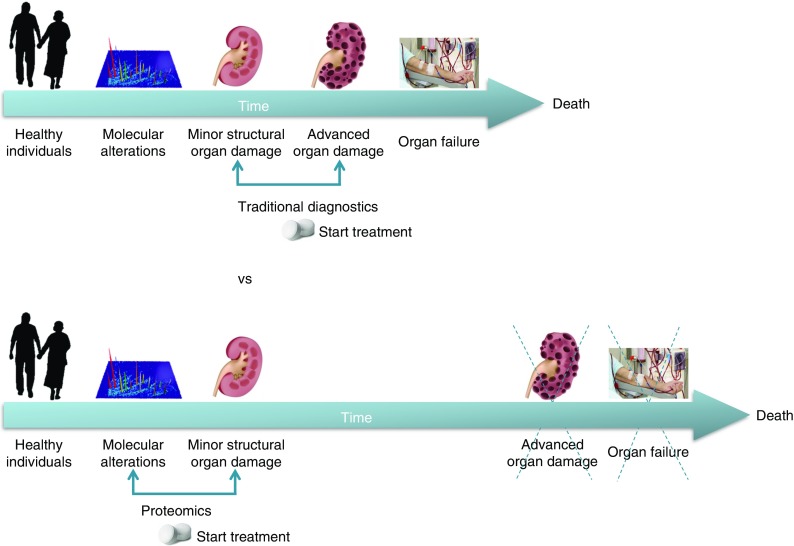
The past decade has resulted in multiple new findings of potential proteomic biomarkers of diabetic kidney disease (DKD). Many of these biomarkers reflect an important role in the (patho)physiology and biological processes of DKD. Situations in which proteomics could be applied in clinical practice include the identification of individuals at risk of progressive kidney disease and those who would respond well to treatment, in order to tailor therapy for those at highest risk. However, while many proteomic biomarkers have been discovered, and even found to be predictive, most lack rigorous external validation in sufficiently powered studies with renal endpoints. Moreover, studies assessing short-term changes in the proteome for therapy-monitoring purposes are lacking. Collaborations between academia and industry and enhanced interactions with regulatory agencies are needed to design new, sufficiently powered studies to implement proteomics in clinical practice.
在过去十年中,已发现多个糖尿病肾病(DKD)潜在蛋白质组学生物标志物的新成果。其中许多生物标志物在DKD的(病理)生理学和生物学过程中发挥着重要作用。蛋白质组学可应用于临床实践的情况包括识别有进展性肾病风险的个体以及对治疗反应良好的个体,以便为风险最高的个体量身定制治疗方案。然而,尽管已发现许多蛋白质组学生物标志物,甚至发现它们具有预测性,但大多数在有足够样本量且以肾脏终点为指标的研究中缺乏严格的外部验证。此外,缺乏用于治疗监测目的、评估蛋白质组短期变化的研究。学术界和产业界需要开展合作,并加强与监管机构的互动,以设计新的、有足够样本量的研究,从而在临床实践中应用蛋白质组学。