Imoh Lucius C, Mutale Mubanga, Parker Christopher T, Erasmus Rajiv T, Zemlin Annalise E
Department of Chemical Pathology, Tygerberg Hospital, National Health Laboratory Service (NHLS) and University of Stellenbosch, Cape Town, South Africa.
Biochem Med (Zagreb). 2016;26(2):194-201. doi: 10.11613/BM.2016.021.
Timeliness of laboratory results is crucial to patient care and outcome. Monitoring turnaround times (TAT), especially for emergency tests, is important to measure the effectiveness and efficiency of laboratory services. Laboratory-based clinical audits reveal opportunities for improving quality. Our aim was to identify the most critical steps causing a high TAT for cerebrospinal fluid (CSF) chemistry analysis in our laboratory.
A 6-month retrospective audit was performed. The duration of each operational phase across the laboratory work flow was examined. A process-mapping audit trail of 60 randomly selected requests with a high TAT was conducted and reasons for high TAT were tested for significance.
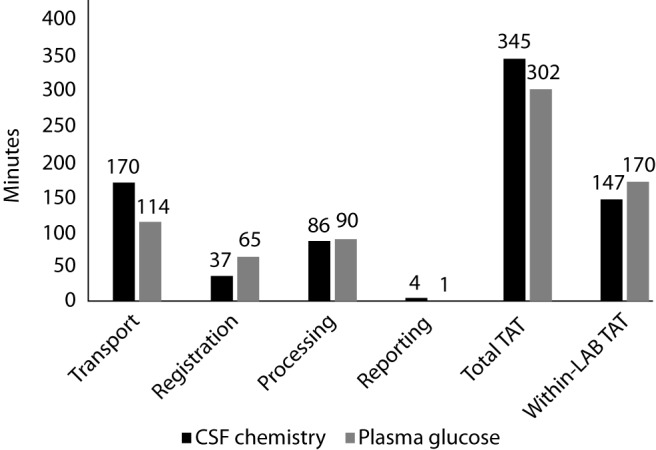
A total of 1505 CSF chemistry requests were analysed. Transport of samples to the laboratory was primarily responsible for the high average TAT (median TAT = 170 minutes). Labelling accounted for most delays within the laboratory (median TAT = 71 minutes) with most delays occurring after regular work hours (P < 0.05). CSF chemistry requests without the appropriate number of CSF sample tubes were significantly associated with delays in movement of samples from the labelling area to the technologist's work station (caused by a preference for microbiological testing prior to CSF chemistry).
A laboratory-based clinical audit identified sample transportation, work shift periods and use of inappropriate CSF sample tubes as drivers of high TAT for CSF chemistry in our laboratory. The results of this audit will be used to change pre-analytical practices in our laboratory with the aim of improving TAT and customer satisfaction.
实验室检测结果的及时性对患者护理和治疗结果至关重要。监测周转时间(TAT),尤其是急诊检测的周转时间,对于衡量实验室服务的有效性和效率非常重要。基于实验室的临床审核揭示了质量改进的机会。我们的目的是确定导致我们实验室脑脊液(CSF)化学分析周转时间过长的最关键步骤。
进行了为期6个月的回顾性审核。检查了实验室工作流程中每个操作阶段的持续时间。对60个随机选择的周转时间较长的请求进行了流程映射审核跟踪,并对周转时间过长的原因进行了显著性测试。
共分析了1505份脑脊液化学检测请求。样本运送到实验室是平均周转时间过长的主要原因(中位周转时间 = 170分钟)。贴标签是实验室内部造成延误最多的环节(中位周转时间 = 71分钟),大多数延误发生在正常工作时间之后(P < 0.05)。脑脊液化学检测请求未配备适当数量的脑脊液样本管,与样本从贴标签区域转移到技术人员工作站的延误显著相关(原因是在脑脊液化学检测之前优先进行微生物检测)。
基于实验室的临床审核确定了样本运输、工作班次以及不适当使用脑脊液样本管是我们实验室脑脊液化学检测周转时间过长的驱动因素。本次审核结果将用于改变我们实验室的分析前操作,以提高周转时间和客户满意度。