Department of Epidemiology, German Institute of Human Nutrition Potsdam-Rehbruecke, Nuthetal, Germany.
Institute of Experimental Genetics, Helmholtz Center Munich, German Research Center for Environmental Health, Neuherberg, Germany.
Nutr Diabetes. 2016 Jun 27;6(6):e215. doi: 10.1038/nutd.2016.23.
BACKGROUND/OBJECTIVES: The metabolic consequences of type of body shape need further exploration. Whereas accumulation of body mass in the abdominal area is a well-established metabolic risk factor, accumulation in the gluteofemoral area is controversially debated. We evaluated the associations of anthropometric markers of overall body mass and body shape with 127 serum metabolites within a sub-sample of the European Prospective Investigation into Cancer and Nutrition (EPIC)-Potsdam cohort.
SUBJECTS/METHODS: The cross-sectional analysis was conducted in 2270 participants, randomly drawn from the EPIC-Potsdam cohort. Metabolites were measured by targeted metabolomics. To select metabolites related with both waist circumference (WC) (abdominal subcutaneous and visceral fat) and hip circumference (HC) (gluteofemoral fat, muscles and bone structure) correlations (r) with body mass index (BMI) as aggregating marker of body mass (lean and fat mass) were calculated. Relations with body shape were assessed by median metabolite concentrations across tertiles of WC and HC, mutually adjusted to each other.
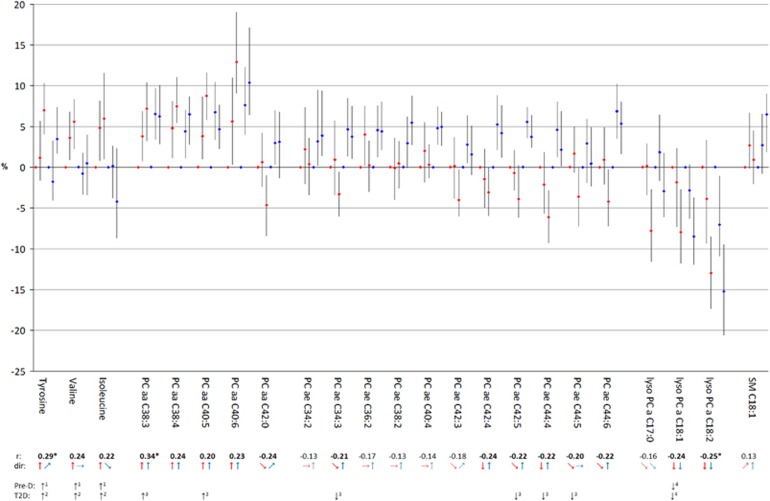
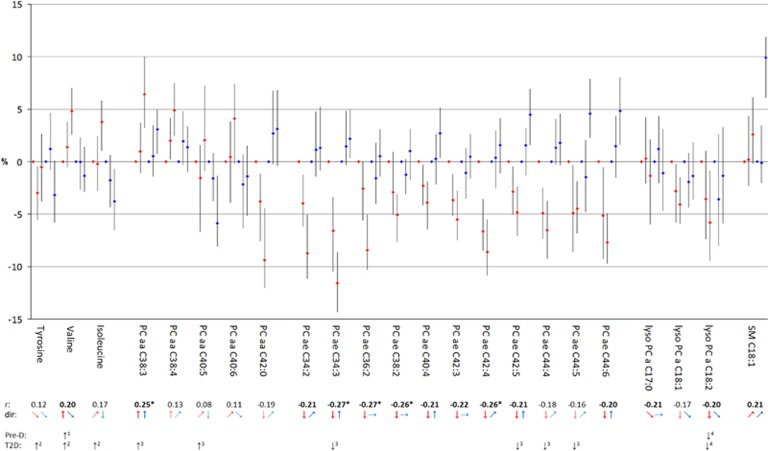
Correlations revealed 23 metabolites related to BMI (r⩾I0.20 I). Metabolites showing relations with BMI were showing similar relations with HC adjusted WC (WCHC). In contrast, relations with WC adjusted HC (HCWC) were less concordant with relations of BMI and WCHC. In both sexes, metabolites with concordant relations regarding WCHC and HCWC included tyrosine, diacyl-phosphatidylcholine C38:3, C38:4, lyso-phosphatidylcholine C18:1, C18:2 and sphingomyelin C18:1; metabolites with opposite relations included isoleucine, diacyl-phosphatidylcholine C42:0, acyl-alkyl-phosphatidylcholine C34:3, C42:4, C42:5, C44:4 and C44:6. Metabolites specifically related to HCWC included acyl-alkyl-phosphatidylcholine C34:2, C36:2, C38:2 and C40:4, and were solely observed in men. Other metabolites were related to WCHC only.
The study revealed specific metabolic profiles for HCWC as marker of gluteofemoral body mass differing from those for BMI and WCHC as markers of overall body mass and abdominal fat, respectively. Thus, the study suggests that gluteofemoral mass may have less-adverse metabolic implications than abdominal fat.
背景/目的:体型的代谢后果需要进一步探索。虽然腹部区域的体重增加是一个公认的代谢危险因素,但臀部区域的体重增加仍存在争议。我们在欧洲癌症前瞻性调查和营养(EPIC)-波茨坦队列的一个子样本中,评估了整体体重和体型的人体测量标志物与 127 种血清代谢物之间的关系。
受试者/方法:对 EPIC-Potsdam 队列中随机抽取的 2270 名参与者进行了横断面分析。通过靶向代谢组学测量代谢物。为了选择与腰围(WC)(腹部皮下和内脏脂肪)和臀围(HC)(臀部脂肪、肌肉和骨骼结构)相关的代谢物,计算了与身体质量指数(BMI)作为体重聚集标志物(瘦体重和脂肪体重)的相关性(r)。通过相互调整彼此的 WC 和 HC 三分位数的代谢物中位数浓度评估与体型的关系。
相关性显示 23 种与 BMI 相关的代谢物(r ⩾ I0.20)。与 BMI 相关的代谢物与调整 WC 的 HC(WCHC)也呈相似关系。相比之下,与调整 HC 的 WC(HCWC)的关系与 BMI 和 WCHC 的关系不太一致。在男性和女性中,关于 WCHC 和 HCWC 具有一致关系的代谢物包括酪氨酸、二酰基磷脂酰胆碱 C38:3、C38:4、溶血磷脂酰胆碱 C18:1、C18:2 和神经鞘磷脂 C18:1;具有相反关系的代谢物包括异亮氨酸、二酰基磷脂酰胆碱 C42:0、酰基烷氧基磷脂酰胆碱 C34:3、C42:4、C42:5、C44:4 和 C44:6。仅在男性中观察到特异性与 HCWC 相关的代谢物包括酰基烷氧基磷脂酰胆碱 C34:2、C36:2、C38:2 和 C40:4。其他代谢物仅与 WCHC 相关。
该研究揭示了 HCWC 作为臀部脂肪的标志物的特定代谢特征,与 BMI 和 WCHC 作为整体体重和腹部脂肪的标志物分别不同。因此,该研究表明,臀部脂肪的代谢影响可能不如腹部脂肪不利。