Floegel A, Wientzek A, Bachlechner U, Jacobs S, Drogan D, Prehn C, Adamski J, Krumsiek J, Schulze M B, Pischon T, Boeing H
Department of Epidemiology, German Institute of Human Nutrition Potsdam-Rehbruecke, Nuthetal, Germany.
Department of Molecular Epidemiology, German Institute of Human Nutrition Potsdam-Rehbruecke, Nuthetal, Germany.
Int J Obes (Lond). 2014 Nov;38(11):1388-96. doi: 10.1038/ijo.2014.39. Epub 2014 Mar 10.
It is not yet resolved how lifestyle factors and intermediate phenotypes interrelate with metabolic pathways. We aimed to investigate the associations between diet, physical activity, cardiorespiratory fitness and obesity with serum metabolite networks in a population-based study.
The present study included 2380 participants of a randomly drawn subcohort of the European Prospective Investigation into Cancer and Nutrition-Potsdam. Targeted metabolomics was used to measure 127 serum metabolites. Additional data were available including anthropometric measurements, dietary assessment including intake of whole-grain bread, coffee and cake and cookies by food frequency questionnaire, and objectively measured physical activity energy expenditure and cardiorespiratory fitness in a subsample of 100 participants. In a data-driven approach, Gaussian graphical modeling was used to draw metabolite networks and depict relevant associations between exposures and serum metabolites. In addition, the relationship of different exposure metabolite networks was estimated.
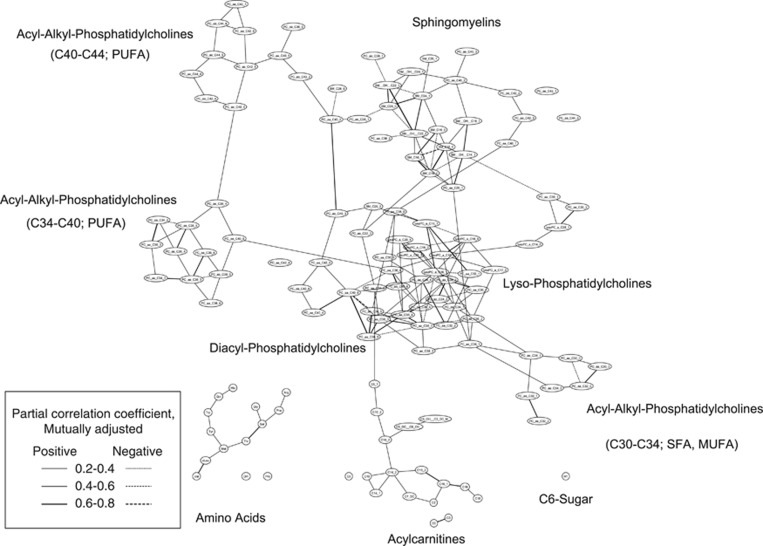
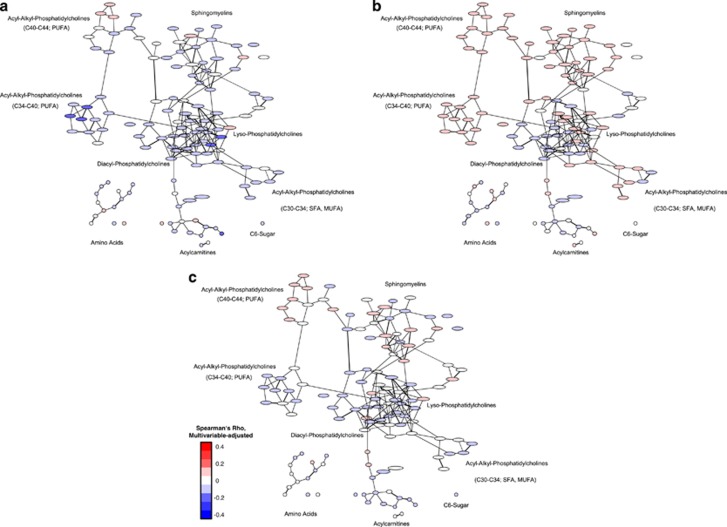
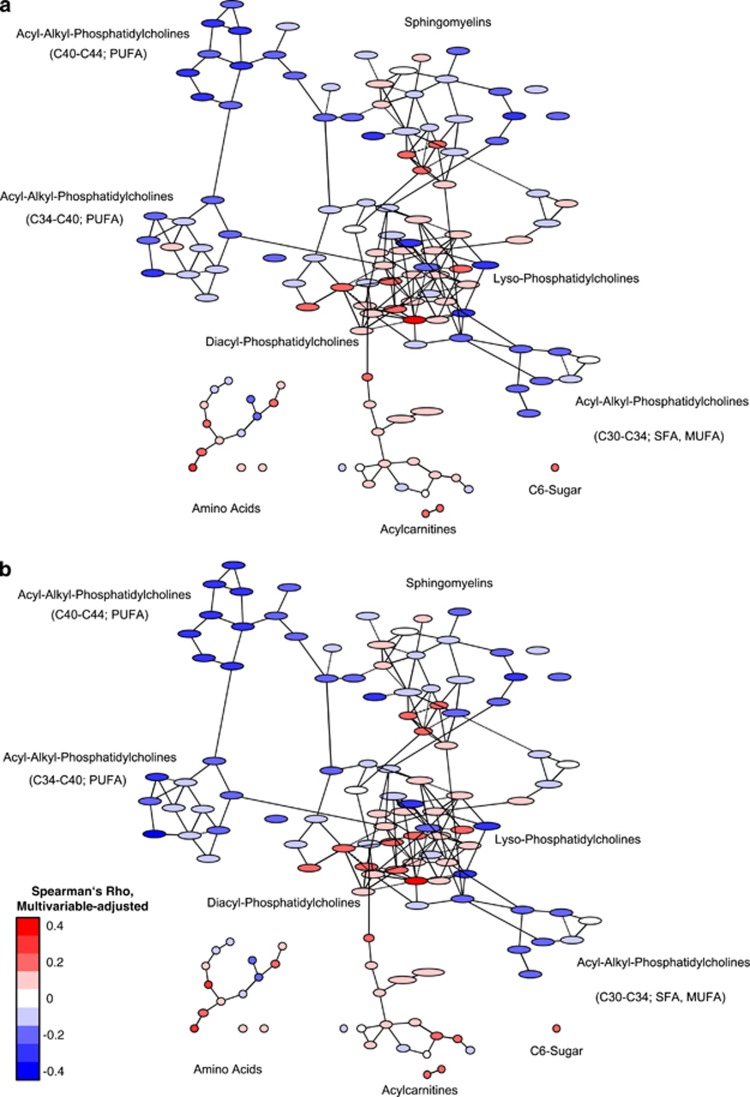
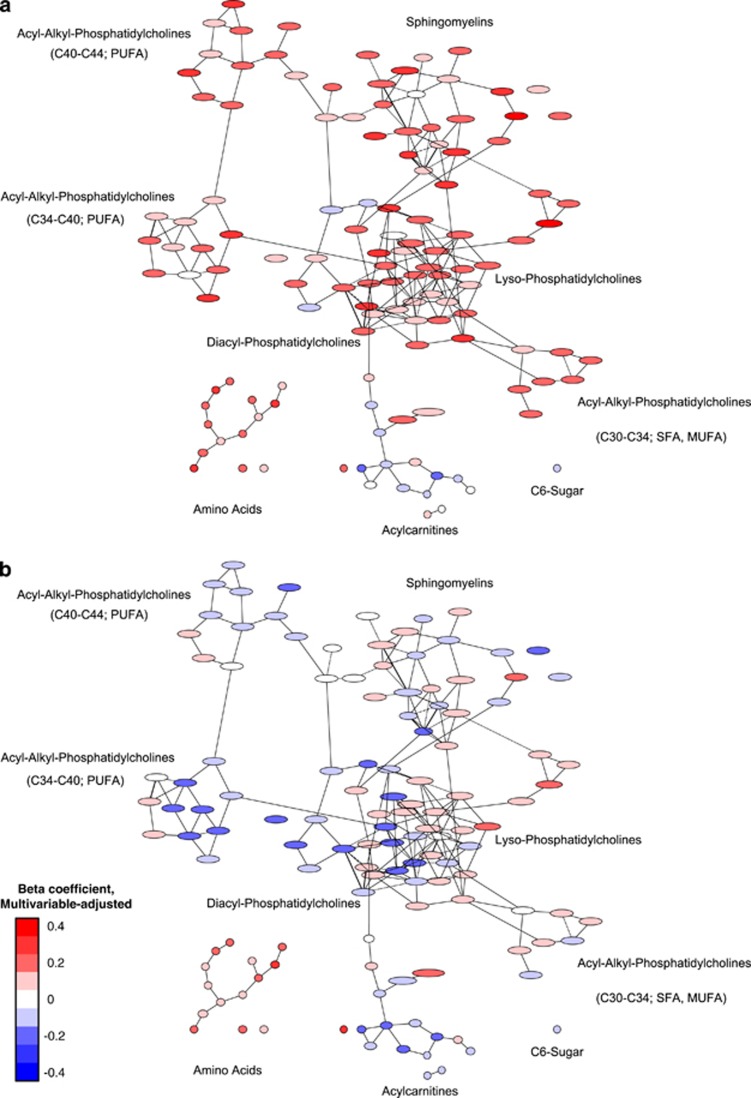
In the serum metabolite network, the different metabolite classes could be separated. There was a big group of phospholipids and acylcarnitines, a group of amino acids and C6-sugar. Amino acids were particularly positively associated with cardiorespiratory fitness and physical activity. C6-sugar and acylcarnitines were positively associated with obesity and inversely with intake of whole-grain bread. Phospholipids showed opposite associations with obesity and coffee intake. Metabolite networks of coffee intake and obesity were strongly inversely correlated (body mass index (BMI): r = -0.57 and waist circumference: r = -0.59). A strong positive correlation was observed between metabolite networks of BMI and waist circumference (r = 0.99), as well as the metabolite networks of cake and cookie intake with cardiorespiratory fitness and intake of whole-grain bread (r = 0.52 and r = 0.50; respectively).
Lifestyle factors and phenotypes seem to interrelate in various metabolic pathways. A possible protective effect of coffee could be mediated via counterbalance of pathways of obesity involving hepatic phospholipids. Experimental studies should validate the biological mechanisms.
生活方式因素和中间表型如何与代谢途径相互关联尚未明确。我们旨在通过一项基于人群的研究,调查饮食、身体活动、心肺适能和肥胖与血清代谢物网络之间的关联。
本研究纳入了欧洲癌症与营养前瞻性调查-波茨坦随机抽取的亚队列中的2380名参与者。采用靶向代谢组学方法测量127种血清代谢物。还可获取其他数据,包括人体测量数据、通过食物频率问卷进行的饮食评估(包括全麦面包、咖啡以及蛋糕和饼干的摄入量),以及在100名参与者的子样本中客观测量的身体活动能量消耗和心肺适能。采用数据驱动方法,使用高斯图形模型绘制代谢物网络,并描述暴露因素与血清代谢物之间的相关关联。此外,还估计了不同暴露代谢物网络之间的关系。
在血清代谢物网络中,不同的代谢物类别可以区分开来。有一大组磷脂和酰基肉碱,一组氨基酸和C6糖。氨基酸与心肺适能和身体活动呈显著正相关。C6糖和酰基肉碱与肥胖呈正相关,与全麦面包摄入量呈负相关。磷脂与肥胖和咖啡摄入量呈相反的关联。咖啡摄入量和肥胖的代谢物网络呈强烈负相关(体重指数(BMI):r = -0.57,腰围:r = -0.59)。观察到BMI和腰围的代谢物网络之间存在强正相关(r = 0.99),以及蛋糕和饼干摄入量的代谢物网络与心肺适能和全麦面包摄入量之间存在强正相关(分别为r = 0.52和r = 0.50)。
生活方式因素和表型似乎在各种代谢途径中相互关联。咖啡可能的保护作用可能是通过平衡涉及肝脏磷脂的肥胖途径来介导的。实验研究应验证其生物学机制。