Department of Nutrition, Harvard T.H. Chan School of Public Health, 665 Huntington Avenue, Boston, MA, 02115, USA.
Microbiome and Host Health Programme, South Australian Health and Medical Research Institute, North Terrace, Adelaide, SA, 5000, Australia.
BMC Microbiol. 2022 Mar 29;22(1):82. doi: 10.1186/s12866-022-02495-0.
The conversion of plant lignans to bioactive enterolignans in the gastrointestinal tract is mediated through microbial processing. The goal of this study was to examine the relationships between lignan intake, plasma enterolactone concentrations, gut microbiome composition, and metabolic risk in free-living male adults.
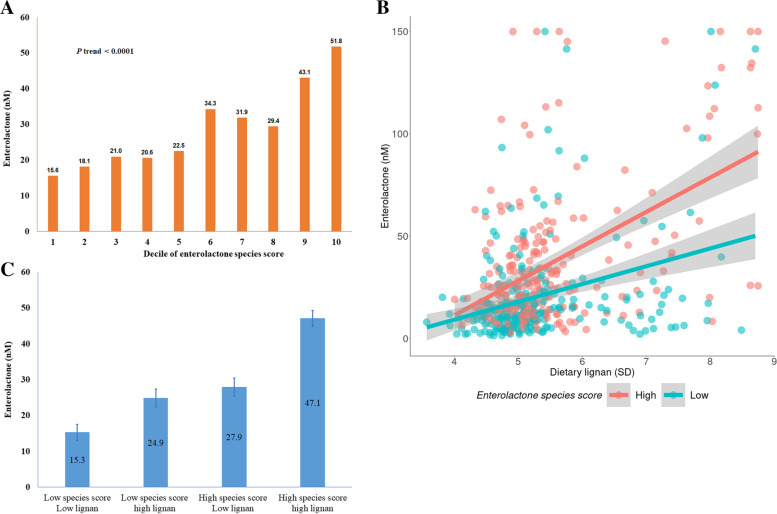
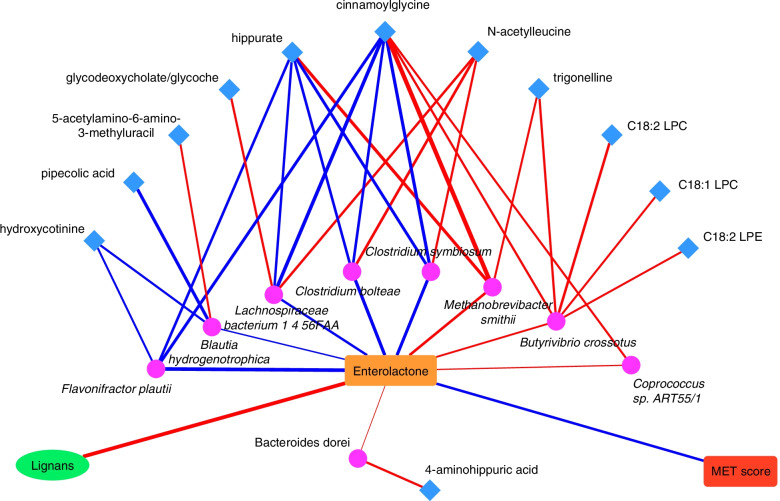
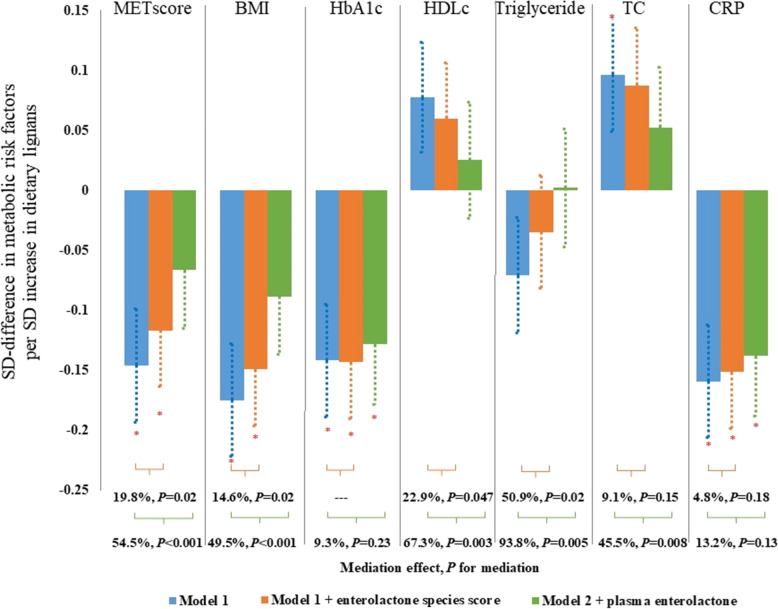
In 303 men participating in the Men's Lifestyle Validation Study (MLVS), lignan intake was assessed using two sets of 7-day diet records, and gut microbiome was profiled through shotgun sequencing of up to 2 pairs of fecal samples (n = 911). A score was calculated to summarize the abundance of bacteria species that were significantly associated with plasma enterolactone levels. Of the 138 filtered species, plasma enterolactone levels were significantly associated with the relative abundances of 18 species at FDR < 0.05 level. Per SD increment of lignan intake was associated with 20.7 nM (SEM: 2.3 nM) higher enterolactone concentrations among participants with a higher species score, whereas the corresponding estimate was 4.0 nM (SEM: 1.7 nM) among participants with a lower species score (P for interaction < 0.001). A total of 12 plasma metabolites were also significantly associated with these enterolactone-predicting species. Of the association between lignan intake and metabolic risk, 19.8% (95%CI: 7.3%-43.6%) was explained by the species score alone, 54.5% (95%CI: 21.8%-83.7%) by both species score and enterolactone levels, and 79.8% (95%CI: 17.7%-98.6%) by further considering the 12 plasma metabolites.
We identified multiple gut bacteria species that were enriched or depleted at higher plasma levels of enterolactone in men. These species jointly modified the associations of lignan intake with plasma enterolactone levels and explained the majority of association between lignan intake and metabolic risk along with enterolactone levels and certain plasma metabolites.
植物木脂素在胃肠道中转化为生物活性肠内木脂素是通过微生物处理介导的。本研究的目的是检验游离生活的成年男性中木脂素摄入、血浆肠内酯浓度、肠道微生物组组成和代谢风险之间的关系。
在参与男性生活方式验证研究(MLVS)的 303 名男性中,使用两套 7 天饮食记录评估木脂素摄入,通过对多达 2 对粪便样本进行测序(n=911)来分析肠道微生物组。计算了一个评分来总结与血浆肠内酯水平显著相关的细菌物种的丰度。在 138 个过滤物种中,有 18 个物种的相对丰度与血浆肠内酯水平显著相关,在 FDR<0.05 水平。木脂素摄入量每增加一个标准差,与具有较高物种评分的参与者中肠内酯浓度升高 20.7 nM(SEM:2.3 nM)相关,而在具有较低物种评分的参与者中,相应的估计值为 4.0 nM(SEM:1.7 nM)(P 交互<0.001)。共有 12 种血浆代谢物也与这些预测肠内酯的物种显著相关。在木脂素摄入与代谢风险之间的关联中,仅物种评分单独解释了 19.8%(95%CI:7.3%-43.6%),物种评分和肠内酯水平共同解释了 54.5%(95%CI:21.8%-83.7%),进一步考虑 12 种血浆代谢物后解释了 79.8%(95%CI:17.7%-98.6%)。
我们鉴定出在男性中血浆肠内酯水平较高时被富集或耗尽的多种肠道细菌物种。这些物种共同改变了木脂素摄入与血浆肠内酯水平之间的关联,并与肠内酯水平和某些血浆代谢物一起解释了木脂素摄入与代谢风险之间的大部分关联。