Dunham Yarrow, Dotsch Ron, Clark Amelia R, Stepanova Elena V
Department of Psychology, Yale University, New Haven, CT, United States of America.
Department of Psychology, Utrecht University, Utrecht, The Netherlands.
PLoS One. 2016 Jun 29;11(6):e0158211. doi: 10.1371/journal.pone.0158211. eCollection 2016.
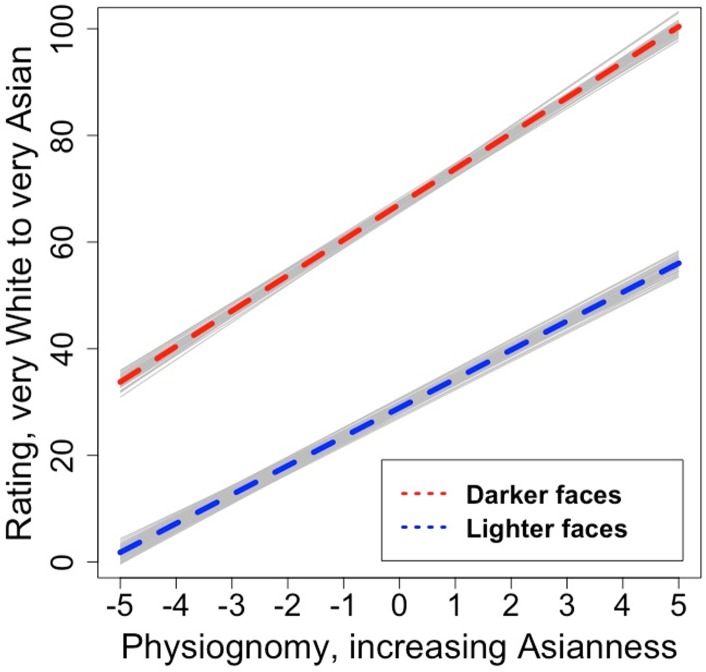
We examined the development of racial categorizations of faces spanning the European-East Asian ("White-Asian") categorical continuum in children between the ages of four and nine as well as adults. We employed a stimulus set that independently varied skin color and other aspects of facial physiognomy, allowing the contribution of each to be assessed independently and in interaction with each other. Results demonstrated substantial development across this age range in children's ability to draw on both sorts of cue, with over twice as much variance explained by stimulus variation in adults than children. Nonetheless, children were clearly sensitive to both skin color and other aspects of facial physiognomy, suggesting that understanding of the White-Asian category boundary develops in a somewhat different way than understanding of the White-Black category boundary, in which attention to features other than skin color appear only somewhat later. Discussion focuses on the implications of these findings for theories of social categorization.
我们研究了4至9岁儿童以及成年人对跨越欧洲-东亚(“白人-亚洲人”)类别连续统的面部种族分类的发展情况。我们采用了一组刺激物,其肤色和面部相貌的其他方面是独立变化的,从而能够分别评估每一个因素的作用以及它们之间的相互作用。结果表明,在这个年龄范围内,儿童利用这两种线索的能力有显著发展,成年人中由刺激变化所解释的方差是儿童的两倍多。尽管如此,儿童显然对肤色和面部相貌的其他方面都很敏感,这表明对白人-亚洲人类别边界的理解与对白人-黑人类别边界的理解发展方式有所不同,在后一种情况中,对肤色以外特征的关注出现得稍晚一些。讨论集中在这些发现对社会分类理论的意义上。