van Ginkel Willem G, Jahja Rianne, Huijbregts Stephan C J, Daly Anne, MacDonald Anita, De Laet Corinne, Cassiman David, Eyskens François, Körver-Keularts Irene M L W, Goyens Philippe J, McKiernan Patrick J, van Spronsen Francjan J
University of Groningen, Beatrix Children's Hospital, University Medical Center Groningen, 9700 RB, Groningen, The Netherlands.
University of Leiden, Leiden, The Netherlands.
Orphanet J Rare Dis. 2016 Jun 29;11(1):87. doi: 10.1186/s13023-016-0472-5.
Hereditary Tyrosinemia type 1 (HT1) is a rare metabolic disorder caused by a defect in the enzyme Fumarylacetoacetate Hydrolase. Due to this defect, toxic products accumulate which, in turn, cause liver and kidney dysfunction. Treatment with 2-(2-nitro-4-trifluoromethylbenoyl)-1,3-cyclohexanedione (NTBC) and diet has diminished these problems, but recent data indicate that HT1 patients have neurocognitive problems. However, the neuropsychological profile of these patients is unknown. Therefore, this study aimed to investigate this neuropsychological profile by comparing HT1 patients with healthy controls.
Neurocognitive testing was performed in a heterogeneous group of 19 NTBC and dietary treated HT1 patients (five female, fourteen male; mean age 12.9 ± 4.8 years; range 7.9-23.6 years) and 19 age and gender matched controls (five female, fourteen male; mean age 13.2 ± 4.6 years; range 8.1-24.8 years). IQ scores were estimated and all participants performed the Amsterdam Neuropsychological Tasks, measuring executive functions (inhibition, cognitive flexibility and working memory) and social cognition (face recognition and identification of facial emotions).
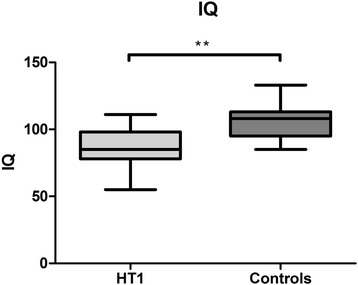
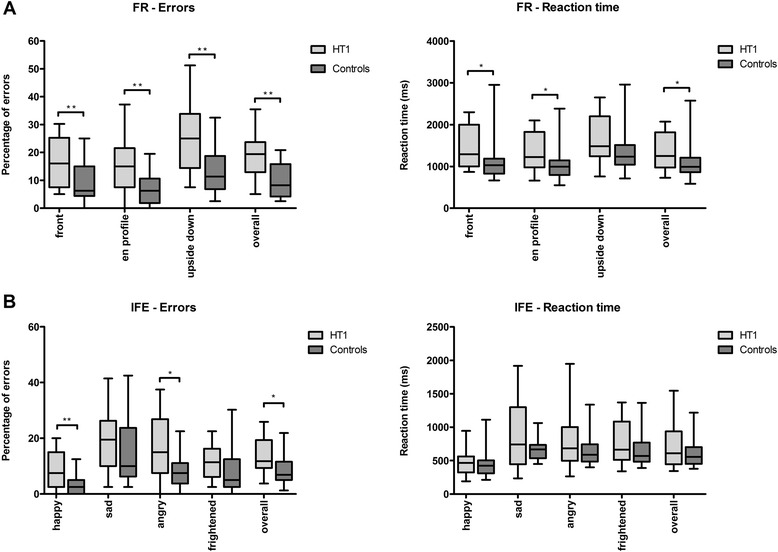
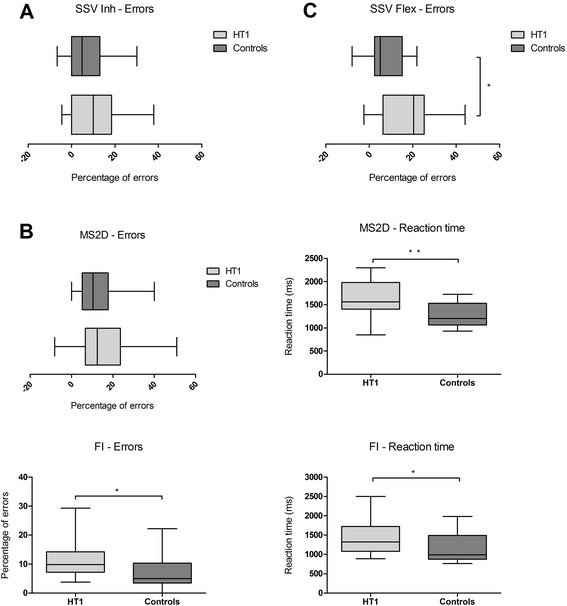
HT1 patients showed poorer estimated IQ, executive functioning (working memory and cognitive flexibility), and social cognition compared to healthy controls. Lower IQ scores in HT1 patients were mostly unrelated to scores on executive function- and social cognition tasks and therefore did not account for group differences in these domains. Further analyses within the HT1 patient group (comparing different groups of patients based on the age at diagnosis and the clinical symptoms at diagnosis) did not reveal any significant results. The duration of NTBC treatment was negatively correlated with IQ.
Despite the heterogeneity of the patient group, these data clearly show that IQ, executive functioning and social cognition are affected in HT1 patients, and that IQ screening is not sufficient for cognitive monitoring of these patients. Further research should focus on the underlying pathophysiological mechanisms of these impairments to consequently try to improve treatment strategies.
1型遗传性酪氨酸血症(HT1)是一种罕见的代谢紊乱疾病,由富马酰乙酰乙酸水解酶缺陷引起。由于这种缺陷,有毒产物会蓄积,进而导致肝脏和肾脏功能障碍。使用2-(2-硝基-4-三氟甲基苯甲酰基)-1,3-环己二酮(NTBC)和饮食治疗已减少了这些问题,但最近的数据表明HT1患者存在神经认知问题。然而,这些患者的神经心理学特征尚不清楚。因此,本研究旨在通过比较HT1患者与健康对照来调查这种神经心理学特征。
对一组异质性的19例接受NTBC和饮食治疗的HT1患者(5名女性,14名男性;平均年龄12.9±4.8岁;范围7.9 - 23.6岁)和19名年龄及性别匹配的对照者(5名女性,14名男性;平均年龄13.2±4.6岁;范围8.1 - 24.8岁)进行神经认知测试。估计智商分数,所有参与者完成阿姆斯特丹神经心理学任务,测量执行功能(抑制、认知灵活性和工作记忆)和社会认知(面部识别和面部情绪识别)。
与健康对照相比,HT1患者的估计智商、执行功能(工作记忆和认知灵活性)和社会认知较差。HT1患者较低的智商分数大多与执行功能和社会认知任务的分数无关,因此不能解释这些领域的组间差异。在HT1患者组内进一步分析(根据诊断年龄和诊断时的临床症状比较不同患者组)未发现任何显著结果。NTBC治疗的持续时间与智商呈负相关。
尽管患者组存在异质性,但这些数据清楚地表明HT1患者的智商、执行功能和社会认知受到影响,并且智商筛查不足以对这些患者进行认知监测。进一步的研究应关注这些损伤的潜在病理生理机制,从而尝试改进治疗策略。