Kho Alvin T, Sharma Sunita, Davis Joshua S, Spina Joseph, Howard Dagnie, McEnroy Kevin, Moore Kip, Sylvia Jody, Qiu Weiliang, Weiss Scott T, Tantisira Kelan G
Children's Hospital Informatics Program, Boston Children's Hospital and Harvard Medical School, Boston MA 02115, United States of America.
Division of Pulmonary Sciences and Critical Care Medicine, University of Colorado School of Medicine, Aurora, CO 80045, United States of America.
PLoS One. 2016 Jun 30;11(6):e0157998. doi: 10.1371/journal.pone.0157998. eCollection 2016.
MicroRNAs are key transcriptional and network regulators previously associated with asthma susceptibility. However, their role in relation to asthma severity has not been delineated.
We hypothesized that circulating microRNAs could serve as biomarkers of changes in lung function in asthma patients.
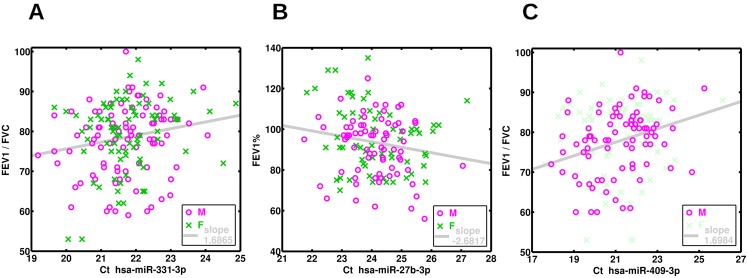
We isolated microRNAs from serum samples obtained at randomization for 160 participants of the Childhood Asthma Management Program. Using a TaqMan microRNA array containing 754 microRNA primers, we tested for the presence of known asthma microRNAs, and assessed the association of the individual microRNAs with lung function as measured by FEV1/FVC, FEV1% and FVC%. We further tested the subset of FEV1/FVC microRNAs for sex-specific and lung developmental associations.
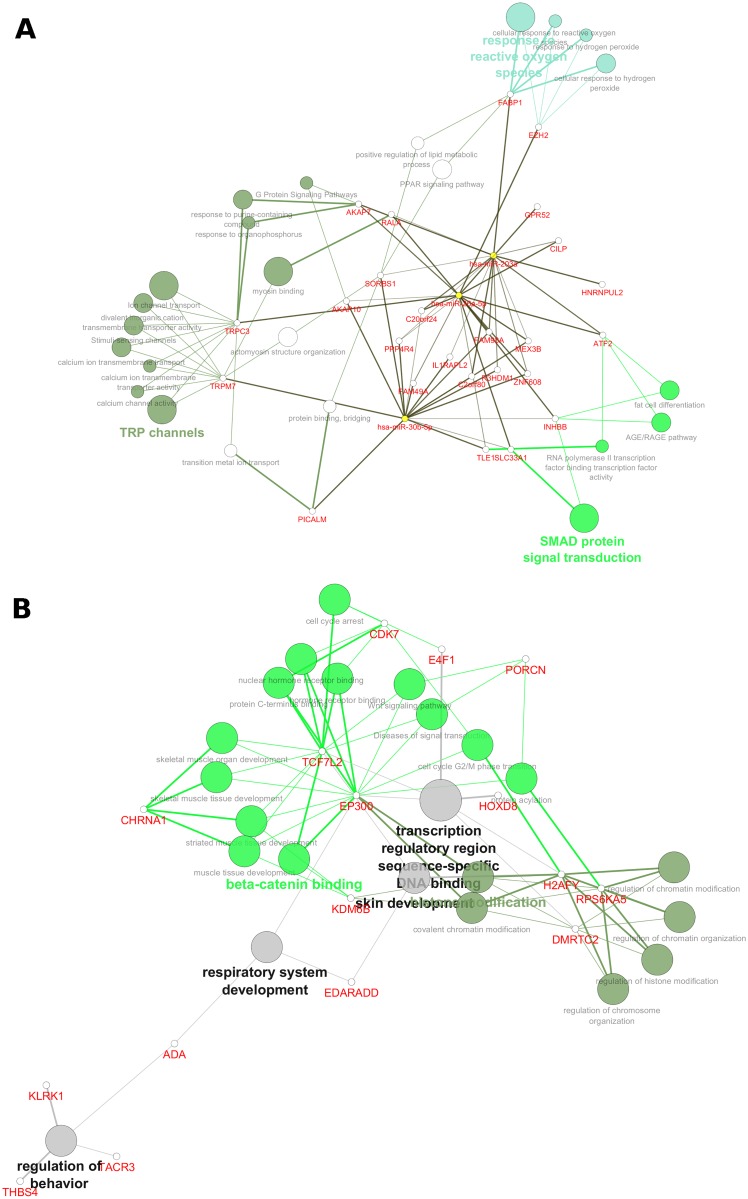
Of the 108 well-detected circulating microRNAs, 74 (68.5%) had previously been linked to asthma susceptibility. We found 22 (20.3%), 4 (3.7%) and 8 (7.4%) microRNAs to be associated with FEV1/FVC, FEV1% and FVC%, respectively. 8 (of 22) FEV1/FVC, 3 (of 4) FEV1% and 1 (of 8) FVC% microRNAs had functionally validated target genes that have been linked via genome wide association studies to asthma and FEV1 change. Among the 22 FEV1/FVC microRNAs, 9 (40.9%) remain associated with FEV1/FVC in boys alone in a sex-stratified analysis (compared with 3 FEV1/FVC microRNAs in girls alone), 7 (31.8%) were associated with fetal lung development, and 3 (13.6%) in both. Ontology analyses revealed enrichment for pathways integral to asthma, including PPAR signaling, G-protein coupled signaling, actin and myosin binding, and respiratory system development.
Circulating microRNAs reflect asthma biology and are associated with lung function differences in asthmatics. They may represent biomarkers of asthma severity.
微小RNA是先前与哮喘易感性相关的关键转录和网络调节因子。然而,它们在哮喘严重程度方面的作用尚未明确。
我们假设循环微小RNA可作为哮喘患者肺功能变化的生物标志物。
我们从儿童哮喘管理项目的160名参与者随机分组时采集的血清样本中分离微小RNA。使用包含754种微小RNA引物的TaqMan微小RNA阵列,我们检测已知哮喘微小RNA的存在,并评估各个微小RNA与通过FEV1/FVC、FEV1%和FVC%测量的肺功能之间的关联。我们进一步测试了FEV1/FVC微小RNA子集与性别特异性和肺发育的关联。
在108种检测良好的循环微小RNA中,74种(68.5%)先前已与哮喘易感性相关联。我们发现分别有22种(20.3%)、4种(3.7%)和8种(7.4%)微小RNA与FEV1/FVC、FEV1%和FVC%相关。22种FEV1/FVC微小RNA中的8种、4种FEV1%微小RNA中的3种和8种FVC%微小RNA中的1种具有经功能验证的靶基因,这些靶基因已通过全基因组关联研究与哮喘和FEV1变化相关联。在22种FEV1/FVC微小RNA中,在性别分层分析中,9种(40.9%)仅在男孩中仍与FEV1/FVC相关(相比之下,仅在女孩中有3种FEV1/FVC微小RNA),7种(31.8%)与胎儿肺发育相关,3种(13.6%)在两者中均相关。本体分析显示哮喘相关途径的富集,包括PPAR信号传导、G蛋白偶联信号传导、肌动蛋白和肌球蛋白结合以及呼吸系统发育。
循环微小RNA反映哮喘生物学特性,并与哮喘患者的肺功能差异相关。它们可能代表哮喘严重程度的生物标志物。