Karalis Aristeidis, Joannopoulos J D
Research Laboratory of Electronics, Massachusetts Institute of Technology, Cambridge, MA 02139, USA.
Department of Physics, Massachusetts Institute of Technology, Cambridge, MA 02139, USA.
Sci Rep. 2016 Jul 1;6:28472. doi: 10.1038/srep28472.
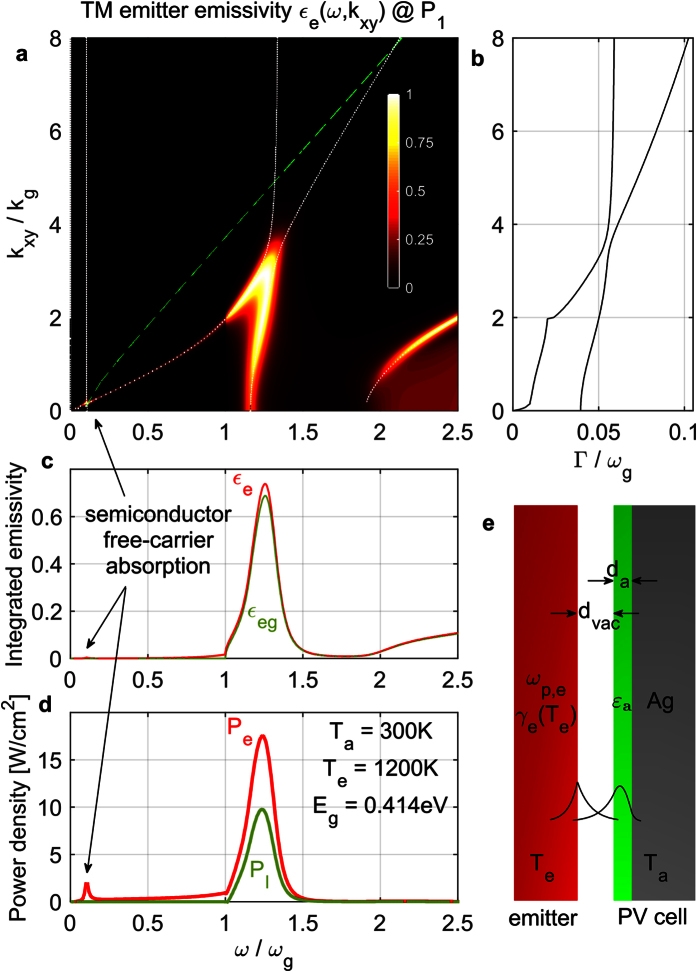
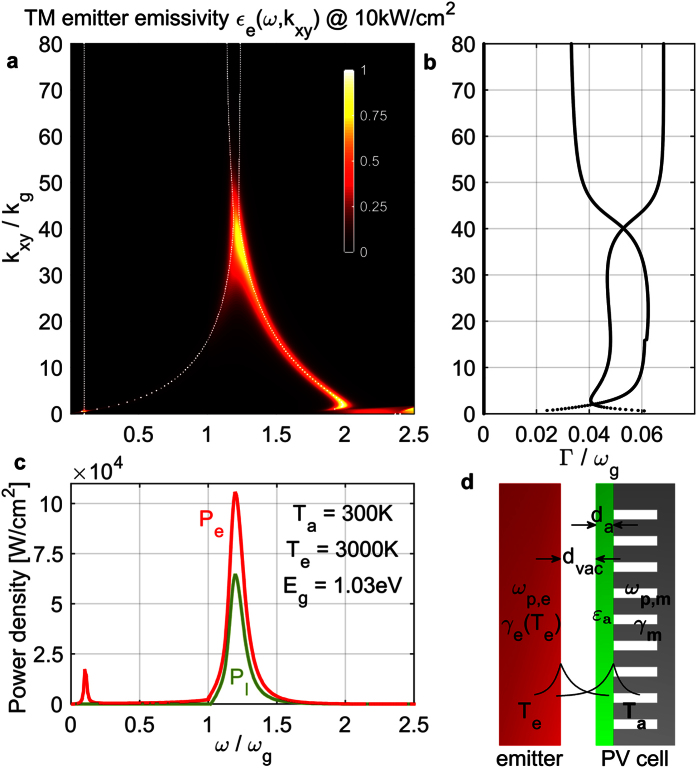
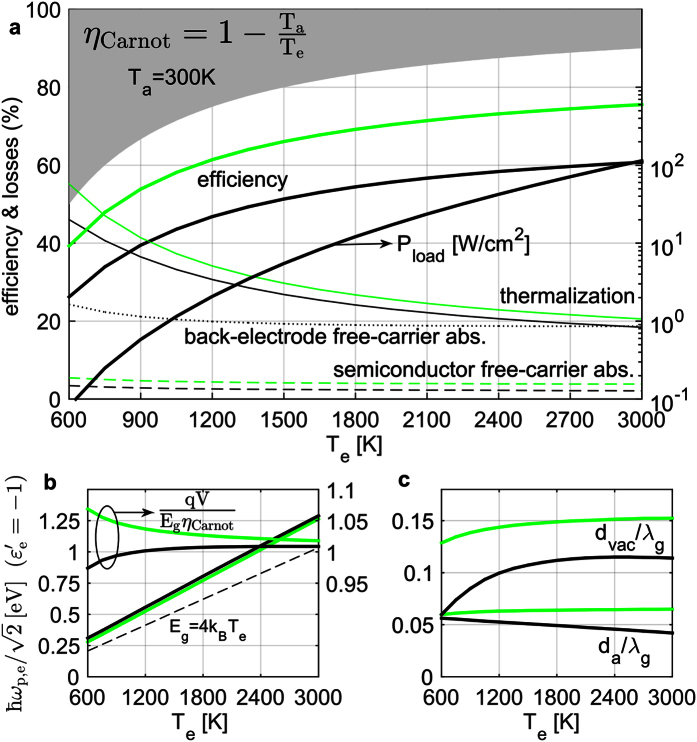
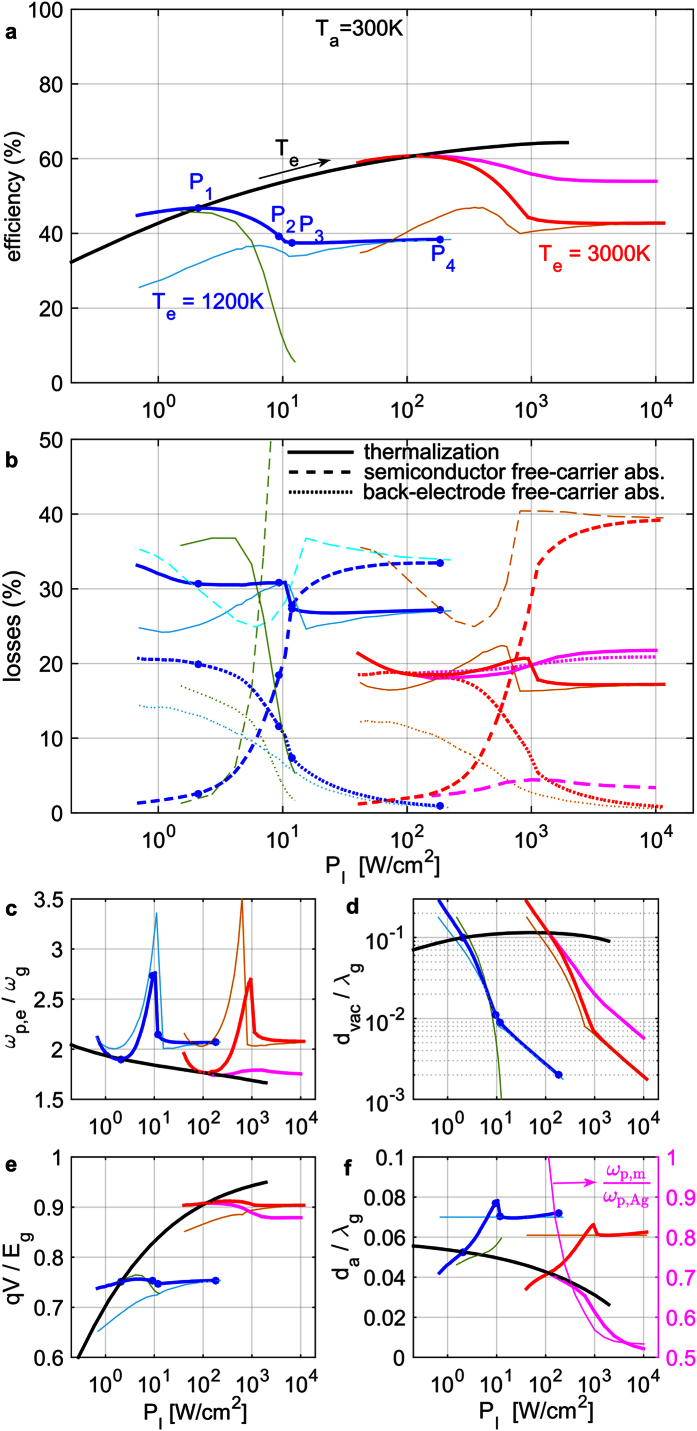
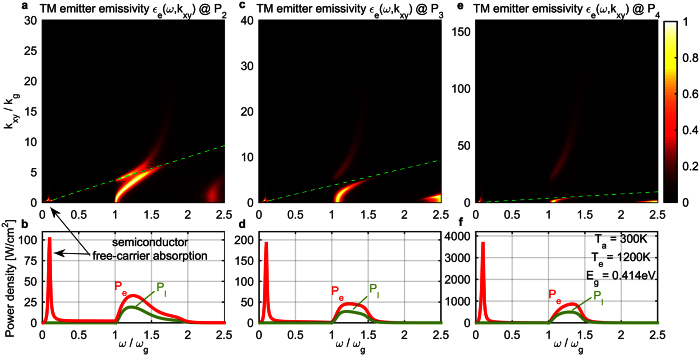
We numerically demonstrate near-field planar ThermoPhotoVoltaic systems with very high efficiency and output power, at large vacuum gaps. Example performances include: at 1200 °K emitter temperature, output power density 2 W/cm(2) with ~47% efficiency at 300 nm vacuum gap; at 2100 °K, 24 W/cm(2) with ~57% efficiency at 200 nm gap; and, at 3000 °K, 115 W/cm(2) with ~61% efficiency at 140 nm gap. Key to this striking performance is a novel photonic design forcing the emitter and cell single modes to cros resonantly couple and impedance-match just above the semiconductor bandgap, creating there a 'squeezed' narrowband near-field emission spectrum. Specifically, we employ surface-plasmon-polariton thermal emitters and silver-backed semiconductor-thin-film photovoltaic cells. The emitter planar plasmonic nature allows for high-power and stable high-temperature operation. Our simulations include modeling of free-carrier absorption in both cell electrodes and temperature dependence of the emitter properties. At high temperatures, the efficiency enhancement via resonant mode cross-coupling and matching can be extended to even higher power, by appropriately patterning the silver back electrode to enforce also an absorber effective surface-plasmon-polariton mode. Our proposed designs can therefore lead the way for mass-producible and low-cost ThermoPhotoVoltaic micro-generators and solar cells.
我们通过数值模拟展示了在大真空间隙下具有非常高的效率和输出功率的近场平面热光伏系统。示例性能包括:在发射极温度为1200 °K时,在300 nm真空间隙下输出功率密度为2 W/cm²,效率约为47%;在2100 °K时,在200 nm间隙下输出功率为24 W/cm²,效率约为57%;在3000 °K时,在140 nm间隙下输出功率为115 W/cm²,效率约为61%。这种显著性能的关键在于一种新颖的光子设计,该设计迫使发射极和电池的单模交叉共振耦合,并在半导体带隙上方进行阻抗匹配,从而在那里产生一个“压缩”的窄带近场发射光谱。具体而言,我们采用表面等离激元极化子热发射极和银背半导体薄膜光伏电池。发射极的平面等离激元特性允许实现高功率和稳定的高温运行。我们的模拟包括对电池电极中的自由载流子吸收以及发射极特性的温度依赖性进行建模。在高温下,通过适当对银背电极进行图案化处理,以强制吸收体也具有有效的表面等离激元极化子模式,通过共振模式交叉耦合和匹配提高的效率可以扩展到更高的功率。因此,我们提出的设计可为大规模生产且低成本的热光伏微型发电机和太阳能电池开辟道路。