Omair Zunaid, Scranton Gregg, Pazos-Outón Luis M, Xiao T Patrick, Steiner Myles A, Ganapati Vidya, Peterson Per F, Holzrichter John, Atwater Harry, Yablonovitch Eli
Department of Electrical Engineering and Computer Science, University of California, Berkeley, CA 94720.
Material Science Division, Lawrence Berkeley National Laboratory, Berkeley, CA 94720.
Proc Natl Acad Sci U S A. 2019 Jul 30;116(31):15356-15361. doi: 10.1073/pnas.1903001116. Epub 2019 Jul 16.
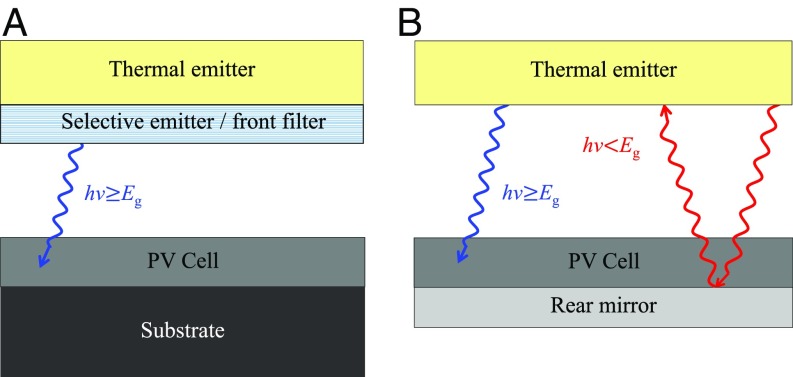
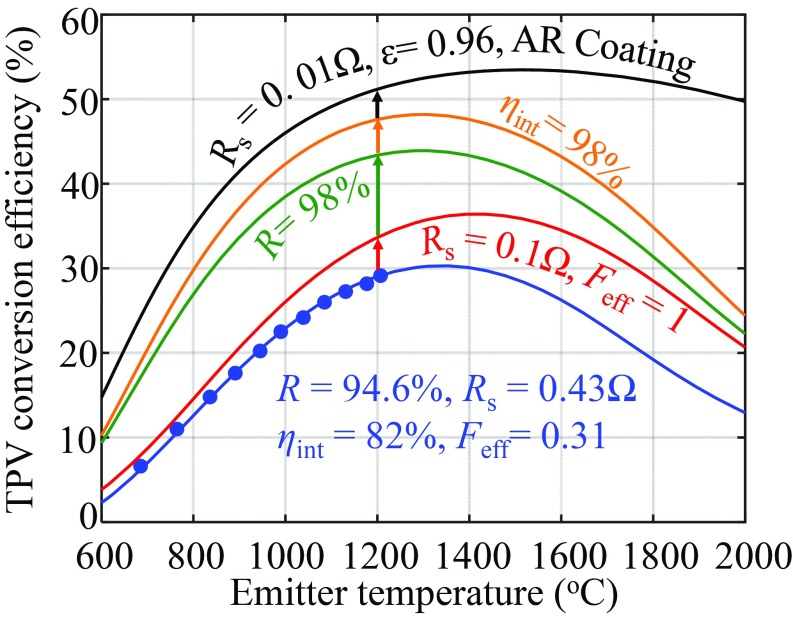
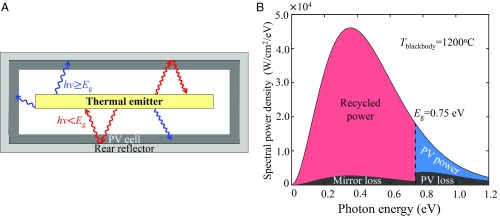
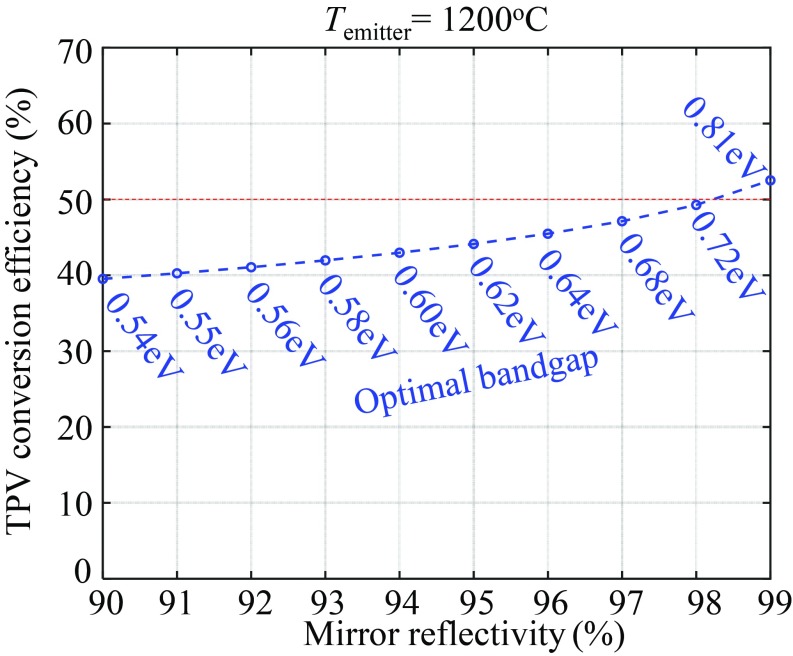
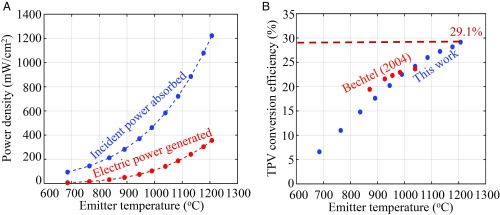
Thermophotovoltaic power conversion utilizes thermal radiation from a local heat source to generate electricity in a photovoltaic cell. It was shown in recent years that the addition of a highly reflective rear mirror to a solar cell maximizes the extraction of luminescence. This, in turn, boosts the voltage, enabling the creation of record-breaking solar efficiency. Now we report that the rear mirror can be used to create thermophotovoltaic systems with unprecedented high thermophotovoltaic efficiency. This mirror reflects low-energy infrared photons back into the heat source, recovering their energy. Therefore, the rear mirror serves a dual function; boosting the voltage and reusing infrared thermal photons. This allows the possibility of a practical >50% efficient thermophotovoltaic system. Based on this reflective rear mirror concept, we report a thermophotovoltaic efficiency of 29.1 ± 0.4% at an emitter temperature of 1,207 °C.
热光伏能量转换利用来自局部热源的热辐射在光伏电池中发电。近年来研究表明,在太阳能电池上添加高反射率的后镜可使发光提取最大化。这进而提高了电压,能够创造破纪录的太阳能效率。现在我们报告,该后镜可用于创建具有前所未有的高热光伏效率的热光伏系统。此镜将低能量红外光子反射回热源,回收其能量。因此,后镜具有双重功能;提高电压并重新利用红外热光子。这使得有可能实现效率大于50%的实用热光伏系统。基于这种反射后镜概念,我们报告在发射极温度为1207°C时热光伏效率为29.1±0.4%。