Hong In-Sun
Laboratory of Stem Cell Research, Lee Gil Ya Cancer and Diabetes Institute, Gachon University, Incheon, South Korea.
Department of Molecular Medicine, School of Medicine, Gachon University, Incheon, South Korea.
Exp Mol Med. 2016 Jul 1;48(7):e242. doi: 10.1038/emm.2016.64.
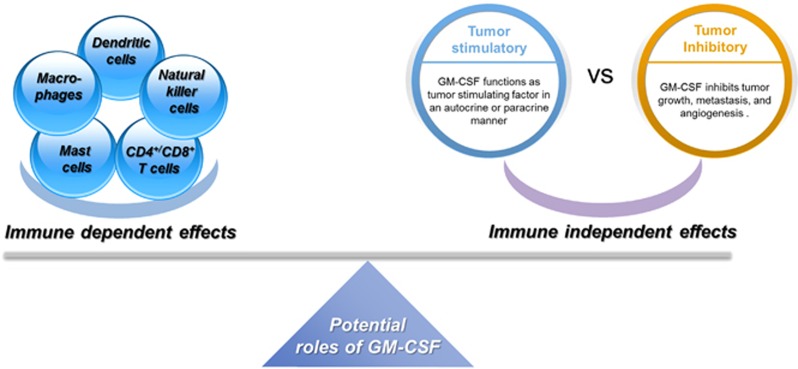
Granulocyte-macrophage colony-stimulating factor (GM-CSF, also called CSF-2) is best known for its critical role in immune modulation and hematopoiesis. A large body of experimental evidence indicates that GM-CSF, which is frequently upregulated in multiple types of human cancers, effectively marks cancer cells with a 'danger flag' for the immune system. In this context, most studies have focused on its function as an immunomodulator, namely its ability to stimulate dendritic cell (DC) maturation and monocyte/macrophage activity. However, recent studies have suggested that GM-CSF also promotes immune-independent tumor progression by supporting tumor microenvironments and stimulating tumor growth and metastasis. Although some studies have suggested that GM-CSF has inhibitory effects on tumor growth and metastasis, an even greater number of studies show that GM-CSF exerts stimulatory effects on tumor progression. In this review, we summarize a number of findings to provide the currently available information regarding the anticancer immune response of GM-CSG. We then discuss the potential roles of GM-CSF in the progression of multiple types of cancer to provide insights into some of the complexities of its clinical applications.
粒细胞-巨噬细胞集落刺激因子(GM-CSF,也称为CSF-2)因其在免疫调节和造血过程中的关键作用而广为人知。大量实验证据表明,GM-CSF在多种人类癌症中经常上调,它能有效地为免疫系统标记癌细胞,竖起“危险信号旗”。在此背景下,大多数研究集中在其作为免疫调节剂的功能上,即刺激树突状细胞(DC)成熟和单核细胞/巨噬细胞活性的能力。然而,最近的研究表明,GM-CSF还通过支持肿瘤微环境以及刺激肿瘤生长和转移来促进非免疫依赖性肿瘤进展。尽管一些研究表明GM-CSF对肿瘤生长和转移有抑制作用,但更多研究表明GM-CSF对肿瘤进展有刺激作用。在本综述中,我们总结了一些研究结果,以提供有关GM-CSF抗癌免疫反应的现有信息。然后,我们讨论GM-CSF在多种癌症进展中的潜在作用,以深入了解其临床应用的一些复杂性。