Tominaga Kei, Doyama Hisashi, Nakanishi Hiroyoshi, Yoshida Naohiro, Takeda Yasuhito, Ota Ryosuke, Tsuji Kunihiro, Matsunaga Kazuhiro, Tsuji Shigetsugu, Takemura Kenichi, Yamada Shinya, Katayanagi Kazuyoshi, Kurumaya Hiroshi
Department of Gastroenterology (Kei Tominaga, Hisashi Doyama, Hiroyoshi Nakanishi, Naohiro Yoshida, Yasuhito Takeda, Ryosuke Ota, Kunihiro Tsuji, Kazuhiro Matsunaga, Shigetsugu Tsuji, Kenichi Takemura, Shinya Yamada).
Department of Diagnostic Pathology (Kazuyoshi Katayanagi, Hiroshi Kurumaya), Ishikawa Prefectural Central Hospital, Kanazawa, Japan.
Ann Gastroenterol. 2016 Jul-Sep;29(3):318-24. doi: 10.20524/aog.2016.0025. Epub 2016 Mar 17.
The aim of the study was to clarify the frequency of colorectal neoplasm (CRN) complicating superficial esophageal squamous cell carcinoma (ESCC) and the need for colonoscopy.
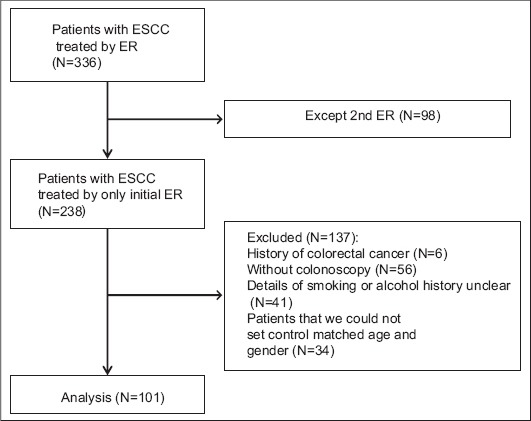
We retrospectively reviewed 101 patients who had undergone initial endoscopic resection (ER) for superficial ESCC. Control group participants were age- and sex-matched asymptomatic subjects screened at our hospital over the same period of time. Advanced adenoma was defined as an adenoma ≥10 mm, with villous features, or high-grade dysplasia. Advanced CRN referred to advanced adenoma or cancer. We measured the incidence of advanced CRN in superficial ESCC and controls, and we compared the characteristics of superficial ESCC patients with and without advanced CRN.
In the superficial ESCC group, advanced CRNs were found in 17 patients (16.8%). A history of smoking alone was found to be a significant risk factor of advanced CRN [odds ratio 6.02 (95% CI 1.30-27.8), P=0.005].
The frequency of synchronous advanced CRN is high in superficial ESCC patients subjected to ER. Colonoscopy should be highly considered for most patients who undergo ER for superficial ESCC with a history of smoking, and is recommended even in superficial ESCC patients.
本研究旨在明确合并浅表性食管鳞状细胞癌(ESCC)的结直肠肿瘤(CRN)的发生率以及结肠镜检查的必要性。
我们回顾性分析了101例行浅表性ESCC初次内镜切除(ER)的患者。对照组参与者为同期在我院接受筛查的年龄和性别匹配的无症状受试者。高级别腺瘤定义为直径≥10 mm、具有绒毛状特征或高级别异型增生的腺瘤。高级别CRN指高级别腺瘤或癌症。我们测量了浅表性ESCC患者和对照组中高级别CRN的发生率,并比较了有和无高级别CRN的浅表性ESCC患者的特征。
在浅表性ESCC组中,17例患者(16.8%)发现有高级别CRN。仅吸烟史被发现是高级别CRN的显著危险因素[比值比6.02(95%CI 1.30 - 27.8),P = 0.005]。
接受ER的浅表性ESCC患者中同步发生高级别CRN的频率较高。对于大多数有吸烟史且接受ER治疗浅表性ESCC的患者,应高度考虑进行结肠镜检查,即使是浅表性ESCC患者也建议进行。