Liu Wei, Jiang Hong-Li, Cai Lin-Li, Yan Min, Dong Shou-Jin, Mao Bing
Pneumology Group, Department of Integrated Traditional Chinese and Western Medicine, West China Hospital, Sichuan University, Chengdu 610041, China.
Evid Based Complement Alternat Med. 2016;2016:5292346. doi: 10.1155/2016/5292346. Epub 2016 Jun 5.
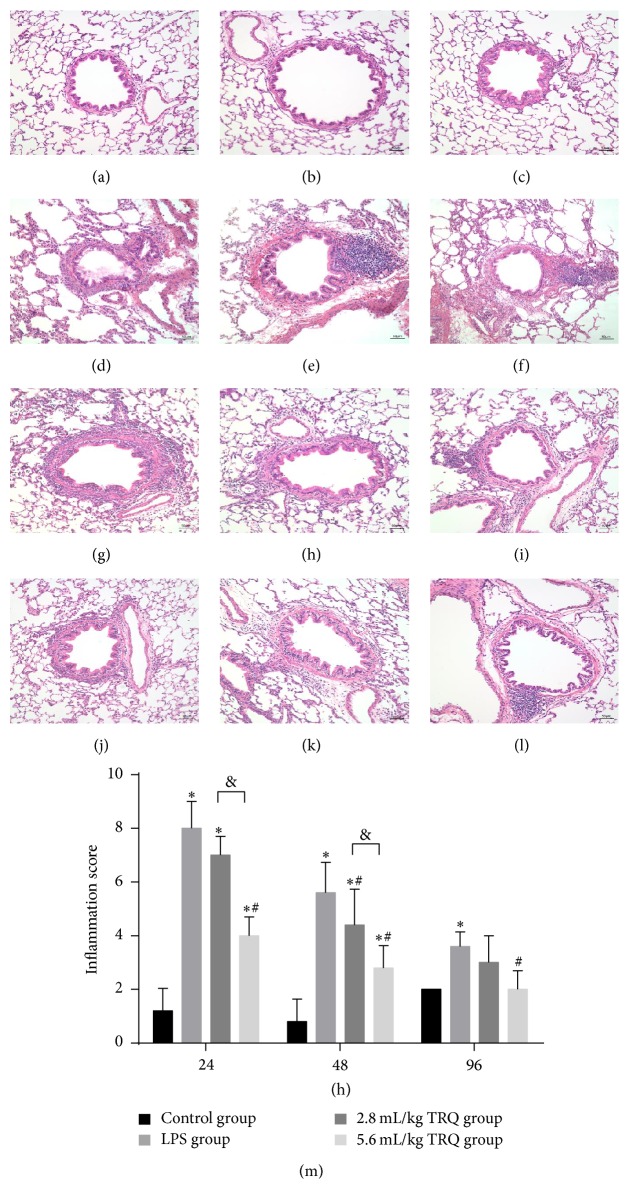
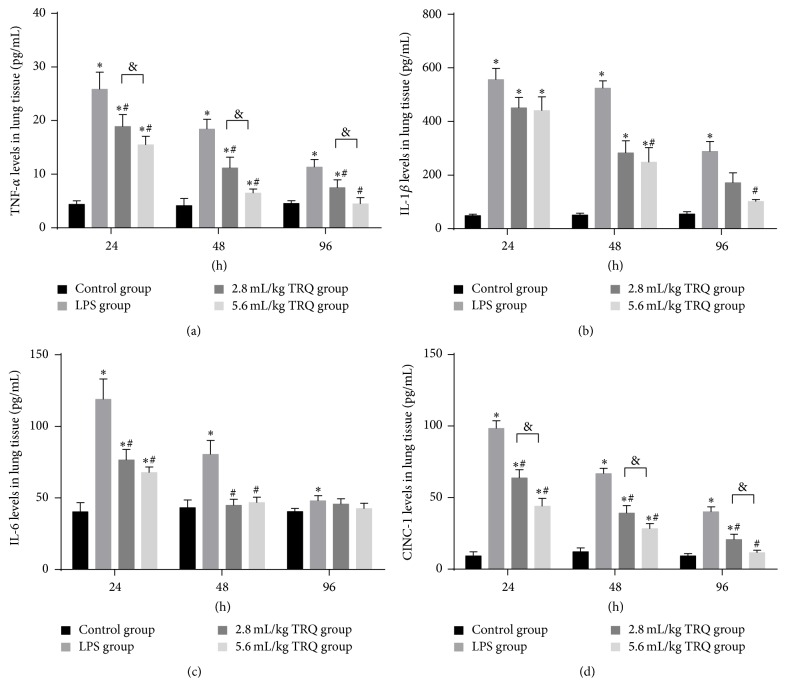
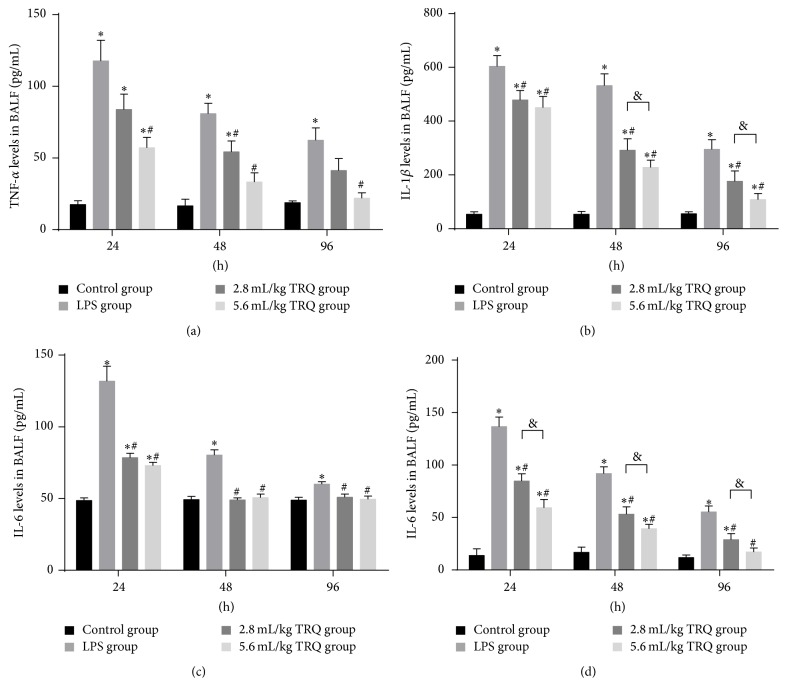
Background. Tanreqing injection (TRQ) is a commonly used herbal patent medicine for treating inflammatory airway diseases in view of its outstanding anti-inflammatory properties. In this study, we explored the signaling pathways involved in contributions of TRQ to LPS-induced airway inflammation in rats. Methods/Design. Adult male Sprague Dawley (SD) rats randomly divided into different groups received intratracheal instillation of LPS and/or intraperitoneal injection of TRQ. Bronchoalveolar Lavage Fluid (BALF) and lung samples were collected at 24 h, 48 h, and 96 h after TRQ administration. Protein and mRNA levels of tumor necrosis factor- (TNF-) α, Interleukin- (IL-) 1β, IL-6, and IL-8 in BALF and lung homogenate were observed by ELISA and real-time PCR, respectively. Lung sections were stained for p38 MAPK and NF-κB detection by immunohistochemistry. Phospho-p38 MAPK, phosphor-extracellular signal-regulated kinases ERK1/2, phospho-SAPK/JNK, phospho-NF-κB p65, phospho-IKKα/β, and phospho-IκB-α were measured by western blot analysis. Results. The results showed that TRQ significantly counteracted LPS-stimulated release of TNF-α, IL-1β, IL-6, and IL-8, attenuated cells influx in BALF, mitigated mucus hypersecretion, suppressed phosphorylation of NF-κB p65, IκB-α, ΙKKα/β, ERK1/2, JNK, and p38 MAPK, and inhibited p38 MAPK and NF-κB p65 expression in rat lungs. Conclusions. Results of the current research indicate that TRQ possesses potent exhibitory effects in LPS-induced airway inflammation by, at least partially, suppressing the MAPKs and NF-κB signaling pathways, in a general dose-dependent manner.
背景。痰热清注射液(TRQ)鉴于其出色的抗炎特性,是治疗气道炎症性疾病常用的中药专利药。在本研究中,我们探究了TRQ对脂多糖(LPS)诱导的大鼠气道炎症作用所涉及的信号通路。方法/设计。成年雄性Sprague Dawley(SD)大鼠随机分为不同组,接受气管内滴注LPS和/或腹腔注射TRQ。在给予TRQ后24小时、48小时和96小时收集支气管肺泡灌洗液(BALF)和肺组织样本。分别通过酶联免疫吸附测定(ELISA)和实时聚合酶链反应(PCR)观察BALF和肺匀浆中肿瘤坏死因子-α(TNF-α)、白细胞介素-1β(IL-1β)、IL-6和IL-8的蛋白质和信使核糖核酸(mRNA)水平。通过免疫组织化学对肺切片进行p38丝裂原活化蛋白激酶(MAPK)和核因子-κB(NF-κB)检测染色。通过蛋白质印迹分析测定磷酸化p38 MAPK、磷酸化细胞外信号调节激酶ERK1/2、磷酸化应激激活蛋白激酶/应激活化蛋白激酶(SAPK/JNK)、磷酸化NF-κB p65、磷酸化IκB激酶α/β(IKKα/β)和磷酸化IκB-α。结果。结果显示,TRQ显著对抗LPS刺激的TNF-α、IL-1β、IL-6和IL-8释放,减轻BALF中的细胞流入,减轻黏液分泌过多,抑制NF-κB p65、IκB-α、IKKα/β、ERK1/2、JNK和p38 MAPK的磷酸化,并抑制大鼠肺中p38 MAPK和NF-κB p65的表达。结论。当前研究结果表明,TRQ在LPS诱导的气道炎症中具有显著作用,至少部分是通过以一般剂量依赖性方式抑制MAPK和NF-κB信号通路实现的。