Huang Shih-Wei, Wang Wei-Te, Lin Li-Fong, Liao Chun-De, Liou Tsan-Hon, Lin Hui-Wen
aDepartment of Physical Medicine and Rehabilitation, Shuang Ho Hospital, Taipei Medical University bDepartment of Physical Medicine and Rehabilitation, School of Medicine, College of Medicine, Taipei Medical University, Taipei cDepartment of Physical Medicine and Rehabilitation, Changhua Christian Hospital, Changhua dInstitute of Gerontology and Health Management, Taipei Medical University eGraduate Institute of Injury Prevention, Taipei Medical University fDepartment of Mathematics, Soochow University gEvidence-Based Medicine Center, Wan Fang Hospital, Taipei Medical University, Taipei, Taiwan.
Medicine (Baltimore). 2016 Jun;95(26):e4016. doi: 10.1097/MD.0000000000004016.
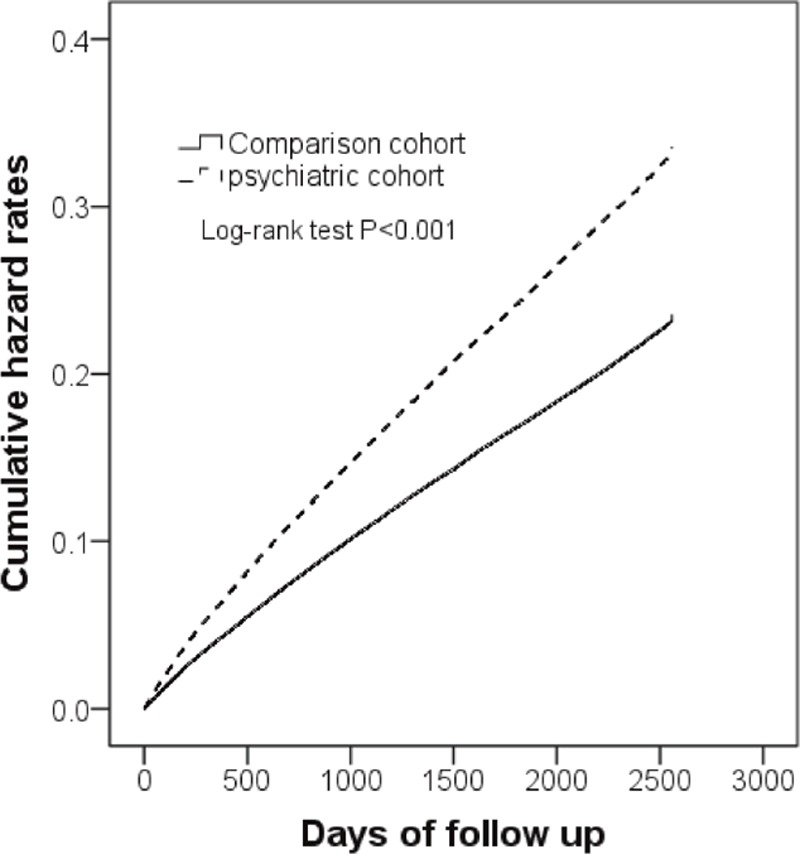
Although the association between depressive disorders and osteoarthritis (OA) has been studied, the association of other psychiatric disorders with OA remains unclear. Here, we investigated whether psychiatric disorders are risk factors for OA.The data were obtained from the Longitudinal Health Insurance Database 2005 of Taiwan. We collected the ambulatory care claim records of patients who were diagnosed with psychiatric disorders according to the International Classification of Diseases, Ninth Revision, Clinical Modification (ICD-9-CM) codes between January 1, 2004 and December 31, 2008. The prevalence and adjusted hazard ratios (HRs) of osteoarthritis among patients with psychiatric disorders and the control cohort were estimated.Of 74,393 patients with psychiatric disorders, 16,261 developed OA during the 7-year follow-up period. The crude HR for OA was 1.44 (95% confidence interval [CI], 1.39-1.49), which was higher than that of the control cohort. The adjusted HR for OA was 1.42 (95% CI, 1.39-1.42) among patients with psychiatric disorders during the 7-year follow-up period. Further analysis revealed that affective psychoses, neurotic illnesses or personality disorders, alcohol and drug dependence or abuse, and other mental disorders were risk factors for OA.This large-scale longitudinal population-based study revealed that affective psychoses, personality disorders, and alcohol and drug dependence or abuse are risk factors for OA.
尽管已对抑郁症与骨关节炎(OA)之间的关联进行了研究,但其他精神障碍与OA之间的关联仍不明确。在此,我们调查了精神障碍是否为OA的危险因素。数据取自台湾2005年纵向健康保险数据库。我们收集了2004年1月1日至2008年12月31日期间根据国际疾病分类第九版临床修订本(ICD-9-CM)编码被诊断为精神障碍患者的门诊护理索赔记录。估计了精神障碍患者和对照队列中骨关节炎的患病率及调整后的风险比(HRs)。在74393例精神障碍患者中,16261例在7年随访期内患上OA。OA的粗风险比为1.44(95%置信区间[CI],1.39 - 1.49),高于对照队列。在7年随访期内,精神障碍患者中OA的调整后风险比为1.42(95%CI,1.39 - 1.42)。进一步分析显示,情感性精神病、神经症性疾病或人格障碍、酒精和药物依赖或滥用以及其他精神障碍是OA的危险因素。这项基于大规模纵向人群的研究表明,情感性精神病、人格障碍以及酒精和药物依赖或滥用是OA的危险因素。