Faculty of Medicine, Damascus University, Fayez Mansour St. Al-Mezzeh, Damascus, Syria.
Faculty of Medicine, Syrian Private University, Damascus, Syria.
BMC Med Educ. 2018 Jun 18;18(1):142. doi: 10.1186/s12909-018-1241-z.
Peer training has been identified as a useful tool for delivering undergraduate training in basic life support (BLS) which is fundamental as an initial response in cases of emergency. This study aimed to (1) Evaluate the efficacy of peer-led model in basic life support training among medical students in their first three years of study, compared to professional-led training and (2) To assess the efficacy of the course program and students' satisfaction of peer-led training.
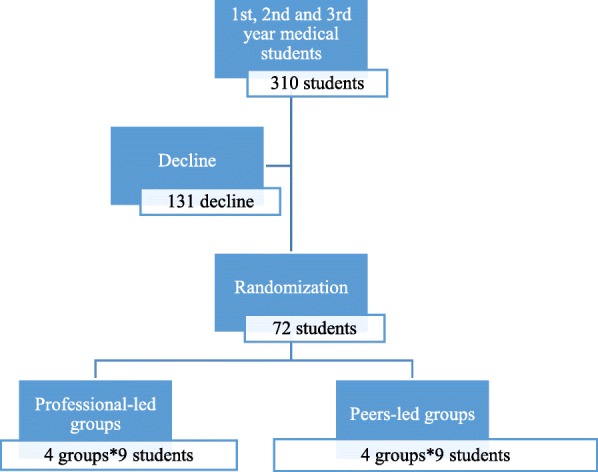
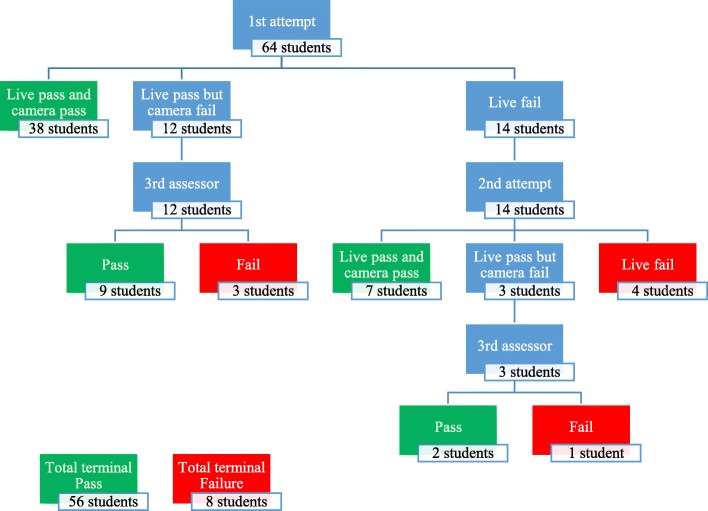
A randomized controlled trial with blinded assessors was conducted on 72 medical students from the pre-clinical years (1st to 3rd years in Syria) at Syrian Private University. Students were randomly assigned to peer-led or to professional-led training group for one-day-course of basic life support skills. Sixty-four students who underwent checklist based assessment using objective structured clinical examination design (OSCE) (practical assessment of BLS skills) and answered BLS knowledge checkpoint-questionnaire were included in the analysis.
There was no statistically significant difference between the two groups in delivering BLS skills to medical students in practical (P = 0.850) and BLS knowledge questionnaire outcomes (P = 0.900). Both groups showed statistically significant improvement from pre- to post-course assessment with significant statistical difference in both practical skills and theoretical knowledge (P-Value < 0.001). Students were satisfied with the peer model of training.
Peer-led training of basic life support for medical students was beneficial and it provided a quality of education which was as effective as training conducted by professionals. This method is applicable and desirable especially in poor-resource countries and in crisis situation.
同伴培训已被确定为在基本生命支持 (BLS) 方面提供本科培训的有用工具,这是紧急情况下的初始反应的基础。本研究旨在:(1) 评估同伴主导模式在医学专业一年级至三年级学生基本生命支持培训中的效果,与专业主导培训相比;(2) 评估课程计划的效果和学生对同伴主导培训的满意度。
在叙利亚私立大学,对来自临床前阶段(第 1 年至第 3 年)的 72 名医学生进行了一项随机对照试验,评估员设盲。学生被随机分配到同伴主导或专业主导培训组,参加为期一天的基本生命支持技能课程。64 名学生接受了基于检查表的评估,使用客观结构化临床考试设计 (OSCE)(基本生命支持技能的实际评估),并回答了基本生命支持知识检查点问卷,他们被纳入分析。
在向医学生传授基本生命支持技能方面,两组在实践(P=0.850)和基本生命支持知识问卷结果(P=0.900)方面没有统计学上的显著差异。两组在课程前后评估中都显示出统计学上的显著改善,实践技能和理论知识都有显著的统计学差异(P 值<0.001)。学生对同伴培训模式感到满意。
同伴主导的基本生命支持培训对医学生是有益的,它提供了与专业人员培训一样有效的教育质量。这种方法尤其适用于资源匮乏的国家和危机情况。