Kobel Susanne, Lämmle Christine, Wartha Olivia, Kesztyüs Dorothea, Wirt Tamara, Steinacker Jürgen M
Division of Sports and Rehabilitation, Department of Internal Medicine II, Ulm University Medical Centre, Frauensteige 6, Haus 58/33, 89075, Ulm, Germany.
J Immigr Minor Health. 2017 Apr;19(2):254-262. doi: 10.1007/s10903-016-0460-9.
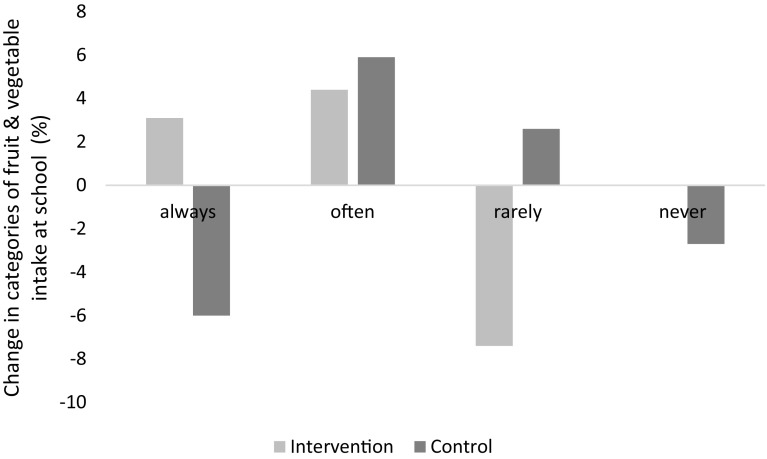
Children with migration background (MB) appear to be at higher risk of developing obesity, therefore, prevention is necessary to avoid possible health inequalities. This study investigated a 1-year intervention with focus on increasing physical activity (PA) and fruit and vegetable intake (FVI), decreasing screen media use (SMU) and soft drink consumption (SDC) in children with MB. 525 children (7.1 ± 0.7 years) with MB who participated in the cluster-randomised study were assessed at baseline and after 1 year. Daily SMU, PA behaviours, SDC and FVI were assessed using a parental questionnaire. After one year, significant effects were found in the intervention group for FVI (p ≤ 0.035). Partially strong tendencies but no significant differences were found for PA and SDC. Although the effects are small, the intervention seems to reach children with MB. An intervention lasting longer than one year might result in more changes.
有移民背景(MB)的儿童似乎患肥胖症的风险更高,因此,有必要进行预防以避免可能出现的健康不平等。本研究调查了一项为期1年的干预措施,重点是增加有移民背景儿童的身体活动(PA)和水果及蔬菜摄入量(FVI),减少屏幕媒体使用(SMU)和软饮料消费(SDC)。对参与整群随机研究的525名有移民背景的儿童(7.1±0.7岁)在基线时和1年后进行了评估。使用家长问卷评估每日屏幕媒体使用、身体活动行为、软饮料消费和水果及蔬菜摄入量。1年后,干预组在水果及蔬菜摄入量方面有显著效果(p≤0.035)。在身体活动和软饮料消费方面发现了部分较强的趋势,但没有显著差异。尽管效果较小,但该干预措施似乎对有移民背景的儿童有作用。持续时间超过1年的干预可能会带来更多变化。