Vallerand David, Massonnet Gérald, Kébir Fatima, Gentien David, Maciorowski Zofia, De la Grange Pierre, Sigal-Zafrani Brigitte, Richardson Marion, Humbert Sandrine, Thuleau Aurélie, Assayag Franck, de Plater Ludmilla, Nicolas André, Scholl Suzy, Marangoni Elisabetta, Weigand Stefan, Roman-Roman Sergio, Savina Ariel, Decaudin Didier
Translational Research Department, Laboratory of Preclinical Investigation, Institut Curie, PSL University, Paris, France.
Institut Roche, Boulogne-Billancourt, France.
PLoS One. 2016 Jul 7;11(7):e0157670. doi: 10.1371/journal.pone.0157670. eCollection 2016.
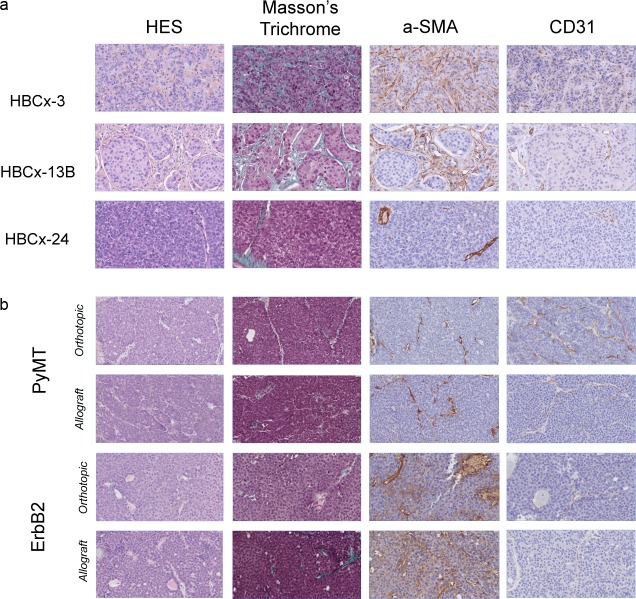
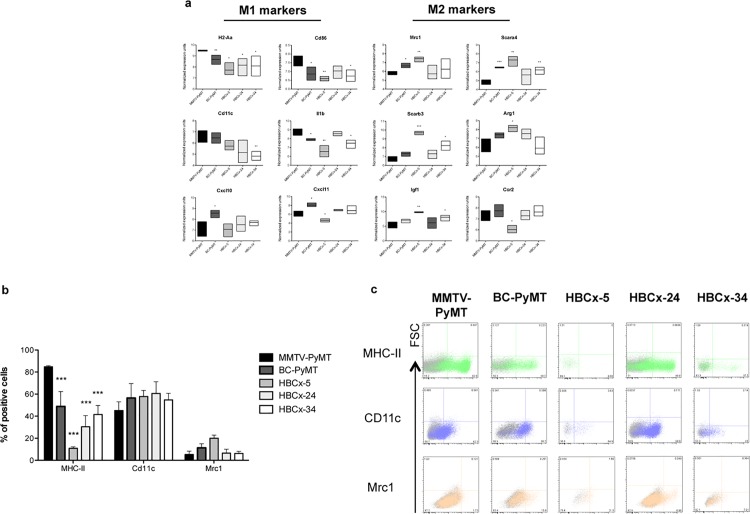
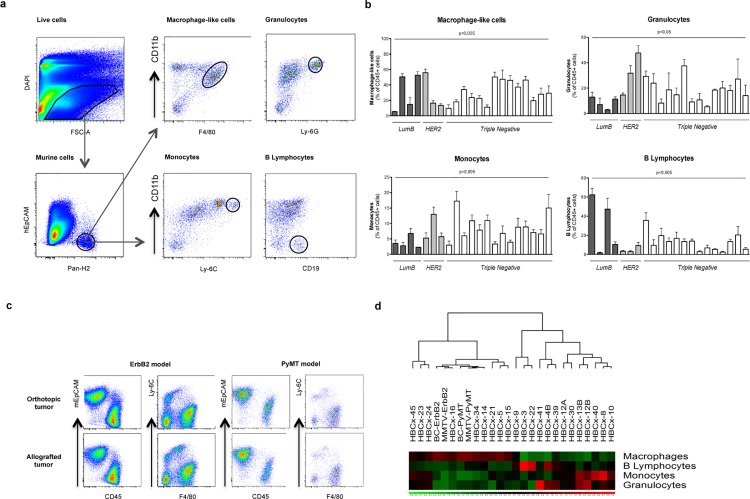
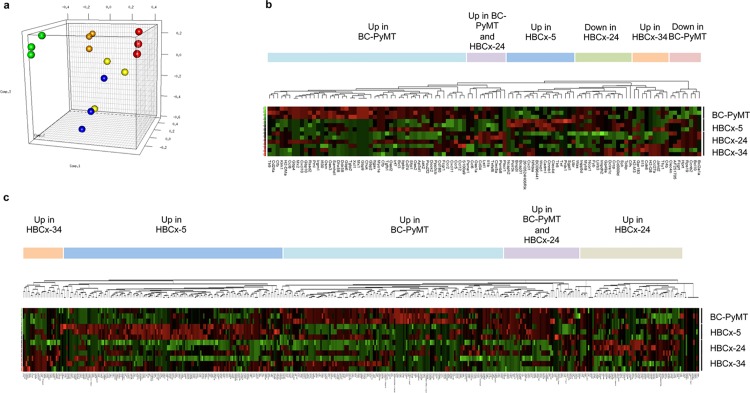
Drug discovery efforts have focused on the tumor microenvironment in recent years. However, few studies have characterized the stroma component in patient-derived xenografts (PDXs) and genetically engineered mouse models (GEMs). In this study, we characterized the stroma in various models of breast cancer tumors in mice. We performed transcriptomic and flow cytometry analyses on murine populations for a series of 25 PDXs and the two most commonly used GEMs (MMTV-PyMT and MMTV-erBb2). We sorted macrophages from five models. We then profiled gene expression in these cells, which were also subjected to flow cytometry for phenotypic characterization. Hematopoietic cell composition, mostly macrophages and granulocytes, differed between tumors. Macrophages had a specific polarization phenotype related to their M1/M2 classification and associated with the expression of genes involved in the recruitment, invasion and metastasis processes. The heterogeneity of the stroma component of the models studied suggests that tumor cells modify their microenvironment to satisfy their needs. Our observations suggest that such models are of relevance for preclinical studies.
近年来,药物研发工作聚焦于肿瘤微环境。然而,很少有研究对源自患者的异种移植模型(PDXs)和基因工程小鼠模型(GEMs)中的基质成分进行表征。在本研究中,我们对小鼠乳腺癌肿瘤的各种模型中的基质进行了表征。我们对一系列25个PDXs以及两种最常用的GEMs(MMTV-PyMT和MMTV-erBb2)的小鼠群体进行了转录组学和流式细胞术分析。我们从五个模型中分选了巨噬细胞。然后我们分析了这些细胞中的基因表达,这些细胞也进行了流式细胞术以进行表型表征。肿瘤之间造血细胞组成(主要是巨噬细胞和粒细胞)有所不同。巨噬细胞具有与其M1/M2分类相关的特定极化表型,并与参与招募、侵袭和转移过程的基因表达相关。所研究模型的基质成分的异质性表明肿瘤细胞会改变其微环境以满足自身需求。我们的观察结果表明,此类模型对于临床前研究具有相关性。