Henritzi Dinah, Zhao Na, Starick Elke, Simon Gaelle, Krog Jesper S, Larsen Lars Erik, Reid Scott M, Brown Ian H, Chiapponi Chiara, Foni Emanuela, Wacheck Silke, Schmid Peter, Beer Martin, Hoffmann Bernd, Harder Timm C
Institute of Diagnostic Virology, Friedrich-Loeffler-Institute (FLI), Greifswald-Insel Riems, Germany.
Anses, Ploufragan-Plouzané Laboratory, Swine Virology Immunology Unit, Ploufragan, France.
Influenza Other Respir Viruses. 2016 Nov;10(6):504-517. doi: 10.1111/irv.12407. Epub 2016 Aug 9.
A diversifying pool of mammalian-adapted influenza A viruses (IAV) with largely unknown zoonotic potential is maintained in domestic swine populations worldwide. The most recent human influenza pandemic in 2009 was caused by a virus with genes originating from IAV isolated from swine. Swine influenza viruses (SIV) are widespread in European domestic pig populations and evolve dynamically. Knowledge regarding occurrence, spread and evolution of potentially zoonotic SIV in Europe is poorly understood.
Efficient SIV surveillance programmes depend on sensitive and specific diagnostic methods which allow for cost-effective large-scale analysis.
New SIV haemagglutinin (HA) and neuraminidase (NA) subtype- and lineage-specific multiplex real-time RT-PCRs (RT-qPCR) have been developed and validated with reference virus isolates and clinical samples.
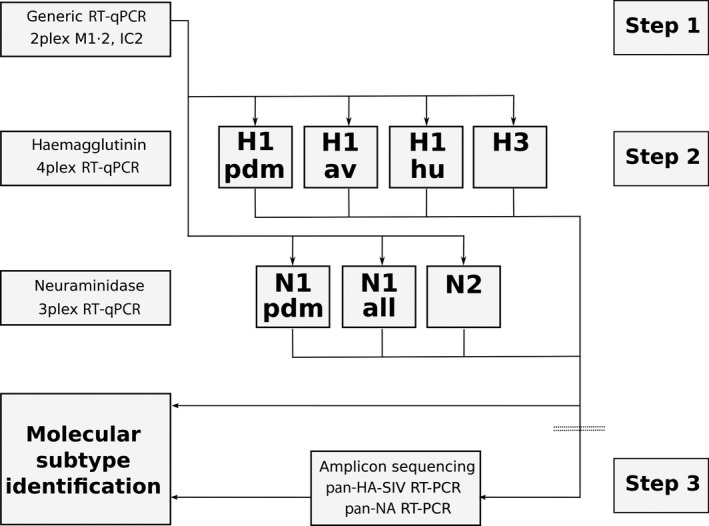
A diagnostic algorithm is proposed for the combined detection in clinical samples and subtyping of SIV strains currently circulating in Europe that is based on a generic, M-gene-specific influenza A virus RT-qPCR. In a second step, positive samples are examined by tetraplex HA- and triplex NA-specific RT-qPCRs to differentiate the porcine subtypes H1, H3, N1 and N2. Within the HA subtype H1, lineages "av" (European avian-derived), "hu" (European human-derived) and "pdm" (human pandemic A/H1N1, 2009) are distinguished by RT-qPCRs, and within the NA subtype N1, lineage "pdm" is differentiated. An RT-PCR amplicon Sanger sequencing method of small fragments of the HA and NA genes is also proposed to safeguard against failure of multiplex RT-qPCR subtyping.
These new multiplex RT-qPCR assays provide adequate tools for sustained SIV monitoring programmes in Europe.
全球家猪群体中存在多样化的适应哺乳动物的甲型流感病毒(IAV)库,其人畜共患病潜力大多未知。2009年最近一次人类流感大流行是由一种基因源自猪源IAV的病毒引起的。猪流感病毒(SIV)在欧洲家猪群体中广泛存在且动态演变。关于欧洲潜在人畜共患SIV的发生、传播和演变的知识了解甚少。
高效的SIV监测计划依赖于灵敏且特异的诊断方法,以实现具有成本效益的大规模分析。
已开发出新的SIV血凝素(HA)和神经氨酸酶(NA)亚型及谱系特异性多重实时逆转录聚合酶链反应(RT-qPCR),并使用参考病毒分离株和临床样本进行了验证。
提出了一种诊断算法,用于临床样本中的联合检测以及对欧洲目前流行的SIV毒株进行亚型分型,该算法基于通用的、M基因特异性甲型流感病毒RT-qPCR。第二步,通过四重HA特异性和三重NA特异性RT-qPCR检测阳性样本,以区分猪亚型H1、H3、N1和N2。在HA亚型H1内,通过RT-qPCR区分“av”(欧洲禽源)、“hu”(欧洲人源)和“pdm”(2009年甲型H1N1大流行毒株)谱系,在NA亚型N1内,区分“pdm”谱系。还提出了一种HA和NA基因小片段的RT-PCR扩增子桑格测序方法,以防止多重RT-qPCR亚型分型失败。
这些新的多重RT-qPCR检测方法为欧洲持续的SIV监测计划提供了适当的工具。