Zhang Peng, Wang Rui, Gao Chunshi, Song Yuanyuan, Lv Xin, Jiang Lingling, Yu Yaqin, Wang Yuhan, Li Bo
Department of Epidemiology and Biostatistics, Jilin University School of Public Health, 1163 Xinmin Street, Changchun, Jilin 130021, China.
Int J Environ Res Public Health. 2016 Jul 7;13(7):685. doi: 10.3390/ijerph13070685.
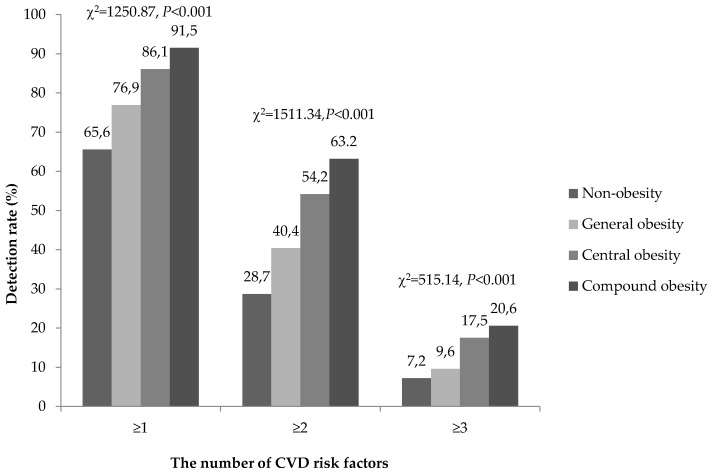
Cardiovascular disease (CVD) has become a serious public health problem in recent years in China. Aggregation of CVD risk factors in one individual increases the risk of CVD and the risk increases substantially with each additional risk factor. This study aims to explore the relationship between the number of clustered CVD risk factors and different types of obesity. A multistage stratified random cluster sampling design was used in this population-based cross-sectional study in 2012. Information was collected by face to face interviews. One-way analysis of variance (ANOVA), chi-square test, Kruskal-Wallis test and multiple logistic regression were used in this study. The prevalence of general obesity, central obesity and compound obesity were 0.3%, 36.1% and 14.7%, respectively. The prevalence of hypertension, hyperlipidemia and diabetes in the compound obesity group were higher than those in other groups (compound obesity > central obesity > general obesity > non-obesity), while smoking rate in the non-obesity group was higher than those in other groups (non-obesity > general obesity > central obesity > compound obesity). People with obesity were more likely to have one or more CVD risk factor compared with non-obesity subjects (general obesity (OR: 2.27, 95% CI: 1.13-4.56), central obesity (OR: 2.64, 95% CI: 2.41-2.89), compound obesity (OR: 5.09, 95% CI: 4.38-5.90). The results were similar when the number of clustered CVD risk factors was ≥ 2 and ≥ 3. As a conclusion, more than half of the residents in Jilin Province have a problem of obesity, especially central obesity. Government and health department should take measures to improve people's awareness of central obesity in Jilin Province of China. The prevalence of hypertension, hyperlipidemia and diabetes are associated with obesity types. Compound obesity has a greater risk to cluster multiple CVD risk factors than central obesity and general obesity. Taking measures to control obesity will reduce the prevalence of CVD in Jilin Province.
近年来,心血管疾病(CVD)在中国已成为一个严重的公共卫生问题。个体中CVD危险因素的聚集会增加患CVD的风险,且每增加一个危险因素,风险会大幅上升。本研究旨在探讨聚集性CVD危险因素的数量与不同类型肥胖之间的关系。在这项基于人群的2012年横断面研究中,采用了多阶段分层随机整群抽样设计。通过面对面访谈收集信息。本研究使用了单因素方差分析(ANOVA)、卡方检验、Kruskal-Wallis检验和多元逻辑回归。总体肥胖、中心性肥胖和复合性肥胖的患病率分别为0.3%、36.1%和14.7%。复合性肥胖组的高血压、高脂血症和糖尿病患病率高于其他组(复合性肥胖>中心性肥胖>总体肥胖>非肥胖),而非肥胖组的吸烟率高于其他组(非肥胖>总体肥胖>中心性肥胖>复合性肥胖)。与非肥胖受试者相比,肥胖者更有可能有一个或多个CVD危险因素(总体肥胖(OR:2.27,95%CI:1.13 - 4.56),中心性肥胖(OR:2.64,95%CI:2.41 - 2.89),复合性肥胖(OR:5.09,95%CI:4.38 - 5.90)。当聚集性CVD危险因素的数量≥2和≥3时,结果相似。结论是,吉林省超过一半的居民存在肥胖问题,尤其是中心性肥胖。中国吉林省的政府和卫生部门应采取措施提高人们对中心性肥胖的认识。高血压、高脂血症和糖尿病的患病率与肥胖类型有关。复合性肥胖比中心性肥胖和总体肥胖聚集多个CVD危险因素的风险更大。采取措施控制肥胖将降低吉林省CVD的患病率。