Botana Luis M, Alfonso Amparo, Rodríguez Ines, Botana Ana M, Louzao Maria Del Carmen, Vieytes Mercedes R
Departamento de Farmacología, Facultad Veterinaria, Universidad de Santiago de Compostela, 27002 Lugo, Spain.
Facultad de Ciencias, Universidad de Santiago, 27002 Lugo, Spain.
Toxins (Basel). 2016 Jul 6;8(7):208. doi: 10.3390/toxins8070208.
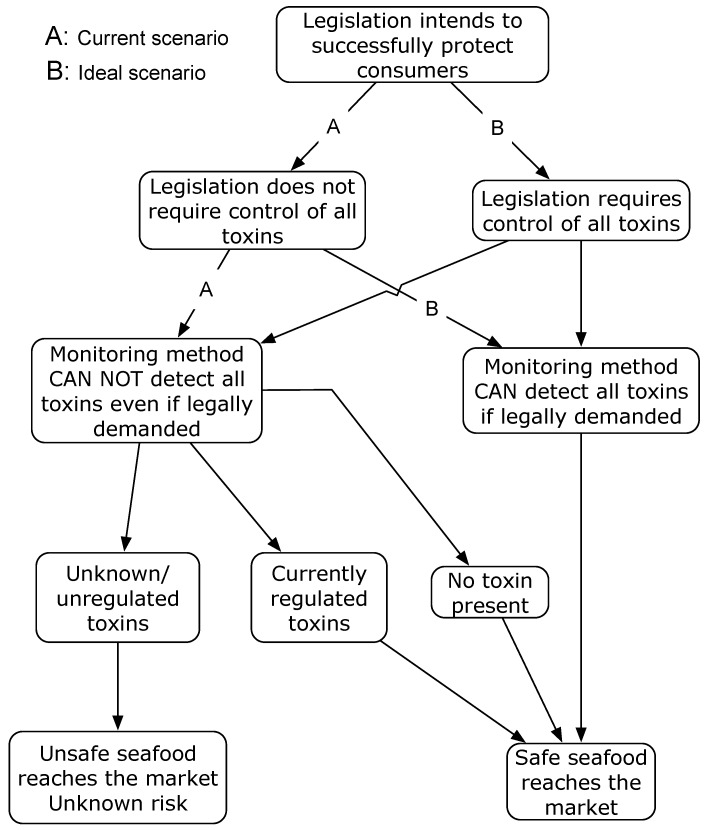
Current regulation for marine toxins requires a monitoring method based on mass spectrometric analysis. This method is pre-targeted, hence after searching for pre-assigned masses, it identifies those compounds that were pre-defined with available calibrants. Therefore, the scope for detecting novel toxins which are not included in the monitoring protocol are very limited. In addition to this, there is a poor comprehension of the toxicity of some marine toxin groups. Also, the validity of the current approach is questioned by the lack of sufficient calibrants, and by the insufficient coverage by current legislation of the toxins reported to be present in shellfish. As an example, tetrodotoxin, palytoxin analogs, or cyclic imines are mentioned as indicators of gaps in the system that require a solid comprehension to assure consumers are protected.
目前对海洋毒素的监管要求采用基于质谱分析的监测方法。这种方法是预靶向的,因此在搜索预分配的质量数后,它会识别那些用可用校准物预先定义的化合物。因此,检测监测方案中未包括的新型毒素的范围非常有限。除此之外,对一些海洋毒素类别的毒性了解不足。此外,当前方法的有效性受到缺乏足够校准物以及现行法规对贝类中报告存在的毒素覆盖不足的质疑。例如,河豚毒素、岩沙海葵毒素类似物或环亚胺被提及作为该系统中存在差距的指标,需要深入了解以确保消费者得到保护。