Scharmga A, Peters M, van Tubergen A, van den Bergh J, de Jong J, Loeffen D, van Rietbergen B, Weijers R, Geusens P
Department of Medicine, division of Rheumatology, Maastricht University Medical Centre, P.O. Box 5800, NL-6202 AZ, Maastricht, The Netherlands.
NUTRIM School of Nutrition and Translational Research in Metabolism, Maastricht University, Maastricht, The Netherlands.
BMC Musculoskelet Disord. 2016 Jul 11;17:271. doi: 10.1186/s12891-016-1148-y.
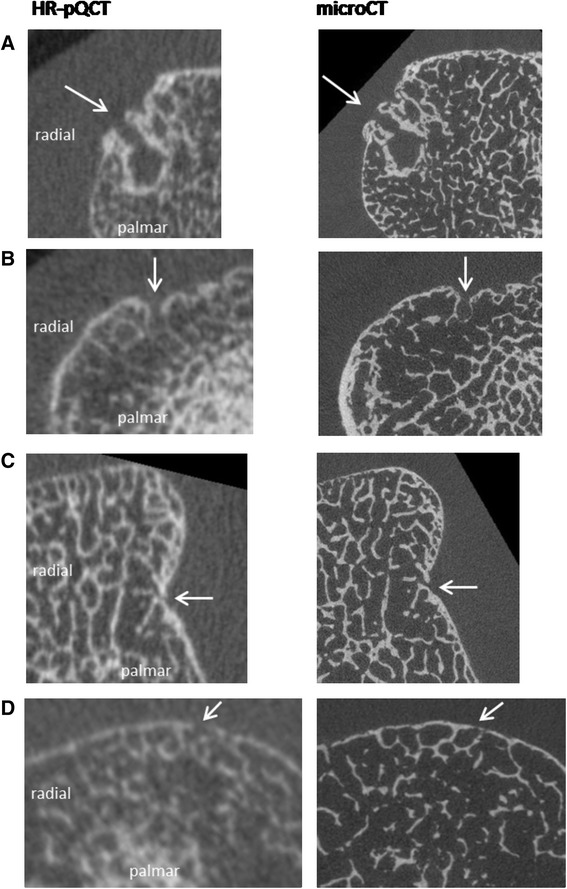
To study the reliability and validity of high-resolution peripheral quantitative CT (HR-pQCT) with microCT (μCT) as gold standard in the visual detection of cortical breaks in metacarpophalangeal (MCP) and proximal interphalangeal (PIP) joints.
Ten cadaveric fingers (10 MCP and 9 PIP joints) were imaged by HR-pQCT and μCT and visually analyzed by two independent readers. Intra- and interreader reliability were evaluated for the presence (yes/no, kappa statistics) and the total number (intraclass correlation coefficient, ICC) of cortical breaks. Sensitivity, specificity, positive and negative predictive value (PPV respectively NPV) of HR-pQCT in detecting cortical breaks were calculated.
With HR-pQCT, mean 149 cortical breaks were identified and with μCT mean 129 (p < 0.05). Intrareader reliability for the presence of a cortical break per quadrant was 0.52 (95 % CI 0.48-0.56) and 0.71 (95 % CI 0.67-0.75) for HR-pQCT and μCT, respectively, and for the total number of cortical breaks 0.61 (95 % CI 0.49-0.70) and 0.75 (95 % CI 0.68-0.82). Interreader reliability for the presence of a cortical break per quadrant was 0.37 (95 % CI 0.33-0.41) and 0.45 (95 % CI 0.41-0.49) for HR-pQCT and μCT, respectively, and for the number of cortical breaks 0.55 (95 % CI 0.43-0.65) and 0.54 (95 % CI 0.35-0.67). Sensitivity, specificity, PPV and NPV of HR-pQCT were 81.6, 64.0, 81.6, and 64 % respectively.
Cortical breaks were commonly visualized in MCP and PIP joints with HR-pQCT and μCT. Reliability of both HR-pQCT and μCT was fair to moderate. HR-pQCT was highly sensitive to detect cortical breaks with μCT as gold standard.
以微型计算机断层扫描(μCT)作为金标准,研究高分辨率外周定量CT(HR-pQCT)在肉眼检测掌指关节(MCP)和近端指间关节(PIP)皮质骨断裂方面的可靠性和有效性。
对10个尸体手指(10个MCP关节和9个PIP关节)进行HR-pQCT和μCT成像,并由两名独立的阅片者进行肉眼分析。评估阅片者内部和阅片者之间对于皮质骨断裂的存在情况(是/否,kappa统计量)和总数(组内相关系数,ICC)的可靠性。计算HR-pQCT检测皮质骨断裂的敏感性、特异性、阳性预测值和阴性预测值(分别为PPV和NPV)。
使用HR-pQCT平均识别出149处皮质骨断裂,使用μCT平均识别出129处(p < 0.05)。对于每个象限皮质骨断裂的存在情况,HR-pQCT的阅片者内部可靠性为0.52(95%CI 0.48 - 0.56),μCT为0.71(95%CI 0.67 - 0.75);对于皮质骨断裂的总数,HR-pQCT为0.61(95%CI 0.49 - 0.70),μCT为0.75(95%CI 0.68 - 0.82)。对于每个象限皮质骨断裂的存在情况,HR-pQCT的阅片者间可靠性为0.37(95%CI 0.33 - 0.41),μCT为0.45(95%CI 0.41 - 0.49);对于皮质骨断裂数量,HR-pQCT为0.55(95%CI 0.43 - 0.65),μCT为0.54(95%CI 0.35 - 0.67)。HR-pQCT的敏感性、特异性、PPV和NPV分别为81.6%、64.0%、81.6%和64%。
使用HR-pQCT和μCT在MCP和PIP关节中常可观察到皮质骨断裂。HR-pQCT和μCT的可靠性均为中等。以μCT作为金标准,HR-pQCT在检测皮质骨断裂方面具有高度敏感性。