Lombaert Isabelle, Movahednia Mohammad M, Adine Christabella, Ferreira Joao N
Department of Biologic & Materials Sciences, School of Dentistry, University of Michigan, Ann Arbor, Michigan, USA.
Biointerfaces Institute, North Campus Research Complex, University of Michigan, Ann Arbor, Michigan, USA.
Stem Cells. 2017 Jan;35(1):97-105. doi: 10.1002/stem.2455. Epub 2016 Jul 15.
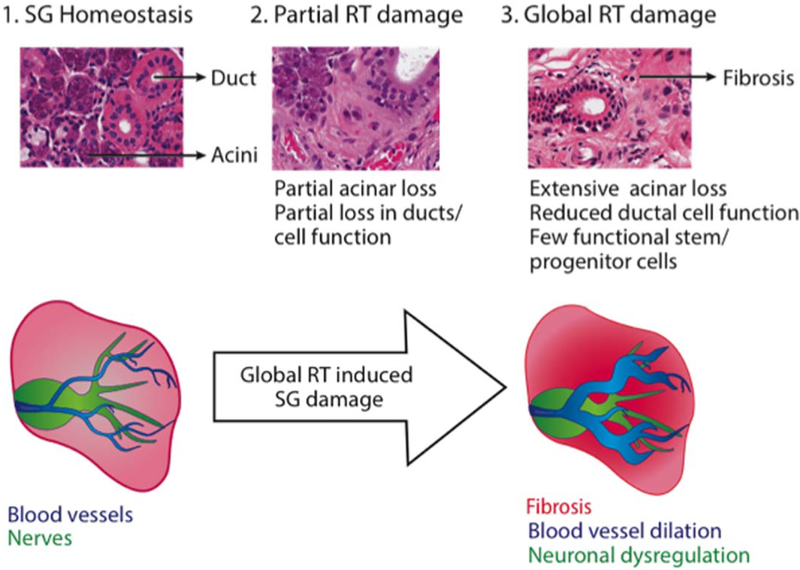
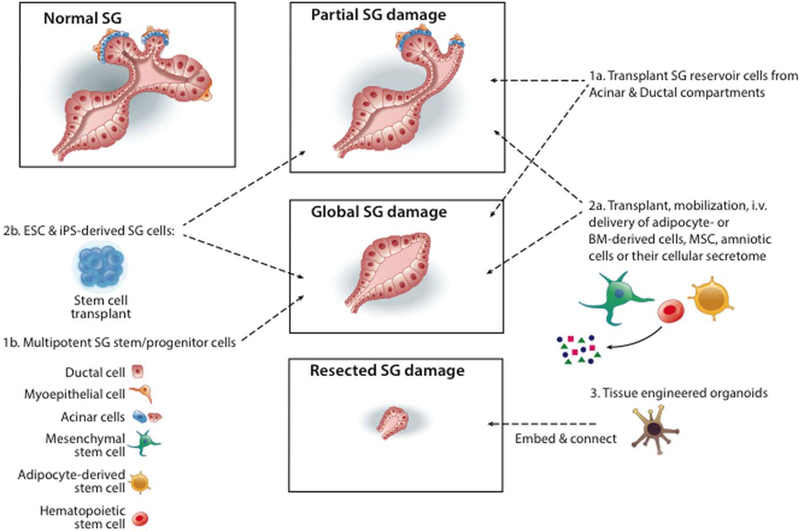
The human salivary gland (SG) has an elegant architecture of epithelial acini, connecting ductal branching structures, vascular and neuronal networks that together function to produce and secrete saliva. This review focuses on the translation of cell- and tissue-based research toward therapies for patients suffering from SG hypofunction and related dry mouth syndrome (xerostomia), as a consequence of radiation therapy or systemic disease. We will broadly review the recent literature and discuss the clinical prospects of stem/progenitor cell and tissue-based therapies for SG repair and/or regeneration. Thus far, several strategies have been proposed for the purpose of restoring SG function: (1) transplanting autologous SG-derived epithelial stem/progenitor cells; (2) exploiting non-epithelial cells and/or their bioactive lysates; and (3) tissue engineering approaches using 3D (three-dimensional) biomaterials loaded with SG cells and/or bioactive cues to mimic in vivo SGs. We predict that further scientific improvement in each of these areas will translate to effective therapies toward the repair of damaged glands and the development of miniature SG organoids for the fundamental restoration of saliva secretion. Stem Cells 2017;35:97-105.
人类唾液腺(SG)具有由上皮腺泡、连接导管分支结构、血管和神经网络构成的精妙结构,它们共同发挥作用以产生和分泌唾液。本综述聚焦于将基于细胞和组织的研究转化为针对因放射治疗或全身性疾病而患有唾液腺功能减退及相关口干综合征(口腔干燥症)患者的治疗方法。我们将广泛回顾近期文献,并讨论基于干细胞/祖细胞和组织的疗法用于唾液腺修复和/或再生的临床前景。迄今为止,为恢复唾液腺功能已提出了几种策略:(1)移植自体唾液腺来源的上皮干细胞/祖细胞;(2)利用非上皮细胞和/或其生物活性裂解物;(3)使用负载有唾液腺细胞和/或生物活性信号的3D(三维)生物材料的组织工程方法来模拟体内唾液腺。我们预测,这些领域中的每一个领域的进一步科学进展都将转化为修复受损腺体的有效疗法,以及开发用于基本恢复唾液分泌的微型唾液腺类器官。《干细胞》2017年;第35卷:97 - 105页