G T Pereira Anirene, Utsunomiya Yuri T, Milanesi Marco, Torrecilha Rafaela B P, Carmo Adriana S, Neves Haroldo H R, Carvalheiro Roberto, Ajmone-Marsan Paolo, Sonstegard Tad S, Sölkner Johann, Contreras-Castillo Carmen J, Garcia José F
Departamento de Agroindústria, Alimentos e Nutrição, Escola Superior de Agricultura "Luiz de Queiroz", USP, Piracicaba, Brazil.
International Atomic Energy Agency (IAEA) Collaborating Centre on Animal Genomics and Bioinformatics, Araçatuba, São Paulo, Brazil.
PLoS One. 2016 Jul 13;11(7):e0158165. doi: 10.1371/journal.pone.0158165. eCollection 2016.
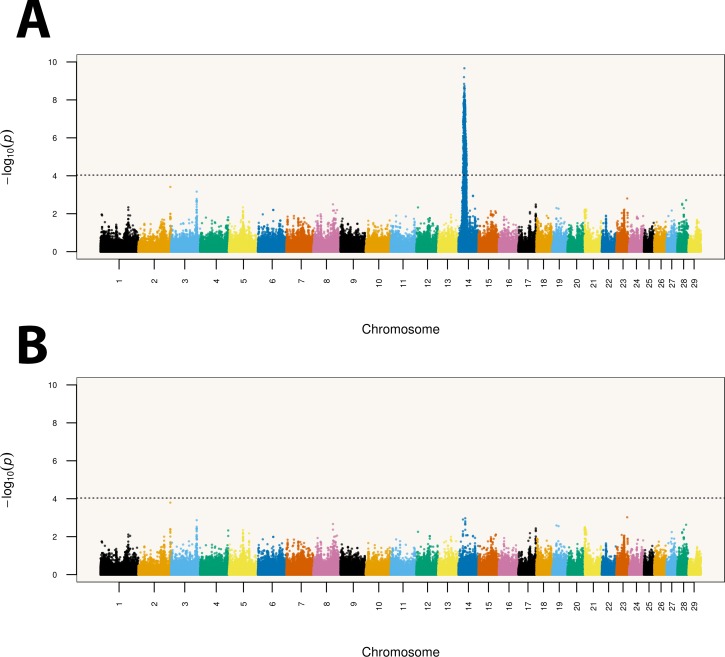
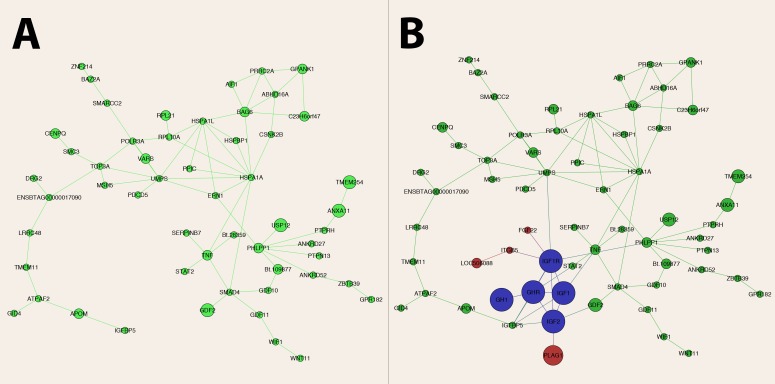
Two complementary methods, namely Multi-Trait Meta-Analysis and Versatile Gene-Based Test for Genome-wide Association Studies (VEGAS), were used to identify putative pleiotropic genes affecting carcass traits in Bos indicus (Nellore) cattle. The genotypic data comprised over 777,000 single-nucleotide polymorphism markers scored in 995 bulls, and the phenotypic data included deregressed breeding values (dEBV) for weight measurements at birth, weaning and yearling, as well visual scores taken at weaning and yearling for carcass finishing precocity, conformation and muscling. Both analyses pointed to the pleomorphic adenoma gene 1 (PLAG1) as a major pleiotropic gene. VEGAS analysis revealed 224 additional candidates. From these, 57 participated, together with PLAG1, in a network involved in the modulation of the function and expression of IGF1 (insulin like growth factor 1), IGF2 (insulin like growth factor 2), GH1 (growth hormone 1), IGF1R (insulin like growth factor 1 receptor) and GHR (growth hormone receptor), suggesting that those pleiotropic genes operate as satellite regulators of the growth pathway.
采用两种互补方法,即多性状荟萃分析和全基因组关联研究通用基因检测法(VEGAS),来鉴定影响印度瘤牛(Nellore)胴体性状的潜在多效性基因。基因型数据包含在995头公牛中评分的超过77.7万个单核苷酸多态性标记,表型数据包括出生、断奶和周岁时体重测量的去回归育种值(dEBV),以及断奶和周岁时对胴体育肥早熟性、体型和肌肉量的视觉评分。两种分析均指出多形性腺瘤基因1(PLAG1)是主要的多效性基因。VEGAS分析还揭示了另外224个候选基因。其中57个基因与PLAG1一起参与了一个涉及调节胰岛素样生长因子1(IGF1)、胰岛素样生长因子2(IGF2)、生长激素1(GH1)、胰岛素样生长因子1受体(IGF1R)和生长激素受体(GHR)功能和表达的网络,这表明这些多效性基因作为生长途径的卫星调节因子发挥作用。