Hofman Susanna E, Lucke Jacinta A, Heim Noor, de Gelder Jelle, Fogteloo Anne J, Heringhaus Christian, de Groot Bas, de Craen Anton J M, Blauw Gerard Jan, Mooijaart Simon P
Department of Gerontology and Geriatrics, Leiden University Medical Center, PO Box 9600, Leiden, 2300 RC, The Netherlands.
Department of Emergency Medicine, Leiden University Medical Center, PO Box 9600, Leiden, 2300 RC, The Netherlands.
BMC Emerg Med. 2016 Jul 13;16(1):26. doi: 10.1186/s12873-016-0090-5.
Older people frequently attend the emergency department (ED) and have a high risk of poor outcome as compared to their younger counterparts. Our aim was to study routinely collected clinical parameters as predictors of 90-day mortality in older patients attending our ED.
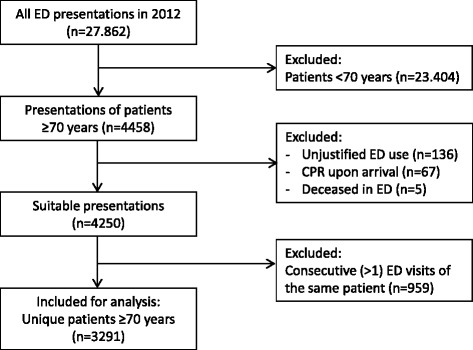
We conducted a retrospective follow-up study at the Leiden University Medical Center (The Netherlands) among patients aged 70 years or older attending the ED in 2012. Predictors were age, gender, time and way of arrival, presenting complaint, consulting medical specialty, vital signs, pain score and laboratory testing. Cox regression analyses were performed to analyse the association between these predictors and 90-day mortality.
Three thousand two hundred one unique patients were eligible for inclusion. Ninety-day mortality was 10.5 % for the total group. Independent predictors of mortality were age (hazard ratio [HR] 1.06, 95 % confidence interval [95 % CI] 1.04-1.08), referral from another hospital (HR 2.74, 95 % CI 1.22-6.11), allocation to a non-surgical specialty (HR: 1.55, 95 % CI 1.13-2.14), increased respiration rate (HR up to 2.21, 95 % CI 1.25-3.92), low oxygen saturation (HR up to 1.96, 95 % CI 1.19-3.23), hypothermia (HR 2.27, 95 % CI 1.28-4.01), fever (HR 0.43, 95 % CI 0.24-0.75), high pain score (HR 1.55, 95 % CI 1.03-2.32) and the indication to perform laboratory testing (HR 3.44, 95 % CI 2.13-5.56).
Routinely collected parameters at the ED can predict 90-day mortality in older patients presenting to the ED. This study forms the first step towards creating a new and simple screening tool to predict and improve health outcome in acutely presenting older patients.
与年轻患者相比,老年人经常前往急诊科就诊,且预后不良风险较高。我们的目的是研究常规收集的临床参数,以预测在我院急诊科就诊的老年患者90天死亡率。
我们在荷兰莱顿大学医学中心对2012年70岁及以上在急诊科就诊的患者进行了一项回顾性随访研究。预测因素包括年龄、性别、到达时间和方式、主诉、会诊医学专科、生命体征、疼痛评分和实验室检查。采用Cox回归分析来分析这些预测因素与90天死亡率之间的关联。
共有3201例患者符合纳入标准。全组90天死亡率为10.5%。死亡率的独立预测因素包括年龄(风险比[HR]1.06,95%置信区间[95%CI]1.04 - 1.08)、从其他医院转诊(HR 2.74,95%CI 1.22 - 6.11)、分配到非外科专科(HR: 1.55,95%CI 1.13 - 2.14)、呼吸频率增加(HR最高达2.21,95%CI 1.25 - 3.92)、低氧饱和度(HR最高达1.96,95%CI 1.19 - 3.23)、体温过低(HR 2.27,95%CI 1.28 - 4.01)、发热(HR 0.43,95%CI 0.24 - 0.75)、高疼痛评分(HR 1.55,95%CI 1.03 - 2.32)以及进行实验室检查的指征(HR 3.44,95%CI 2.13 - 5.56)。
急诊科常规收集的参数可预测在急诊科就诊的老年患者的90天死亡率。本研究朝着创建一种新的简易筛查工具迈出了第一步,该工具可预测并改善急性就诊老年患者的健康结局。