Centre for Sexual Health and HIV/AIDS Research (CeSHHAR), Harare, Zimbabwe University College London, London, United Kingdom.
Population Services International, Harare, Zimbabwe
Glob Health Sci Pract. 2016 Jul 13;4 Suppl 1(Suppl 1):S55-67. doi: 10.9745/GHSP-D-15-00200. Print 2016 Jul.
The World Health Organization (WHO) and the United Nations Children's Fund (UNICEF) recommend early infant male circumcision (EIMC) for prevention of HIV. Here, we present findings from a qualitative study in Zimbabwe that assessed parental and health care workers' perspectives of EIMC conducted using devices.
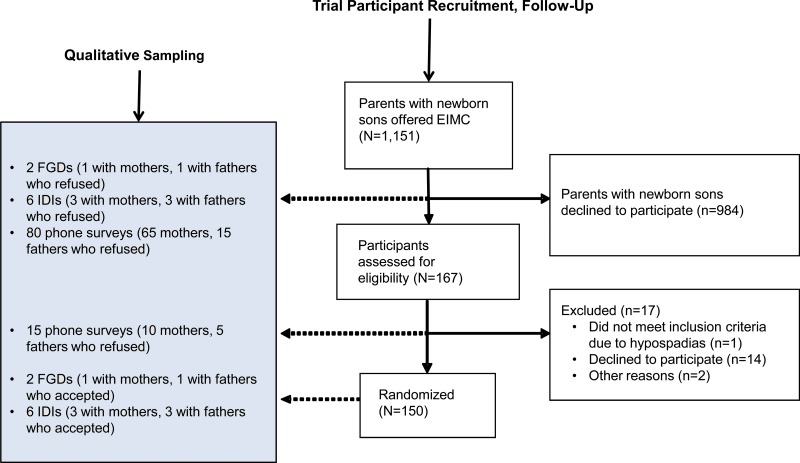
This qualitative study was nested within a trial of EIMC devices. Between January and May 2013, we held 4 focus group discussions (FGDs) and 12 in-depth interviews with parents and 12 in-depth interviews with clinicians (7 trial clinicians and 5 non-trial clinicians). We also conducted 95 short telephone interviews with parents who had arranged to bring their sons for EIMC but then defaulted.
Parents who had adopted EIMC spoke of their initial anxieties about the procedure. Additionally, they commented on both the procedure and outcome. Parents who decided against EIMC cited fear of harm, specifically the infant's death, penile injury, and excessive pain. Misperceptions about male circumcision in general and EIMC specifically were a significant barrier to EIMC adoption and were prevalent among health care workers as well as parents. In particular, the findings suggest strong parental concerns about the fate of the discarded foreskin. Parents who chose EIMC for their newborn sons felt that the procedure was safe and expressed satisfaction with the outcome. For their part, health care workers largely thought that EIMC was safe and that the outcome was aesthetically pleasing. They also felt that it would be feasible to offer wide-scale EIMC for HIV prevention in the public sector; they recommended strategies to increase EIMC uptake, in addition to highlighting a few concerns.
The qualitative study enables us to better understand parental and health care workers' perspectives of EIMC conducted using devices, especially their perspectives on EIMC safety, feasibility, acceptability, and barriers. These findings will be used to design demand-generation activities that support wider adoption of EIMC.
世界卫生组织(WHO)和联合国儿童基金会(UNICEF)建议进行早期婴儿男性割礼(EIMC)以预防 HIV。在这里,我们提出了津巴布韦一项定性研究的结果,该研究评估了使用器具进行 EIMC 的父母和卫生保健工作者的观点。
这项定性研究是在 EIMC 器械试验中进行的嵌套研究。2013 年 1 月至 5 月期间,我们举行了 4 次焦点小组讨论(FGD)和 12 次与父母的深入访谈以及 12 次与临床医生的深入访谈(7 名试验临床医生和 5 名非试验临床医生)。我们还对 95 名已经安排好让儿子进行 EIMC 但后来违约的父母进行了 95 次简短的电话访谈。
已经采用 EIMC 的父母谈到了他们对该程序的最初焦虑。此外,他们还对程序和结果进行了评论。决定不进行 EIMC 的父母引用了对伤害的恐惧,特别是婴儿死亡、阴茎受伤和过度疼痛。对一般男性割礼和 EIMC 的误解是采用 EIMC 的一个重要障碍,并且在卫生保健工作者以及父母中都很普遍。特别是,调查结果表明父母对丢弃的包皮的命运非常关注。选择为新生儿儿子进行 EIMC 的父母认为该程序是安全的,并对结果表示满意。就他们而言,卫生保健工作者在很大程度上认为 EIMC 是安全的,并且结果在美学上令人愉悦。他们还认为,在公共部门为预防 HIV 广泛提供 EIMC 是可行的;他们提出了增加 EIMC 使用率的策略,除了强调一些担忧之外。
定性研究使我们能够更好地了解父母和卫生保健工作者对使用器具进行的 EIMC 的看法,特别是他们对 EIMC 安全性、可行性、可接受性和障碍的看法。这些发现将用于设计支持更广泛采用 EIMC 的需求产生活动。