Department of Molecular and Clinical Medicine, Institute of Medicine, Sahlgrenska Academy, University of Gothenburg, Sahlgrenska University Hospital/Östra, SE 416 85 Göteborg, Sweden.
Department of Food, Nutrition and Sports Science, Institute of Neuroscience and Physiology, Sahlgrenska Academy and, Sahlgrenska University Hospital/Östra, SE 416 85 Gothenburg, Sweden.
Prev Med Rep. 2016 May 1;4:44-9. doi: 10.1016/j.pmedr.2016.04.010. eCollection 2016 Dec.
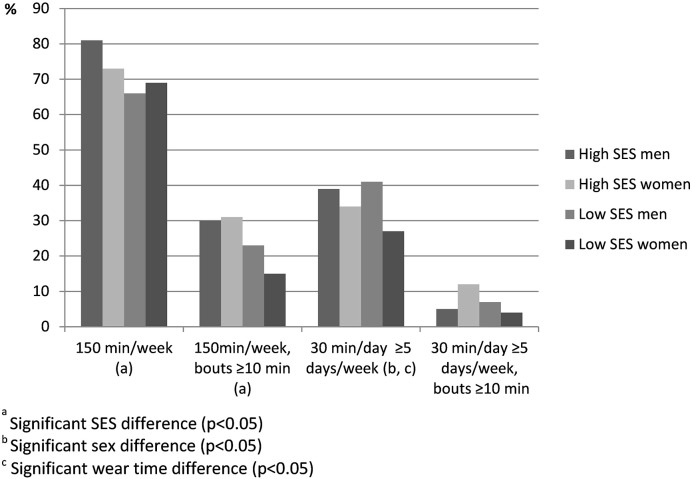
Living in a low socioeconomic status (SES) area is associated with an increased risk of cardiovascular events and all-cause mortality. Previous studies have suggested a socioeconomic gradient in daily physical activity (PA), but have mainly relied on self-reported data, and individual rather than residential area SES. This study aimed to investigate the relationships between residential area SES, PA pattern, compliance with PA-recommendations and fitness in a Swedish middle-aged population, using objective measurements. We included 948 individuals from the SCAPIS pilot study (Gothenburg, Sweden, 2012, stratified for SES, 49% women, median age: 58 years), in three low and three high SES districts. Accelerometer data were summarized into intensity-specific categories: sedentary (SED), low (LIPA), and medium-to-vigorous PA (MVPA). Fitness was estimated by submaximal ergometer testing. Participants of low SES areas had a more adverse cardiovascular disease risk factor profile (smoking: 20% vs. 6%; diabetes: 9% vs. 3%; hypertension: 38% vs. 25%; obesity: 31% vs. 13%), and less frequently reached 150 min of MVPA per week (67% vs. 77%, odds ratio [OR] = 0.61; 95% confidence interval [95% CI] = 0.46-0.82), from 10-minute bouts (19% vs. 31%, OR = 0.53, 95% CI = 0.39-0.72). Individuals in low SES areas showed lower PA levels (mean cpm: 320 vs. 348) and daily average MVPA (29.9 vs. 35.5 min), and 12% lower fitness (25.1 vs. 28.5 mL × min(- 1) × kg(- 1)) than did those in high SES areas. Reduced PA and fitness levels may contribute to social inequalities in health, and should be a target for improved public health in low SES areas.
生活在社会经济地位(SES)较低的地区与心血管事件和全因死亡率的风险增加有关。先前的研究表明,日常体力活动(PA)存在社会经济梯度,但主要依赖于自我报告的数据,以及个体而非居住地区的 SES。本研究旨在使用客观测量方法,调查瑞典中年人群中居住地区 SES、PA 模式、遵守 PA 建议与健康之间的关系。我们纳入了来自 SCAPIS 试点研究(瑞典哥德堡,2012 年,按 SES 分层,49%为女性,中位年龄:58 岁)的 948 名个体,这些个体来自三个低 SES 区和三个高 SES 区。加速度计数据被总结为强度特定的类别:久坐(SED)、低强度(LIPA)和中等到剧烈 PA(MVPA)。通过次最大测功仪测试来估计健康水平。低 SES 地区的参与者具有更不利的心血管疾病风险因素特征(吸烟:20%比 6%;糖尿病:9%比 3%;高血压:38%比 25%;肥胖:31%比 13%),每周达到 150 分钟 MVPA 的频率较低(67%比 77%,优势比[OR] = 0.61;95%置信区间[95%CI] = 0.46-0.82),且由 10 分钟段组成(19%比 31%,OR = 0.53,95%CI = 0.39-0.72)。低 SES 地区的个体表现出较低的 PA 水平(平均 cpm:320 比 348)和每日平均 MVPA(29.9 比 35.5 分钟),以及健康水平低 12%(25.1 比 28.5 mL × min(-1)× kg(-1))。PA 和健康水平的降低可能是健康方面社会不平等的原因,应该成为低 SES 地区改善公共卫生的目标。