Research, Education, Development, Innovation and Implementation, Primary Health Care, .
Unit of Physiotherapy, Department of Health and Rehabilitation, Institute of Neuroscience and Physiology, Sahlgrenska Academy at University of Gothenburg, Gothenburg, Sweden.
BMC Public Health. 2024 Mar 4;24(1):681. doi: 10.1186/s12889-024-18017-8.
The enormous effect of lifestyle-related disorders on health of the global population warrants the development of preventive interventions. Focusing on musculoskeletal health and physical activity may be a way to encourage necessary lifestyle changes by making them more concrete and understandable. The aims of the current study were to develop a function-based preventive intervention aimed at lifestyle-related disorders in physically inactive 40-year-old people and to investigate the feasibility of the intervention. The feasibility study aimed to solve practical and logistical challenges and to develop the intervention based on the experiences of participants and involved clinical personnel according to defined criteria.
Development of the standardised functional examination was based on literature-validated tests and clinical reasoning. Development of a risk profile was based on the functional examination and similar profiles which have already proved feasible. The feasibility of the functional examination and risk profile, together with function-based lifestyle counselling was tested on 27 participants in a pilot study with two physiotherapist examinations over a four-month period. Practical results and feedback from participants and collaborating personnel were examined.
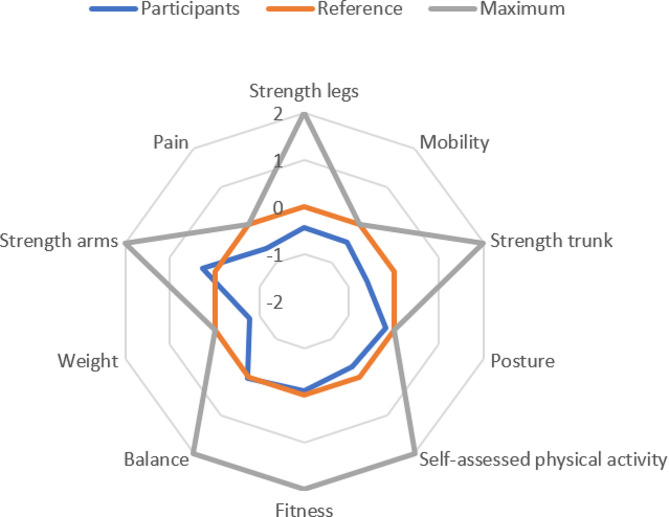
The functional examination consists of 20 established tests not requiring specialised equipment or training which were deemed relevant for a middle-aged population and a sub-maximal ergometer test. The risk profile consists of seven functional dimensions: cardiovascular fitness, strength in upper extremity, lower extremity and trunk, mobility, balance and posture, and three non-functional dimensions: weight, self-assessed physical activity and pain. Each dimension contains at least two measures. The participants appreciated the intervention and found it motivating for making lifestyle changes. They found the tests and risk profile understandable and could see them as tools to help achieve concrete goals. The examination required 60-75 min for one physiotherapist. The recruitment rate was low and recruited participants were highly motivated to making lifestyle changes.
This project developed a functional test battery and risk profile aimed at inactive 40-year-olds which fulfilled our feasibility criteria. Functional screening and lifestyle counselling were found to be of value to a sub-group of inactive 40-year-olds who were already motivated to improve their health situations.
ClinicalTrials.gov: NCT05535296 first posted on 10/09/2022.
与生活方式相关的疾病对全球人口健康的巨大影响,要求开发预防干预措施。关注肌肉骨骼健康和身体活动可能是一种通过使它们更具体和易于理解来鼓励必要的生活方式改变的方法。本研究的目的是开发一种针对不活跃的 40 岁人群与生活方式相关疾病的基于功能的预防干预措施,并调查该干预措施的可行性。可行性研究旨在解决实际和后勤方面的挑战,并根据参与者的经验和参与的临床人员的意见,按照既定标准开发干预措施。
标准化功能检查的开发基于文献验证的测试和临床推理。风险概况的开发基于功能检查和已经证明可行的类似概况。在一项为期四个月的试点研究中,对 27 名参与者进行了功能检查和风险概况以及基于功能的生活方式咨询的可行性测试,其中包括两名物理治疗师的两次检查。检查了实际结果以及参与者和合作人员的反馈。
功能检查包括 20 项已建立的测试,这些测试不需要专门的设备或培训,被认为与中年人群相关,以及一项亚最大量测功计测试。风险概况由七个功能维度组成:心血管健康、上肢、下肢和躯干的力量、活动能力、平衡和姿势以及三个非功能维度:体重、自我评估的身体活动和疼痛。每个维度至少包含两个指标。参与者对干预措施表示赞赏,并发现它对生活方式的改变有激励作用。他们发现测试和风险概况易于理解,可以将其视为帮助实现具体目标的工具。检查需要一名物理治疗师 60-75 分钟。招募率较低,招募的参与者有强烈的动机来改变生活方式。
本项目开发了针对不活跃的 40 岁人群的功能测试组合和风险概况,符合我们的可行性标准。功能筛查和生活方式咨询被认为对已经有改善健康状况动机的不活跃 40 岁人群的亚组有价值。
ClinicalTrials.gov:NCT05535296 于 2022 年 9 月 10 日首次注册。