Lane Athene, Metcalfe Chris, Young Grace J, Peters Tim J, Blazeby Jane, Avery Kerry N L, Dedman Daniel, Down Liz, Mason Malcolm D, Neal David E, Hamdy Freddie C, Donovan Jenny L
School of Social and Community Medicine, University of Bristol, Bristol, UK.
Bristol Randomised Trials Collaboration, University of Bristol, Bristol, UK.
BJU Int. 2016 Dec;118(6):869-879. doi: 10.1111/bju.13582. Epub 2016 Aug 17.
To present the baseline patient-reported outcome measures (PROMs) in the Prostate Testing for Cancer and Treatment (ProtecT) randomized trial comparing active monitoring, radical prostatectomy and external-beam conformal radiotherapy for localized prostate cancer and to compare results with other populations.
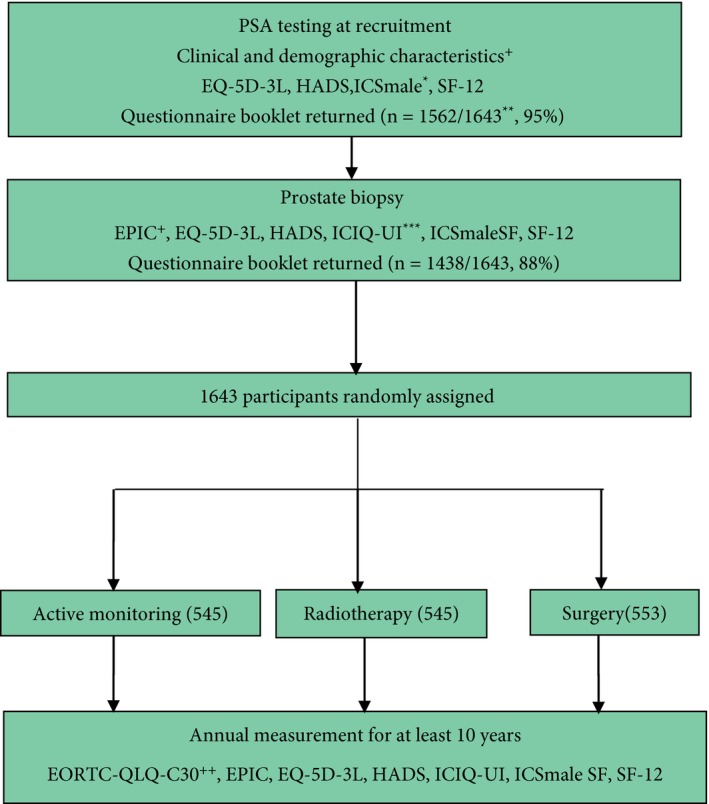
A total of 1643 randomized men, aged 50-69 years and diagnosed with clinically localized disease identified by prostate-specific antigen (PSA) testing, in nine UK cities in the period 1999-2009 were included. Validated PROMs for disease-specific (urinary, bowel and sexual function) and condition-specific impact on quality of life (Expanded Prostate Index Composite [EPIC], 2005 onwards; International Consultation on Incontinence Questionnaire-Urinary Incontinence [ICIQ-UI], 2001 onwards; the International Continence Society short-form male survey [ICSmaleSF]; anxiety and depression (Hospital Anxiety and Depression Scale [HADS]), generic mental and physical health (12-item short-form health survey [SF-12]; EuroQol quality-of-life survey, the EQ-5D-3L) were assessed at prostate biopsy clinics before randomization. Descriptive statistics are presented by treatment allocation and by men's age at biopsy and PSA testing time points for selected measures.
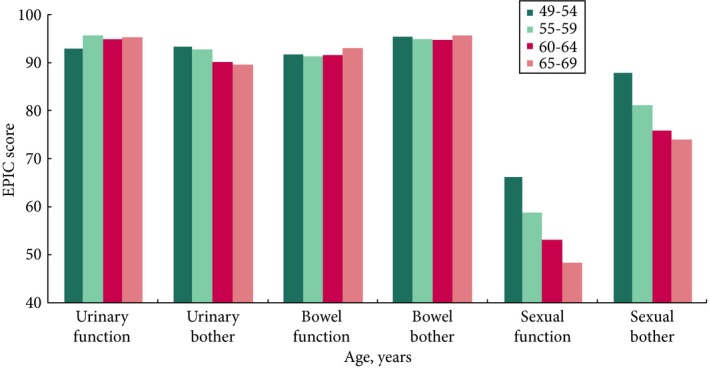
A total of 1438 participants completed biopsy questionnaires (88%) and 77-88% of these were analysed for individual PROMs. Fewer than 1% of participants were using pads daily (5/754). Storage lower urinary tract symptoms were frequent (e.g. nocturia 22%, 312/1423). Bowel symptoms were rare, except for loose stools (16%, 118/754). One third of participants reported erectile dysfunction (241/735) and for 16% (118/731) this was a moderate or large problem. Depression was infrequent (80/1399, 6%) but 20% of participants (278/1403) reported anxiety. Sexual function and bother were markedly worse in older men (65-70 years), whilst urinary bother and physical health were somewhat worse than in younger men (49-54 years, all P < 0.001). Bowel health, urinary function and depression were unaltered by age, whilst mental health and anxiety were better in older men (P < 0.001). Only minor differences existed in mental or physical health, anxiety and depression between PSA testing and biopsy assessments.
The ProtecT trial baseline PROMs response rates were high. Symptom frequencies and generic quality of life were similar to those observed in populations screened for prostate cancer and control subjects without cancer.
在前列腺癌检测与治疗(ProtecT)随机试验中呈现患者报告的基线结局指标(PROMs),该试验比较了主动监测、根治性前列腺切除术和外照射适形放疗用于局限性前列腺癌的情况,并将结果与其他人群进行比较。
纳入了1999年至2009年期间在英国9个城市的1643名随机分组的男性,年龄在50 - 69岁,经前列腺特异性抗原(PSA)检测诊断为临床局限性疾病。在随机分组前,于前列腺活检诊所对疾病特异性(泌尿、肠道和性功能)以及特定疾病对生活质量的影响(2005年起为扩展前列腺指数综合指标[EPIC];2001年起为国际尿失禁咨询问卷 - 尿失禁[ICIQ - UI];国际尿控协会男性简表调查[ICSmaleSF])、焦虑和抑郁(医院焦虑抑郁量表[HADS])、一般心理和身体健康(12项简短健康调查问卷[SF - 12];欧洲生活质量调查,EQ - 5D - 3L)进行了评估。按治疗分配以及活检和PSA检测时间点的男性年龄对选定指标进行描述性统计。
共有1438名参与者完成了活检问卷(88%),其中77 - 88%的问卷用于个体PROMs分析。不到1%的参与者每天使用尿垫(5/754)。储尿期下尿路症状常见(如夜尿症22%,312/1423)。肠道症状少见,除了稀便(16%,118/754)。三分之一的参与者报告有勃起功能障碍(241/735),其中16%(118/731)的人存在中度或重度问题。抑郁不常见(80/1399,6%),但20%的参与者(278/1403)报告有焦虑。老年男性(65 - 70岁)的性功能和困扰明显更差,而泌尿困扰和身体健康比年轻男性(49 - 54岁)稍差(所有P < 0.001)。肠道健康、泌尿功能和抑郁不受年龄影响,而老年男性的心理健康和焦虑状况更好(P < 0.001)。PSA检测和活检评估之间在心理或身体健康、焦虑和抑郁方面仅存在微小差异。
ProtecT试验的基线PROMs应答率很高。症状频率和一般生活质量与在前列腺癌筛查人群及无癌对照受试者中观察到的相似。